Showing posts with label hunting. Show all posts

Saturday, 10 April 2021

A CIVET HUNT IN PEMBA

by Helle V. Goldman

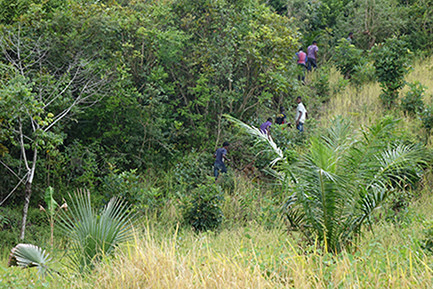
The hunters heading back to Tandavili after our first encounter (photo Helle V. Goldman)
The Small Indian Civet (Viverricula indica) is widespread in Asia, from Pakistan in the west to easternmost China, and from the Sundaic region in the south to the Himalayan foothills in the north (Choudhury et al. 2015). Its perineal gland secretions prized as a perfume and medicinal ingredient in southern Asia, the Small Indian Civet was imported – most likely from the Indian subcontinent – by traders to various places in the Western Indian Ocean (Gaubert et al. 2017). At some unknown point in the past, this included Pemba, the northern island in the Zanzibar archipelago (Moreau & Pakenham 1941; Pakenham 1984; Walsh 2007; Choudhury et al. 2015).

Like other species of mammals introduced to Pemba, Small Indian Civets became naturalised on the island. These crepuscular–nocturnal small carnivores were frequently observed early in the morning or late in the evening by Pakenham, a colonial officer stationed in Zanzibar from the late 1930s through WWII; “if one stood motionless it would pass very close”, he wrote (Pakenham 1984: 46). (What some Zanzibaris made of Pakenham’s keen interest in observing wildlife and collecting animal specimens may be surmised on the basis of the account of an elderly Pemban, who told me in 1993 that Pakenham was remembered for catching spirits in bottles. It is likelier that he was after insects.) According to Pakenham, Small Indian Civets were common on both Unguja and Pemba, the main islands of the archipelago. Yet I never caught sight of one during my anthropological fieldwork in Pemba in the early 1990s, and camera-trapping on Unguja in 2003 (Goldman & Winther-Hansen 2003), 2017, 2018 (Goldman & Walsh 2019a) and 2019 (unpublished) turned up no traces of Small Indian Civets.

Mauwa and her aunt Raya in 1993 (photo: Helle V. Goldman)
When I returned in July 2019 to Mzambarauni, in north-central Pemba, to follow up on my earlier studies with additional anthropological research, I did not anticipate that the opportunity to observe a civet hunt would come my way. The chance presented itself when I tagged along with Mauwa and a handful of her younger kin to her rice field south of Mzambarauni. I had first known her in 1992, when I lived in the thatched wattle-and-daub house across from Mauwa’s aunt. 

On our way to the rice farm, we walked in single file on the path as we headed south from the village, exchanging greetings with folks encountered en route. Some worked singly or in twos in their fields. Others collected fruit or firewood. A few led zebu cows. We passed through a patchwork of small cultivated fields and forest – a hodge-podge of wild trees and shrubs and clove, fruit and lumber trees. Some of the cultivated trees appeared well tended; most were overrun by wild vegetation.

Mauwa and her adult daughter harvest rice (photo: Helle V. Goldman)
At Mauwa’s rice plot, we deposited our gear in the small patch of shade offered by the low open-sided thatched hut beside the field. I made myself useful by planting the spinach seedlings that Mauwa had brought with her in a sack, putting them in the ground that she had previously prepared for this purpose. While the women set to work in the rice field, Rayani – the young daughter of Mauwa’s eldest son – and I played a game with twigs and pebbles that we invented on the spot. A soft-spoken settler from the mainland who cultivated a nearby field came by to exchange pleasantries and drink from the muddy spring next to Mauwa’s field. One of the women harvesting rice found the nest of a Black-winged Red Bishop (kweche; Euplectes hordeaceus) in the field. The red bishop feeds on rice and farmers consider the bird a pest.

Black-winged Red Bishop nest and eggs (photo: Helle V. Goldman)
Mauwa took a short break to boil a small pot of thin rice gruel. I took a few sips of the refreshing porridge from my cup and gave the remainder to Rayani, who seemed to be hungry. Back in the field again, the women chatted non-stop while the heaps of rice ears grew high on the mats. They were periodically carried to the side of the field, stuffed into a sack and beaten with a stout stick to separate the rice grains from the stalks. (The husks would be removed later.) I worked much less efficiently than my companions, though Mauwa heartily extolled my rice-harvesting skills to passersby, which made me laugh.

Suddenly the chaotic sounds of people whooping, dogs yipping and branches crackling reached us from the forest edging the rice field. “What’s going on?” I asked Mauwa. Her small knife never slowing as she clipped off ears of rice from the tall stalks, she told me that it was just youths out after wadudu.

Mauwa harvesting rice (photo: Helle V. Goldman)
Depending on the context, wadudu (singular mdudu) is a term for insects and other small invertebrates (including disease-causing parasites), small reptiles or undesirable wildlife of various sizes, and unspeakable creatures whose names can’t be mentioned. For example, on Unguja, Leopards (Panthera pardus) are sometimes referred to cagily as wadudu, the speakers avoiding explicitly naming the greatly feared animal, which has now in all likelihood been extirpated from the island (Goldman & Walsh 2019b). There is no single English equivalent that covers all these senses of the Swahili word, but “varmints” conveys what Mauwa meant in this case.

When I asked her to clarify which wadudu the boys were hunting, she said they were going for ngawa. On Unguja, ngawa refers to the African Civet (Civettictis civetta), a small carnivore species that I camera-trapped in 2003 in Jozani–Chwaka Bay National Park (Goldman & Winther-Hansen 2003, 2007). On Pemba, where there are no African Civets, ngawa refers to the Small Indian Civet (Viverricula indica).

Small Indian Civet, camera-trapped near Ngezi (photo: Helle V. Goldman)
A few days before, I had asked Ilaria Pretelli, a friend doing research in a village at the edge of Ngezi Forest, near the north-western tip of Pemba, to set up my camera trap near her house for a couple of nights. The trap netted a single video of a Small Indian Civet. Later, the trap was moved to inside Ngezi, where another civet was captured on video.

As I snatched up my notebook and camera and dashed off into the bush to find the hunters, Mauwa called out to give them a head’s up: a European was coming to talk to them. I found the youths close by. They had killed a civet just minutes before. One of the young hunters held up the specimen for me to photograph. The group comprised about ten youths in their teens and early twenties, accompanied by their dogs. Having successfully bagged a civet, the boys were eager to go home and rest but some of them allowed me to briefly detain them so I could ask some questions.

Three of the young hunters and their catch (photo: Helle V. Goldman)
I learned that they hailed from Tandavili, which was the closest village. They comprised a loosely organised group of friends that had started out by catching the civets that bothered their household chickens. Later they expanded their activities to the bush surrounding the settlement. Every three or four days they set out to hunt Small Indian Civets, Marsh Mongooses (chonjwe; Atilax paludinosus), Vervet Monkeys (tumbili; Chlorocebus pygerythrus) and snakes of any variety. These are all animals deemed harmful to people (snakes), crops (vervets) or poultry (civets and mongooses). Sometimes they also go out singly or in pairs to hunt birds with slingshots.

The dead civet (photo: Helle V. Goldman)
Whatever the hunters catch, they feed to the dogs, they said. None of the targeted species contains anything of medicinal value, they told me, and none of the meat is consumed by people in the area. (Although there are local exceptions (Walsh 2007), Islam prohibits the consumption of reptiles, monkeys and animals bearing fangs, i.e. carnivores.) The dead civet whose killing I had arrived just too late to witness was going to be roasted over a fire to remove the fur and then given to the dogs. (The dogs looked like they would have benefited from a good meal.) I gave the most talkative of the youths the telephone number of my hostess in Mzambarauni and he agreed to call the next time they were going hunting.

Hunting (photo: Helle V. Goldman)
According to Walsh (2007), clubs that hunted civets were active at least up to the 1990s. Information about such groups and their activities is scant. During his stay on Pemba over a hundred years ago, Craster heard of Wild Boar (nguruwe; Sus scrofa) hunts there: “they told me that a party of men armed with big knives would start out with as many dogs as they could collect, and walk through the bush till the dogs found a pig” (1913: 284). The boars, which had been introduced centuries earlier by the Portuguese, were not eaten by Muslim islanders; the flesh was given to the dogs, and non-Muslim Africans ate it too. Other species taken opportunistically, such as the Blue Duiker (paa; Cephalophus monticola), were eaten irrespective of religion (Walsh 2007: 88).

Hunting dogs (photo: Helle V. Goldman)
Writing about 20 years after Craster, Wilson observed that the main method of hunting pigs – animals viewed by the colonial authorities as a serious impediment to agricultural production – was with spears and dogs; pit-traps and snares may also have been used (1939: 48). He complained that hunting was “often regarded [by Zanzibaris] more as a sport than the reduction of a pest”. Along with setting out poison to reduce the pig population, the British “encouraged the various pig hunting clubs by the offer of prizes and rewards” (Wilson 1939: 49). Although the resulting boost in hunting activity was short-lived, hunting continued on both islands. By the time of my visit in 2019, Pembans whom I asked said that all, or almost all, of the island’s boars had all been killed and consumed by villagers of Makonde origin, whose roots lay in south-east Tanzania and northern Mozambique.

Hunters crossing Mauwa's rice field (photo: Helle V. Goldman)
After answering my questions, the band of youths crossed Mauwa’s rice field and vanished among the trees on the opposite hillside. Days passed while I investigated family histories and other matters that had nothing to do with wildlife in Mzambarauni. Two days before my departure from Pemba, when I had given up hope of hearing from the young hunters, one of them rang my hostess in the evening with a message for me: the boys were going hunting the next morning. I was to meet them in Tandavili at six if I wanted to come along.

With considerable reluctance, my hostess unbarred and unlocked the front doors of her house and let me outside at 5.30 the following morning. She wasn’t happy about me setting off in the predawn dark and “cold” (it was about 18°C). I knew that she was concerned for my safety. In Pemba, malevolent spirits, often operating at the command of witches, are believed to be common. To walk alone in the night invites trouble. She was only slightly reassured by the knowledge that I was going to meet up with my assistant on the way.

Two of the hunting dogs, one with an amulet (photo: Helle V. Goldman)
It was light by the time we reached Tandavili. With the kind assistance of several villagers, we located the dozen or so youths who were setting out to hunt that day: some were just tumbling out of bed and pulling shirts over their heads upon our arrival, while the others had already loosely assembled at the edge of the forest. The informal leader of the group was a young man who went by the moniker Maasai. Another member was nicknamed Tekno. He brought his dogs Fanta, Ready and Simba. Another boy was known as Taekwondo, who came with his dog Ashoo. Then there was Abdalla and his dog Sharo. Ahmed, otherwise known as Hosama, and his friend Hamadi brought their shared dog Firimbo. Unlike the other dogs, Firimbo was on a lead because she had pups and would peel off to rejoin them if given half a chance. The dogs were small and nervous and some of them were thin. They seemed accustomed to ungentle handling.

The hunters pause to consider their next move (photo: Helle V. Goldman)
The group moved almost without pause, up steep forested hills, down into rice valleys, through mud and streams, across humpy cassava fields, and into dense stands of trees and undergrowth. The morning dew made the going slippery in places. Striving to keep up with lean young men one-third of my age (none of whom had my complement of double hip replacements and a reconstructed anterior cruciate knee ligament), I took photographs and video only when the group slowed down and was in fairly open, flat terrain. When I lost sight of the hunters in the thicket or they temporarily broke apart, the dogs’ yapping and the racket the youths made – a continuous stream of whoops, exhortations and loud popping vocalisations (alveolar clicks?) aimed at exciting the dogs – allowed me to keep tabs on them.

Early on, excitement ran high as the dogs surrounded an animal in a clump of thicket (this occurs in the video below at about the 48-second mark). When the hunters realised it was a bushbaby (komba; Otolemur garnettii, aka Greater Galago) they left it and drew the dogs away. They don’t bother with bushbabies – not even to feed to the dogs – since these small nocturnal primates are not considered pests.

The hunt was called off about an hour and a half later. There had been no takings that day. According to the youths, this is not an uncommon outcome: on some hunts they kill one or two civets or other varmints, but more often they go home empty-handed. They attributed this to the effectiveness of their hunting forays. There was more I would have liked to inquire about, but I could not keep the young men from their breakfasts any longer. 

References

Choudhury A., Duckworth J.W., Timmins R., Chutipong W., Willcox D.H.A., Rahman H., Ghimirey Y. & Mudappa D. 2015. Viverricula indica. The IUCN Red List of Threatened Species 2015: e.T41710A45220632. https://dx.doi.org/10.2305/IUCN.UK.2015-4.RLTS.T41710A45220632.en. Downloaded on 12 March 2021.

Craster J.E.E. 1913. Pemba, The Spice Island of Zanzibar. London: T. Fisher Unwin.

Gaubert P., Patel R.P., Veron G., Goodman S.M., Willsch M., Vasconcelos R., Lourenço A., Sigaud M., Justy F., Joshi B. D., Fickel J. & Wilting A. 2017. Phylogeography of the Small Indian Civet and origin of introductions to Western Indian Ocean islands. Journal of Heredity 108: 270–279.

Goldman H.V. & Walsh M.T. 2019a. First videos of endemic Zanzibar servaline genet Genetta servalina archeri, African palm civet Nandinia binotata (Mammalia: Carnivora: Viverridae) and other small carnivores on Unguja Island, TanzaniaJournal of Threatened Taxa 11(10), 14292-14300.

Goldman H.V. & Walsh M.T. 2019b. Classifying, domesticating and extirpating the Zanzibar leopard, a transgressive felidNorsk Antropologisk Tidsskrift (Norwegian Journal of Anthropology) 30 (3-4): 205-219.

Goldman H.V. & Winther-Hansen J. 2003. First photographs of the Zanzibar servaline genet Genetta servalina archeri and other endemic subspecies on the island of Unguja, TanzaniaSmall Carnivore Conservation 29: 1–4.

Goldman H.V. & Winther-Hansen J. 2007. Lights, camera, actionAfrica Geographic 15: 24–25.

Moreau R.E. & Pakenham R.H.W. 1941. The land vertebrates of Pemba, Zanzibar, and Mafia: a zoogeographical study. Proceedings of the Zoological Society of London 110: 97-128. 

Pakenham R.H.W. 1984. The Mammals of Zanzibar and Pemba Islands. Harpenden: privately printed.

Walsh M.T. 2007. Island subsistence: hunting, trapping and the translocation of wildlife in the Western Indian Ocean. Azania 42: 83-113.

Wilson F.B. 1939. Notes on Peasant Agriculture and Industries in Zanzibar Island. Zanzibar. National Archives, File no. AU2/54.


Monday, 18 October 2010

MICE-HUNTING, RAT-TRAPPING, RODENT-ROASTING

Twenty-five years ago I went to a World Food Day celebration at Kaloleni in the palm-covered hills to the north of Mombasa. The meeting was presided over by the Kaloleni Divisonal Officer and attended mainly by government agricultural staff and the members of women's groups from the surrounding area. The centrepiece was a display of local foods which everyone was invited to inspect and then taste - after the obligatory singing, speechifying, certificate-giving, and distribution of bottles of sugary-sweet soda. Apart from purple maize cobs and meal of a kind that might have excited Barbara McClintock, the most notable of the local delicacies on offer were roasted rodents. At a glance these looked like grilled fish, but I was assured that they were indeed kadzora (pl. udzora) as this "wild rat" was called in Giriama and other northern Mijikenda dialects. The D.O., who was a Luhya from western Kenya, began his speech by referring to the wide variety of foods on display, "plus kadzora", implying that this particular kind of bushmeat didn't quite qualify. Diets divide cultures and subcultures, and the consumption of rodents and other unusual foods is a marker of social difference that is a staple (no pun intended) of everyday humour (kadzora has now made it onto online chat forums) and of 'human interest' stories in the media (e.g. Lukumbo 1995; Ringa 2004).

Coincidentally, walking back from the meeting in Kaloleni to Chilulu, in Jibana location, we passed some children digging for kadzora. I was told that they could also be caught at night in traps made with a coconut shell. On another day, walking to nearby Tsakarolovu (where anthropologist David Parkin worked), I again saw signs of digging for kadzora, and was told that the burrows could be up to a metre in length. One of my companions asserted that kadzora was in fact a Giriama name for an animal that Jibana and Chonyi speakers called pingi (I now doubt this, for reasons discussed below). I had no idea at the time what kind of "wild rat" this might be. The Rev. W. E. Taylor defined Giriama kadzora as a "mole" (1891: 63); Florence Deed as both a "mole" (presumably after Taylor) and a "little black field rat" (1964: 25).The only zoological clue I have since found comes from an old collection at Wema in the Tana Delta where kadzora was given as a Lower Pokomo name for the zebra mouse Lemniscomys griselda (Allen and Lawrence 1936: 106). Lower Pokomo and Northern Mijikenda are neighbouring and closely related groups of dialects, and it may well be that Giriama kadzora also refers to zebra mice and/or other edible murids (cf. Kingdon 1997: 213).

Writing circa 1914, Arthur Champion described a Giriama small mammal trap as follows:

  A most efficacious rat trap is made by splitting down the end of a thick sapling into eight sectors. These are opened out and thin pliant twigs are woven in and out in the manner of a hurdle till a funnel some six or eight inches long is formed. A string made of sisal fibre is attached to the other end of the sapling, which is bent over like a bow. A noose [...] is made at the other end of the string and held by a peg resting against a notch in a small stick or thorn on which is fixed a grain of maize. The slack of the noose is so placed that the rat must put its head and neck right through in order to get at the grain. The slightest agitation of the grain releases the peg, the sapling straightens and the noose tightens. (Champion 1967: 46)

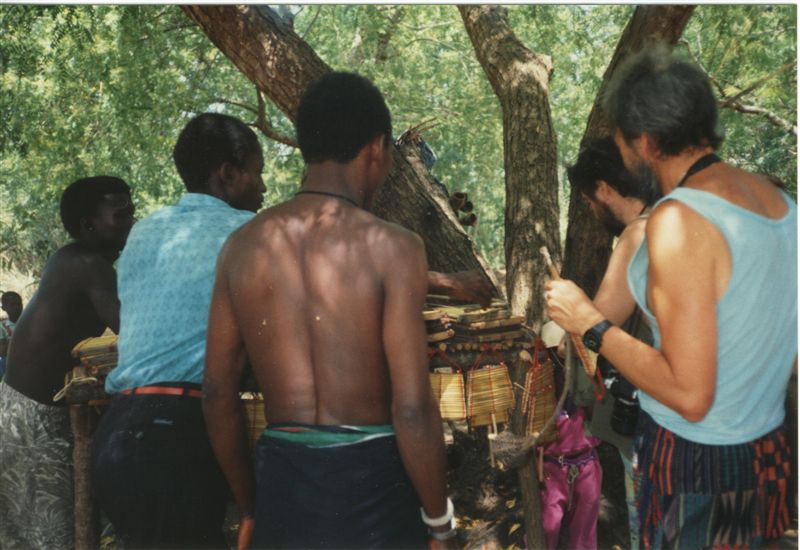
I didn't get my hands on one of these until November 1991, during a family visit to Gede (Gedi) Ruins when we wandered into the artificial 'Giriama village' where groups of tourists pay for dance performances (we watched one that was already paid for) and are sold various knick-knacks and handicrafts. Among the tourist tat were some functional items, including small mammal traps (Giriama muhoto, pl. mihoto). Two types of trap were for sale: the funnel trap described by Champion (muhoto wa mbugu, where mbugu is the creeper it is woven with), and one in which the funnel was replaced by the empty half-shell of a baobab fruit (muhoto wa uyu), with its lovely velvety exterior. Taylor's dictionary also refers to this type (1891: 106), while Deed alludes to similar traps in which the body is supplied by a half-coconut (1964: 60) - the kind I was told about on the way to Chilulu. The funnel trap is depicted in a popular book about the Mijikenda (Mwangudza 1983: 18, Fig. 5); the baobab-shell type in studies of the utilisation of the Arabuko-Sokoke Forest, near to Gede (e.g. Mogaka 1991: 58). Mogaka also illustrates what appears to be a larger version of the funnel type, called kizimba and baited with small mammals to catch medium-sized mammals (1991: 55, 59; 1992: 23, 26). A "Tumbatu Monkey Trap", described by Ingrams from the north of Unguja island, Zanzibar, is similar in design and construction: it comprises a baited peg and noose inside a wicker funnel; when sprung the noose tightens on the monkey's hand (1931: 294-295). I've also discussed these parallels in my paper on 'Island subsistence' (2007: 92). According to studies in the Arabuko-Sokoke, the smaller traps are used to catch elephant shrews and small mongoose as well as rats and mice (Mogaka 1992: 23; Fitzgibbon et al. 1995; 2000).

I elicited the Giriama names of the traps from one of the sellers, who hailed from a village just north of Malindi. I also wrote down the names of different components: the sisal string (lugwe lwa konje), bait (chambo), and the peg used to set the trap (katoyo ka muhoto). He said that they were used to catch both kadzora and the tastier tali, a field-mouse "much esteemed by the Giryamas as a great delicacy" according to Taylor (1891: 64). The tali (thali in current orthography) has been identified at Gede as the Fringe-tailed gerbil, Tatera robusta (syn. Gerbilliscus robustus) (Costich 1977: 12). My Giriama informant contrasted these with the light-colored, long-snouted p'inji, which dies when it crosses a path and is inedible. This creature is a common ingredient in the making of Giriama arrow poison, and although I didn't know it at the time, is a generic name for shrews, inlcuding the white-toothed shrews, Crocidura spp. (cf. Walsh 1992). Giriama p'inji is cognate with Jibana / Chonyi pingi (see above), and I would be surprised if they didn't have the same basic range of reference. Shrews are insectivores, not rodents, but this distinction isn't made by Mijikenda speakers, nor, to my knowledge, is it recognised in other East African ethnotaxonomies.

There are no doubt other edible rodents that he did not mention. I came across one of the largest in our garden in Nyali, Mombasa, in May the following year. This was a dead giant pouched rat - I assumed an immature or small female Cricetomys gambianus - 67 cm from the end of its nose to the tip of its tail, 35 cm of which was the length of its tail. It had puncture marks under one of its eyes and on one of its back legs, and I wondered whether it had been killed by a snake. I stuck it in the fork of a tree. Karisa, our Giriama-speaking gardener, identified it immediately as k'uhe (pl. k'uhe), the largest kind of rat that he knew. He added that two kinds are recognised: the k'uhe which comes out with the moon, and collects a lot of food, and the k'uhe of dark nights - there being nothing to distinguish them other than this difference in their behaviour. Yes, he said, k'uhe are eaten, and like other rodents roasted in their skins once the fur has been scraped off. A single rat can feed four people. Now there's something to chew on for another World Food Day.

Acknowledgements
Thanks to James Walsh for digging out the photo from our trip to Gede Ruins as well as the funnel trap he purchased there. Not long after they were written Liz Wiley kindly sent me copies of the KIFCON reports about the utilisation of the Arabuko-Sokoke. I am also grateful to John Fanshawe for sharing later papers about the research there.

References

Allen, Glover M. and Barbara Lawrence 1936. Scientific results of an expedition to rain forest regions in eastern Africa. III: Mammals. Bulletin of the Museum of Comparative Zoology at Harvard College 79 (3): 31-126.

Champion, Arthur M. 1967. The Agiryama of Kenya (RAI Occasional Paper No. 25, John Middleton ed.). London: Royal Anthropological Institute of Great Britain and Ireland.

Costich, Denise E. 1977. A checklist of mammals in Gedi National Park with KiGiriama names. East Africa Natural History Society Bulletin (January / February): 12-13.

Deed, Florence 1964. Giryama-English Dictionary. Nairobi: East African Literature Bureau. [page numbers refer to the printout of an electronic copy.]

FitzGibbon, Clare D., Hezron Mogaka and John H. Fanshawe 1995. Subsistence hunting in Arabuko-Sokoke Forest, Kenya, and its effects on mammal populations. Conservation Biology 9 (5): 1116-1126.

FitzGibbon, Clare D., Hezron Mogaka and John H. Fanshawe 2000. Threatened mammals, subsistence harvesting, and high human population densities: a recipe for disaster? In John G. Robinson and Elizabeth L. Bennett (eds.) Hunting for Sustainability in Tropical Forests. New York: Columbia University Press. 154-167.

Ingrams, W. H. 1931. Zanzibar: Its History and Its People. London: Frank Cass.

Kingdon, Jonathan 1997. The Kingdon Field Guide to African Mammals. San Diego: Academic Press.

Lukumbo, Lucas 1995. Man who eats, sells rats talks [sic]. Daily News (Dar es Salaam), Wednesday 26 April 1995: 6. [An article about a Makua rat-catcher and roaster in Mpindimbi village, Masasi district, Mtwara region.]

Mogaka, Hezron R. 1991. Local Utilization of Arabuko-Sokoke Forest Reserve. Report to the Kenya Indigenous Forest Conservation Project (KIFCON), Forest Department, Kenya.

Mogaka, Hezron R. 1992. A Report on a Study of Hunting in Arabuko-Sokoke Forest Reserve. Report to the Kenya Indigenous Forest Conservation Project (KIFCON), Forest Department, Kenya.

Mwangudza, Johnson A. 1983. Mijikenda (Kenya's People, Margaret Sharman ed.). London: Evans Brothers Limited.

Ringa, Mathias 2004. Kilifi village where mice is [sic] a delicacy. The Standard (Nairobi), 4 November 2004.

Taylor, W. E. 1891. Giriama Vocabulary and Collections. London: Society for Promoting Christian Knowledge.

Walsh, Martin 1992. Elephant shrews and arrow poison. East Africa Natural History Society Bulletin 22 (2): 18-21.

Walsh, Martin 2007. Island subsistence: hunting, trapping and the translocation of wildlife in the western Indian Ocean. Azania 42: 83-113. (With an online appendix: Island mammal lists and local names.)

Tuesday, 31 March 2009

EATING BATS ON PEMBA ISLAND: A Local Innovation or Cultural Borrowing?

by Martin Walsh

[This is the text of an article orginally published in October 1995 in Mvita: Newsletter of the Regional Centre for the Study of Archaeology in Eastern and Southern Africa (Mombasa), 6: 15-18. I wrote this at short notice during a visit home to Mombasa in September 1995, and still have unpublished notes on the ethnotaxonomy of bats and bat-hunting on Pemba. The historical questions raised in the article are discussed at greater in length in a 2007 paper 'Island Subsistence: Hunting, Trapping and the Translocation of Wildlife in the Western Indian Ocean', Azania, 42 (Special issue: Stephanie Wynne-Jones (ed.) The Indian Ocean as a Cultural Community): 83-113 (with an online appendix: 'Island Mammal Lists and Local Names').]

Introduction

The Swahili are virtually unique among the peoples of East Africa in their possession of a maritime culture. Their early adaptation to the exploitation of marine resources, coupled with a growing involvement in the trade networks of the western Indian Ocean, both enabled and prompted them to establish settlements along more than a thousand miles of coastline and offshore islands. The only other peoples to share in this spectacular maritime expansion were the Mwani and Comorians, speakers of closely related Sabaki Bantu languages. At the same time the Swahili and their close relatives did not live off the sea alone. They also carried with them an Eastern Bantu inheritance of mixed farming, cultivating grain and root crops and keeping cattle and other livestock.

Though it is sometimes easy to forget, hunting and gathering were also a component in this inheritance and therefore the eclectic economy and varied diet of the Swahili. Not surprisingly, hunting and gathering plays much the same role in rural Swahili communities as it does among other Eastern Bantu, and the main differences (including differences among the Swahili themselves) are ones of degree. Swahili methods of hunting and trapping are little different from those of their mainland neighbours, and the range of permissible animal foods is very similar, except for the Islamic prohibition upon pig-meat (which does not stop pigs being hunted as vermin and fed to dogs). Birds, rodents and herbivores are generally fair game: carnivores, primates, reptiles and amphibians are not. The Swahili, like most East African Bantu, have fewer dietary restrictions than Cushitic pastoralists and mixed farmers and the speakers of Nilotic lang-uages who have been influenced by them (and who, like some northern Swahili clans of Eastern Cushitic origin, do not eat fish). However, they are nowhere near as omnivorous as formerly “pure” hunter-gatherers like the Hadza.

Bats are usually considered inedible by Bantu-speakers, a prohibition which is often rationalised with reference to their nocturnal habits and associations with witchcraft and/or death. The Swahili inhabitants of Pemba island, which lies off the northern coast of Tanzania, provide a striking exception to this rule. Pembans appear to be unique among the Swahili and other people of the East African coast in that they hunt and eat bats, and do so with great relish. Their anomalous behaviour in this respect demands an explanation. It seems extremely unlikely that this is an inherited practice which has survived on Pemba but has been discarded by other Swahili-speakers. Two main possibilities remain: either that Pembans have (for reasons which also need to be clarified) innovated the practice, or that they have, at some point in their past, borrowed it from a people who did hunt and eat bats. As we shall see, it is not easy to decide between these two competing hypotheses or different variants of the borrowing hypothesis. Before discussing these at greater length, however, I will first describe the Pemba practice in more detail.

Hunting Bats for Food on Pemba

At least 11 species of bat (Order Chiroptera), probably more, are found on Pemba island. The Swahili-speaking inhabitants of Pemba refer to them collectively as p’opo. Like most other East African Bantu, Pembans usually classify bats as birds (ndege), though close familiarity with these flying mammals leads some people to question this. Not all bats are hunted for food. The largest, tastiest, and most sought-after species is the endemic Pemba Flying Fox, Pteropus voeltzkowi. The second-largest species on the island, the Straw-coloured Fruit Bat, Eidolon helvum (subspecies helvum), which is commonly thought to be an immature flying fox, is also widely hunted, though said not to be quite so tasty. Other edible bats include Decken’s Horseshoe Bat, Rhinolophus deckenii. The importance of bats in Pemban culture is reflected in the fact that there are more than 20 different names for particular kinds in use on the island. The majority of these are alternative names for the principal edible species, underlining their role in the local diet.

Many of the smaller species, however, are not hunted for food. In some places on the island colonies of bats, visible or invisible, are regarded as spirits or their guardians: the Egyptian or Long-haired Rousette, Rousettus aegyptiacus (sub-species leachii), has been definitely identified as one subject of such beliefs. An extraordinary plague of malevolent spirits which swept throughout Pemba during and after Ramadhan in 1995, and subsequently migrated south to Unguja island, also had a nominal association with bats. These spirits were identified as manifestations of a single evil entity, called p’opo bawa, “the bat’s wing”. This designation is said to be purely metaphorical and based upon descriptions of the frightening shadow cast by the nocturnal attacker and his spiritual legions. This is not the first time, however, that p’opo bawa or a plague of the same name has appeared on Pemba, and it may well be that a more substantive association with bats was once known.

A variety of methods are employed to hunt and trap bats, either during the daytime when they are roosting or at night when they are feeding. Until recently shotguns were widely used by hunters, though the rising cost of ammunition and the increasing difficulty of obtaining guns and licenses for them (especially since the introduction of multi-party politics) has much curbed this practice. The most common bat-hunting method now is to shoot them with a catapult, a favourite occupation of groups of boys and youths. Throwing-sticks are sometimes used, but recognised as much less accurate and effective. A more widespread practice is to trap bats by baiting a tangle of thorn branches (from misoo trees) with ripe fruit and lodging this trap high in a tree on which they are feeding. On the eastern coast of Pemba small groups of men sometimes chop down Borassus Palms containing roosting colonies of the Straw-coloured Fruit-bat, enabling them to kill up to 100 bats in one go. The destructiveness of this practice gives some idea of the lengths to which Pembans will go to obtain bats, which form an occasional substitute for fish in the local diet. After the bats have been skinned and their heads and wings removed large catches are usually shared out among the hunters who then take them home for the family pot (they are boiled like chickens). Surplus bats are given to relatives and friends and only occasionally sold.

Until the 19th century the greater part of Pemba was covered by forests: hence its Arabic epithet, “The Green Island”. Settlement appears to have been concentrated along the coast, where shifting cultivation was practised on the coral rag, and rice and other crops were grown on a more permanent basis in the well-watered valleys which penetrate inland. Given the abundance of natural habitat, bat-hunting was presumably once a sustainable activity. Unfortunately this is no longer the case. The large-scale clearing of the forests for clove plantations and the continuing expansion of population and agriculture have destroyed much of the habitat of tree-roosting species. Uncontrolled hunting with shotguns in the 20th century has taken a further heavy toll upon bat populations, especially that of the endemic Pemba Flying Fox, which is now listed as an endangered species. It remains to be seen whether current efforts by conservationists and the Zanzibar government to ensure its survival will meet with any success. Persuading Pembans not to hunt bats is no easy task.

A Pemban Innovation?

Relatively little archaeological work has been undertaken on Pemba. Although we know that Pemba has been settled by Swahili-speakers since at least the second half of the first millennium, we have no evidence to tell us how long bats have been a component in the Pemban diet. However, we can speculate on the origins of this apparently anomalous practice.

One possibility is that the hunting of bats for food is a Pemban innovation. We then have to ask what prompted the inhabitants of Pemba to modify their dietary practice to include a creature which other Swahili-speakers, not to mention other East African Bantu, classify as inedible. The abundance of large bats on Pemba relative to other natural sources of meat could provide an explanation. Pemba supports a limited mammalian fauna, apparently as a consequence of its distance and long period of geological separation from the mainland (though human impacts upon a more extensive original fauna cannot be entirely ruled out as a contributory factor). There is, for example, only one medium-sized herbivore, the Pemba Blue Duiker (Cephalophus monticola, subspecies pembae). Bats, however, comprise a much larger proportion of the mammalian fauna than they do on the mainland: roughly half of the total number of species of land mammal found on Pemba are bats. This is presumably because of the relative ease with which they have been able to colonise the island and thrive in the absence of significant predators. The Pemba Flying Fox is one such colonist, the westernmost representative of a genus with Austronesian affinities and endemic forms on a number of other Indian Ocean islands.

The Swahili settlers of Pemba encountered an abundance of bats relative to other mammals, and one bat in particular which was larger and had more meat than any other which they had encountered before. Under these circumstances the inclusion of bats in the Pemban diet could be conceived as a simple response to locally available opportunities, initially either as a result of pressure during periods of food shortage or perhaps purely as a means of varying the diet. The inherited classification of bats as birds may have assisted in this transition, enabling Pembans to overcome any scruples they may have originally had as to their edibility. A similar explanation can be posited for another Pemban dietary innovation: the consumption of freshwater terrapins, kobe (specifically the Eastern Hinged Terrapin, Pelusios castanoides). In this case the obvious similarity of these reptiles to edible sea turtles (an early addition to the Swahili diet) may have eased their acceptance as an item of food (other Swahili-speakers and their mainland relatives regard the thought of eating kobe, a term which includes land tortoises, with disgust).

There are a number of problems, however, with this argument. The lack of meat protein sources on Pemba has not seen them switch to eating other mammals normally avoided by the Swahili. Vervet monkeys (Cercopithecus aethiops, subspecies nesiotes), for example, are abundant on the island and readily eaten by Makonde immigrants but not by their Swahili hosts (with the exception of isolated and much-criticised individuals prepared to break this dietary taboo). Meanwhile, other island-dwelling Swahili with similar opportunities for eating fruit-bats have not taken up the Pemba practice. The Straw-coloured Fruit-bats of Unguja island are generally only eaten by people of Pemban origin. Likewise, although Mafia island and the adjoining islets support a species of flying fox related to that found on Pemba, the local inhabitants declare that they are only eaten by visitors from Pemba. While these examples do not rule out the possibility that Pembans innovated in this regard, they do make it rather more difficult to explain.

A Borrowed Practice?

The alternative hypothesis is that the Swahili-speakers of Pemba adopted bat-eating from a people who already hunted and ate them. If this were the case, then the fact that they were able to overcome their inherited scruples suggests that this was the result of prolonged interaction, and possibly the incorporation of a group of bat-eaters into the Swahili population. Who might these people have been? There are at least three main candidates, and the case for each is discussed below.

In one of the published references to bat-eating on Pemba it is remarked that one species was considered a delicacy by the Arabs on the island. This raises the possibility that Pembans have turned to hunting bats under the influence of recent (especially 19th century) Arab immigrants, whose descendants are still to be found scattered throughout the clove plantation areas of Pemba. However, there are obvious objections to this argument. As far as I am aware, the consumption of bats is not common practice in Oman or other parts of the south Arabian peninsula from where Pemba’s Arabs originally came. Moreover, Arab immigrants else-where on the Swahili coast have not introduced this practice, nor are they reported to eat bats at all. Under these circumstances it is difficult to explain how they might have fostered a habit which appears to be deeply ingrained in Pemban culture, as widespread in the traditional fishing villages as it is in the mixed settlements of the plant-ation areas. It seems more likely that the opposite process has taken place, and that Arab settlers have adopted existing Pemban practice.

The second possibility is that Pembans adopted bat-hunting under the influence of an earlier population of hunter-gatherers. The problem with this argument is that at present we have no evidence for the existence of such a population on Pemba, though it is a tantalising thought. We do, however, know that Pembans, in common with other Swahili-speakers, had close contact with hunter-gatherers on the northern coast before they migrated and sailed to the south. A number of Swahili words, including some zoological terms, appeared to have been borrowed from the ancestors of the Southern Cushitic-speaking Dahalo, a group of (former) hunter-gatherers in the north of the Tana River delta. Other words, including the generic name for bats (proto-Sabaki *mpopo), derive from the Eastern Cushitic-speaking Aweera (or Boni), a group of hunter-gatherers who live further to the north, on both sides of the Kenya-Somalia border. If bat-eating had likewise derived from one or other of these groups, then we would expect it to be more widely distributed than it is or to find evidence that it was so in the past. Unfortunately this evidence is lacking, as is information on whether or not the Dahalo and/or Aweera actually eat bats, or have ever done so in the past.

Alternatively we could assume that the early Pembans had separate contact with these or other bat-eating hunter-gatherers on the mainland before they migrated to Pemba. Again, we have no other evidence for this. Most of the Pemba Swahili names for different kinds of bats, including the Pemba Flying Fox, are composite and descriptive terms (like p’opo-maembe, “the mango bat”) whose transparent etymologies do not provide any useful clues in this respect.

A third possibility is that the Pembans derived their bat-eating habit from early settlers from Borneo, in other words the same people who settled the island of Madagascar. Suggestions that these people might have had any direct impact upon the East African coast are usually treated with considerable scepticism. There are, however, an increasing number of indications that this might not be as far-fetched a thesis as previously thought. Swahili has at least a sprinkling of words which appear to have originated on the other side of the Indian Ocean: these include the generic term for fish-poison (utupa) and the plants bearing it (mtupa), and the name for a kind of raft (sap’a in Pemba and other dialects). There is also some botanical and zoological evidence for this connection. The presence of the Wild Banana, Musa acuminata, on Pemba (and nowhere else in the western Indian Ocean) is perhaps the best known example. The problem with most of this evidence, however, is that given our current state of knowledge it is extremely diff-icult to distinguish between direct introductions and later, secondary, introductions from Madagascar, where the Swahili also founded coastal settlements.

Even so it is interesting to note that the Ma’anyan, the Bornean people whose language is most closely related to those of Madagascar, hunt and eat fruit-bats, as do many of the peoples of Borneo and elsewhere in the Indonesian archipelago. Not surprisingly, therefore, bats are widely eaten in Madagascar, while Malagasy-speakers are thought to have taken this practice with them to the Comoro islands, where the largest species, Livingstone’s Giant Fruit-bat (Pteropus living-stonii) is threatened with extinction. Whether or not close relatives of the Ma’anyan and/or Malagasy ever settled on Pemba (bringing with them a propensity for eating bats) remains to be determined: it seems, however, to be a possibility which is worth investigating further.

Conclusion

The origin of the Pemban practice of hunting bats for food is a puzzle which has yet to be solved, though the answer probably lies in one or other of the solutions proposed above. Further comparative ethnographic and linguistic work may provide additional clues, but the most telling evidence probably lies buried in the ground, awaiting careful excavation and analysis by archaeologists (though the current practice of discarding the heads and wings of bats before the torso is taken home to be cooked suggests that it may be difficult to identify bats themselves in an archaeological context).

Inconsequential though it may seem, the Pemba case raises a whole series of unresolved issues about the historical emergence of the Swahili and their distinctive economy. As we have seen, the role of hunter-gatherers as well as possible Bornean or early Malagasy contacts in Swahili history is poorly understood. The chronology of early Swahili settlement on Pemba and other Indian Ocean islands, not to mention the coast itself, is still very much the subject of guesswork, though recent archaeological and linguistic research has given us a number of pointers. The precise relation between the Swahili and their fellow long-distance migrants, the Mwani and the Comorians, is also something of a mystery, and in this case recent linguistic work appears only to have made it a more complicated one. The Pemba case provides an analogy for what is perhaps the key problem in understanding the emergence and development of these related peoples: how did they learn to exploit the marine resources of the coast? To what extent did they simply innovate and adapt their existing practices and technologies? To what extent did they adopt or absorb the practices and technologies of others? And who were these others?

Acknowledgements

In addition to the many Pembans who have shared their knowledge of bats and bat-hunting with me (and which I hope to describe in greater detail in future papers), I would like to give special thanks to Tony Archer, Tuula Kurikka, Abigail Entwistle and Nadia Corp for the information and many ideas on this subject which they too have provided.

[The Pemba Flying Fox and some of the other bats mentioned in this article are illustrated on a poster produced by The Field Museum (Chicago) / Critical Ecosystem Partnership Fund: Popo wa Pemba / Bats of Pemba]