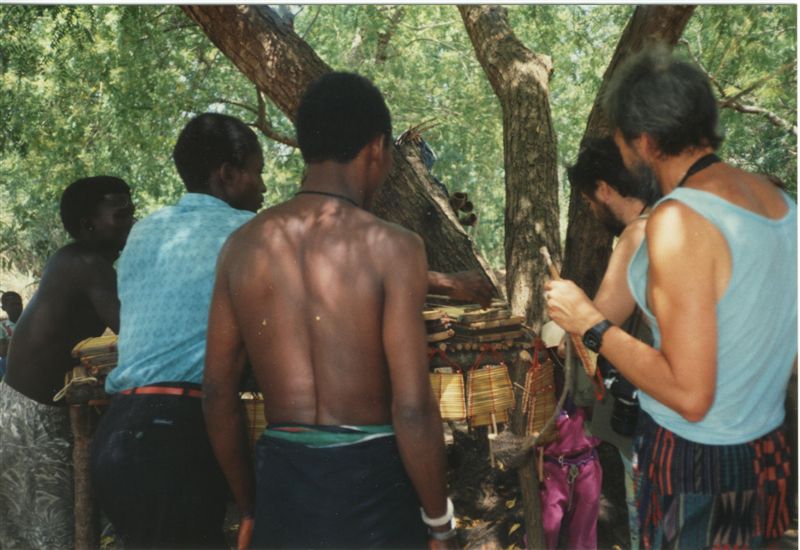
Showing posts with label Giryama. Show all posts

Friday, 26 April 2019

THE WHALE AND THE PANGOLIN

by Martin Walsh

A pilot whale in Pongwe Bay, Unguja, Zanzibar (photo by Yaroslav Alexandrov)
‘Was there a proto-Bantu word for ‘whale’ and other mischievous questions’ is the characteristically thought-provoking title of an unpublished paper (last updated in 2012) by my good friend Roger Blench. As Roger points out, there is no listed proto-Bantu form for ‘whale’, though it is quite possible that early Bantu speakers were familiar with marine creatures, and certainly so once they spread from their putative homeland in southern Cameroon down the west coast of equatorial Africa. The rest of the paper sets out the lexical evidence for knowledge of marine fauna in northwest Bantu, including a generic term for whales (2012: 21-22).

This word did not, of course, make it across or around the central African rainforest to the eastern side of the continent. How, then, did Bantu speakers name whales when they first encountered them on the shores of the Indian Ocean? Knowledge of whales doesn’t require possession of a fully-fledged maritime culture, just familiarity with the seashore. As we know, whales can become stranded on beaches, as well as washing up when they are dead, as reported in my January 2012 post on ‘A pilot whale in Pongwe’.

There are more than 30 species of whale in the western Indian Ocean region (Richmond 2002: 398), and according to the TUKI English-Swahili Dictionary, nyangumi is the common Swahili name for all of them. Indeed, it’s the only name given for whales in both online TUKI dictionaries (English-Swahili and Swahili-English), which are our best guide to contemporary Standard Swahili. Older dictionaries, however, give variants of this term, which has an invariant plural – in the lingo of Bantuists it has 9/10 (singular/plural) noun class prefixes and takes 1/2 animate agreements.

There are even more variants of nyangumi in the different dialects of Swahili, as well as other names. Here’s a provisional list of the generic term for whales in all the dialects between Somalia in the north and Mozambique in the south for which I have data. I’ve also included terms from other Sabaki languages, which are Swahili’s closest historical relatives.

Swahili and other Sabaki language names for whales

Language
and dialects
Attestation
and noun class pairing (if known)
Source and comments
Swahili


Standard
nyangumi 9/10
Johnson 1939a, 1939b; TUKI 2019a, 2019b

nyamngumi 9/10
TUKI 1981
Mwiini
yama 9/10 ~ iyama 5/4
Kisseberth 2016. Cf. nama 9/10 ‘meat, flesh’
Bajuni
muungumi ~ nngumi 3/4
Sacleux 1939; Nurse 2010
Pate
mngumi
Sacleux 1939
Amu
mngumi
Sacleux 1939
Pemba
mngumi
Sacleux 1939
Mvita
mngumi
Sacleux 1939; Abdulaziz 1979

mgumi ~ nyamgumi
Binns 1925
Unguja
nyamgumi 9/10
Madan 1903

mnyāngumi 3/4
Sacleux 1939, 1959

nyangumi 9/10
field notes 2016
Mafia/Ngome
nyamabahari 9/10
Kipacha 2004. Cf. nyama 9/10 ‘meat’ + bahari 9/10 ‘sea’, lit. ‘flesh (animal) of the sea’
Koti
nangumi (1a/2a)
Schadeberg and Mucanheia 2000
Lower Pokomo


(New Testament)
ḅungumi
The British and Foreign Bible Society 1901; BTL 2019
Mijikenda


Giryama
mungumi
United Bible Societies 1951
Comorian


Ngazidja
ngume 3/4
Fischer 1949

mngome ~ mngume 3/4
Ahmed-Chamanga and Gueunier 1979

nduju
Fischer 1949. Cf. Lafon 1991, nduju 9/10 ‘dolphin’

ndundju
Ahmed-Chamanga and Gueunier 1979
Ndzuani
ndruju 9/10
Ahmed-Chamanga 1992, 1997, Cf. fumba-ndruju 5/6 ‘dolphin’
Maore
mongume
Ahmed-Chamanga and Gueunier 1979

The Swahili names from Brava in Somalia (Mwiini) and northern Mafia island (Ngome) in Tanzania are euphemisms that allude to the animality, and perhaps edibility, of whales as large creatures of the sea. Comorian ndruju and variants seem to have been borrowed from Malagasy trózona, ‘whale’, or an earlier form thereof (see Simon 2006: 439). As Sander Adelaar (1989: 17) has pointed out – and kindly expanded upon while I was writing this post, this was originally a loanword from Malay *duyuŋ, ‘dugong’ – the English name of which is ultimately from the same source.

Derek Nurse and Tom Hinnebusch (1993: 665) tentatively reconstructed proto-Sabaki *mungumi 3/4 ‘whale’, citing the Amu, Unguja, Giryama, and Ngazidja forms. Allowing for errors in transcription, the expanded list provides additional support for this reconstruction. The only real anomaly is the initial consonant in Lower Pokomo ḅungumi, assuming that this isn’t a mistake made by different generations of Bible translators. Given that most Pokomo live along the Tana River and not near the sea, then perhaps we should not be surprised to see them using a skewed form of the name of a creature they were unlikely to encounter.

Where, then, did the ancestors of the Swahili and other Sabaki speakers get this word from? There’s no obvious connection between *mungumi (with the root *-ngumi) and another tentative proto-Sabaki reconstruction, *ngumi 9/10 ‘fist’ (Nurse and Hinnebusch 1993: 669). I don’t know if there are cognate whale names in other languages along the Tanzanian coast. The record of nyangumi in a modern vocabulary of Zigua (Mochiwa 2008: 52) might reflect recent borrowing from Swahili. An alternative possibility is that the transfer went in the opposite direction, i.e. that the Unguja and related forms aren’t inherited, but derive from Zigua or another mainland language.

A Termminck's ground pangolin in Iringa (video still by Martin Walsh)
The only similar name that I have come across is given to a very different animal in the drylands of central Tanzania, a long way from the Indian Ocean. Temminck’s ground pangolin, Smutsia temminckii, is called nyamung’umi (9/10, plural zinyamung’umi) by some speakers of the Gogo language (Swynnerton 1946: 30; field notes 2002), abbreviated to nyamumi by others (Rugemalira 2009: 83). Is this just a coincidence? What’s the connection, if any, between these little-seen scaly ant-eaters in the interior of Tanzania and the world’s largest marine mammals?

Gogo, a West Ruvu language, is classified in the same wider group of languages as Zigua and the Sabaki languages: Northeast Coast Bantu (NECB). As the name implies, NECB speakers occupy a large swathe of territory that begins in central Tanzania and sweeps eastwards and northwards, following the Indian Ocean coastline up to southern Somalia. They were presumably the first Bantu to arrive on the coast opposite Zanzibar, and perhaps the first to encounter beached whales on this side of the continent.

The ancestors of the Gogo and other NECB speakers would have been familiar with ground pangolins, which can be found everywhere in the hinterland of the Tanzanian coast. Is there anything that would lead them to dub whales with the same name? A clue may lie in the comparative rarity of pangolin and inshore whale sightings. Among the Gogo and their neighbours, encounters with pangolins were traditionally treated as auspicious events, triggering ritual actions that typically ended in the sacrifice of the animal (for examples see Walsh 1995/96, 2007).

Could it be that the stranding of a whale was viewed as a similarly auspicious event by early NECB settlers on the coast? Was the whale, like the pangolin, thought to offer itself for sacrifice? And did this lead whales to be dubbed with the same name, or a version of it?

I am, of course, letting my imagination run riot. The Gogo name for the ground pangolin, nyamung’umi, doesn’t seem to have a wider distribution, and I don’t know its etymology: it might even be a recent euphemism. Reflexes of proto-Bantu *kákà 9/10 ‘pangolin spp.’ are widespread in East Africa. Swahili kakakuona is one of them, though evidently borrowed from Nyamwezi ngakákύβonwá 9/10 (Maganga and Schadeberg 1992: 268, 305), perhaps via Gogo, which also has a related form, written as ngakakuona by my research assistants in 2002.

It may even be that Gogo nyamung’umi was itself borrowed from the coast (cf. the Swahili form nyamngumi). Whatever the case, the switch to or from velar nasal ng’ /ŋ/ would have to be explained. Likewise, the comings and goings of different prefixes and noun class designations, reminiscent of a case I’ve discussed elsewhere (Walsh 2004). Still, in the absence of alternative hypotheses, I find it difficult to resist speculation. There are certainly cases in which deep cultural knowledge is needed to make sense of an otherwise opaque etymology. This one is a long shot, but every now and then long shots hit the target.

Acknowledgements
Many thanks again to Yaroslav Alexandrov for letting me use his photos from Pongwe. I'm also very grateful to the wonderful Bonny Sands for LOT Project dictionaries (many more than are referenced here!), and Sander Adelaar for putting me right on ndruju. They’re real linguists, and the usual disclaimer applies.

References
Abdulaziz, Mohamed H. 1979. Muyaka: 19th Century Swahili Popular Poetry. Nairobi: Kenya Literature Bureau.

Adelaar, Alexander A. 1989. Malay Influence on Malagasy: linguistic and culture-historical implications. Oceanic Linguistics 28 (1): 1-46.

Ahmed-Chamanga, Mohamed 1992. Lexique comorien-(shindzuwani)-français. Paris: Editions l’Harmattan.

Ahmed-Chamanga, Mohamed 1997. Dictionnaire français-comorien (dialecte shindzuwani). Paris: CEROI-INALCO / L’Harmattan.

Comorian dictionaries
Ahmed Chamanga, Mohamed and Noël-Jacques Gueunier 1979. Le dictionnaire comorien-français et français-comorien du R. P. Sacleux (2 vols.). Paris: SELAF.

Binns, H.K. 1925. Swahili-English Dictionary: Being Dr. Krapf’s Original Swahili-English Dictionary Revised and Re-arranged. London: Society for Promoting Christian Knowledge.


BTL 2019. Bible Translation  and Literacy, Pokomo Language Project. Online at https://kipfokomu.com/en/homepage.

Fischer, François 1949. Grammaire-dictionnaire comorien. Strasbourg: Société d’Édition de la Basse Alsace.

Johnson, Frederick 1939a. A Standard Swahili-English Dictionary. London: Oxford University Press.

Johnson, Frederick 1939b. A Standard English-Swahili Dictionary. London: Oxford University Press.

Kipacha, Ahmad 2004. Kingome-English lexicon. Swahili Forum 11: 179-209.

Kisseberth, Charles W. 2016. Chimiini-English Dictionary and Chrestomathy. Online at http://swahiliendangered.cdh.ucla.edu/wp-content/uploads/2016/05/Chimiini-Lexicon-and-Chrestomathy-February-2016.pdf.

Lafon, Michel 1991. Lexique français-comorien (shingazidja). Paris: Editions L’Harmattan.

Madan, A.C. 1903. Swahili-English Dictionary. Oxford: The Clarendon Press.

Maganga, Clement and Thilo C. Schadeberg 1992. Kinyamwezi: Grammar, Texts, Vocabulary. Köln: Rüdiger Köppe Verlag.

Mochiwa, Zacharia 2008. Kizigula: Msamiati wa Kizigula-Kiswahili-Kiingereza [Zigula-Swahili-English Lexicon]. Dar es Salaam: Languages of Tanzania (LOT) Project, University of Dar es Salaam.

Nurse, Derek 2010. Lexicon for Ki-Bajuni = Ki-Gunya = Ki-Thikhuu. Online at http://www.ucs.mun.ca/~dnurse/bajuni_database/wordlist.pdf.

Nurse, Derek and Thomas J. Hinnebusch 1993. Swahili and Sabaki: A Linguistic History. Berkeley: University of California Press.

Richmond, Matthew D. (ed.) 2002. A Field Guide to the Seashores and Eastern Africa and the Western Indian Ocean Islands (2nd edition). Dar es Salaam: Sida/SAREC & UDSM.

Rugemalira, Josephat M. 2009. Cigogo: Kamusi ya Kigogo-Kiswahili-Kiingereza / Kiingereza-Kigogo / Kiswahili-Kigogo [Gogo-Swahili-English / English-Gogo / Swahili-Gogo Dictionary]. Dar es Salaam: Mradi wa Lugha za Tanzania, Chuo Kikuu cha Dar es Salaam.

Sacleux, Charles 1939. Dictionnaire Swahili-Français. Paris: Institut d’Ethnologie.

Sacleux, Charles 1959. Dictionnaire Français-Swahili (2nd edition). Paris: Institut d’Ethnologie.

Schadeberg, Thilo C. and Francisco Ussene Mucanheia 2000. Ekoti: The Maka or Swahili Language of Angoche. Köln: Rüdiger Köppe.

Simon, Pierre R. 2006. La langue des ancêtres Ny Fitenin-dRazana: Une périodisation du malgache de l’origine au XVème siècle. Paris: L’Harmattan.

Swynnerton, G.H. 1946. Vernacular names for some of the better-known mammals in the Central Province, Tanganyika Territory. Tanganyika Notes and Records 21: 21-38.

The Bible Society of Kenya 1951. Chuwo cha Malagano Masha ga Bwana Wehu Jesu Masihi Mokoli Wehu [The New Testament and Psalms in Giryama].  Nairobi: The Bible Society of Kenya.
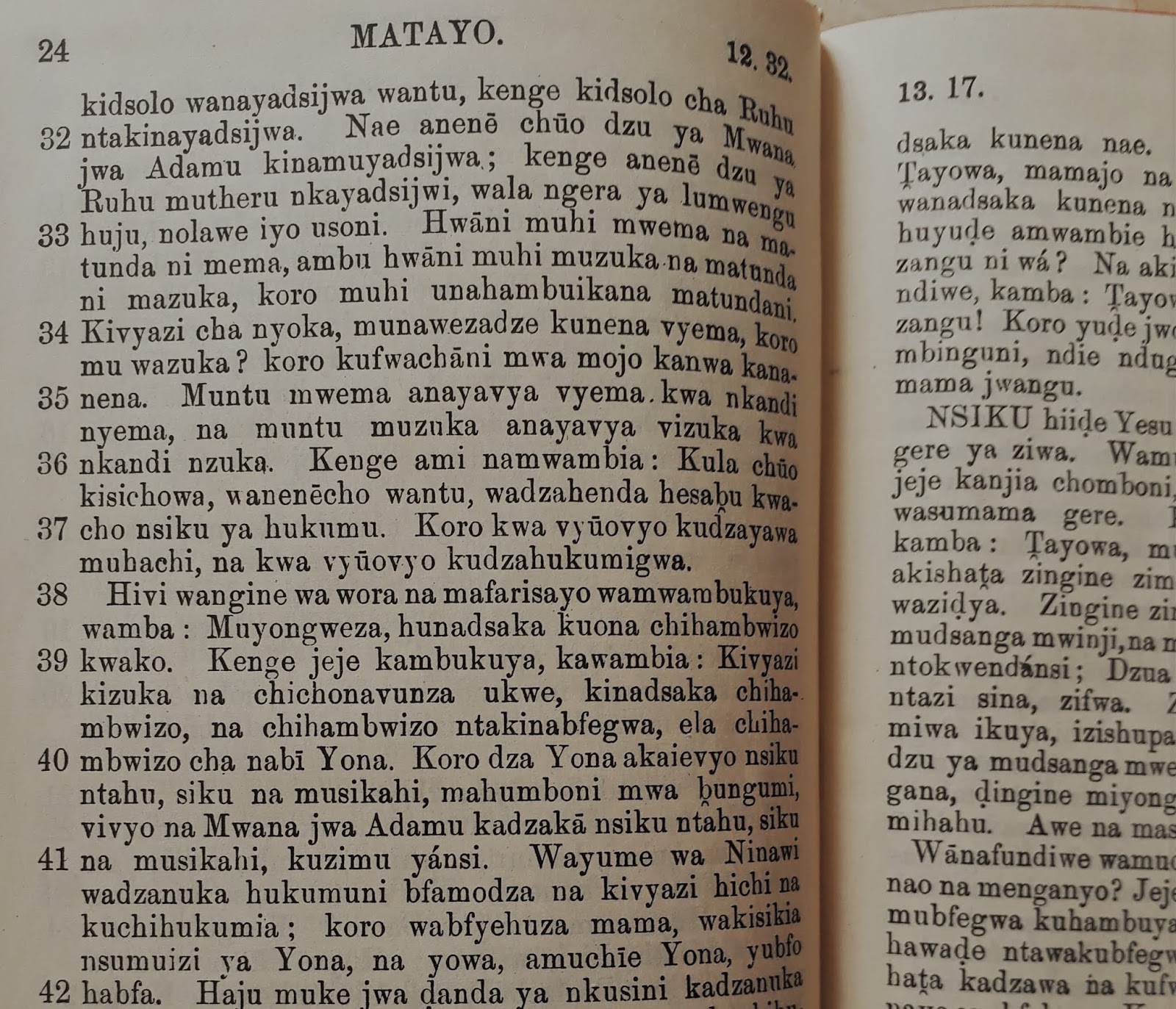
The British and Foreign Bible Society 1901. Chuo cha Ḍamano Ibfya ḍya Ḇwana na Mubfonya Jwehu Yesu Kristo [Pokomo New Testament]. London: The British and Foreign Bible Society.

'Whale' in Pokomo, Matthew 12: 40

TUKI 1981. Kamusi ya Kiswahili Sanifu. Dar es Salaam: Oxford University Press.

TUKI 2019. Kamusi ya Kiswahili-Kiingereza. Online at http://www.elimuyetu.co.tz/subjects/arts/swa-eng/index.html.

TUKI 2019. English-Swahili Dictionary. Online at http://www.elimuyetu.co.tz/subjects/arts/eng-swa/index.html.

Walsh, Martin T. 1995/96. The ritual sacrifice of pangolins among the Sangu of south-west Tanzania. Bulletin of the International Committee on Urgent Anthropological and Ethnological Research 37/38: 155-170. Online at https://www.academia.edu/708993/The_ritual_sacrifice_of_pangolins_among_the_Sangu_of_south-west_Tanzania.

Walsh, Martin T. 2004. Variability and compounding of affixes in Hehe animal names (Tanzania). Paper presented to the 34th Colloquium on African Languages and Linguistics (CALL 34), Leiden University, 23-25 August. Online at https://www.academia.edu/1691467/Variability_and_compounding_of_affixes_in_Hehe_animal_names_Tanzania_.

Walsh, Martin T. 2007. Pangolins and politics in the Great Ruaha valley, Tanzania: symbol, ritual and difference / Pangolin et politique dans la vallée du Great Ruaha, Tanzanie: symbole, rituel et différence. In E. Dounias, E. Motte-Florac and M. Dunham (eds.) Le symbolisme des animaux: L'animal, clef de voûte de la relation entre l'homme et la nature? / Animal Symbolism: Animals, Keystone of the Relationship between Man and Nature? Paris: Éditions de l’IRD. 1003-1044. Online at http://horizon.documentation.ird.fr/exl-doc/pleins_textes/divers16-08/010041952.pdf.

Walsh, Martin T. 2018. The Swahili language and its early history. In S. Wynne-Jones and A. LaViolette (eds.) The Swahili World. Abingdon and New York: Routledge. 121-130. Online at https://www.academia.edu/36719077/The_Swahili_language_and_its_early_history.

Monday, 18 October 2010

MICE-HUNTING, RAT-TRAPPING, RODENT-ROASTING

Twenty-five years ago I went to a World Food Day celebration at Kaloleni in the palm-covered hills to the north of Mombasa. The meeting was presided over by the Kaloleni Divisonal Officer and attended mainly by government agricultural staff and the members of women's groups from the surrounding area. The centrepiece was a display of local foods which everyone was invited to inspect and then taste - after the obligatory singing, speechifying, certificate-giving, and distribution of bottles of sugary-sweet soda. Apart from purple maize cobs and meal of a kind that might have excited Barbara McClintock, the most notable of the local delicacies on offer were roasted rodents. At a glance these looked like grilled fish, but I was assured that they were indeed kadzora (pl. udzora) as this "wild rat" was called in Giriama and other northern Mijikenda dialects. The D.O., who was a Luhya from western Kenya, began his speech by referring to the wide variety of foods on display, "plus kadzora", implying that this particular kind of bushmeat didn't quite qualify. Diets divide cultures and subcultures, and the consumption of rodents and other unusual foods is a marker of social difference that is a staple (no pun intended) of everyday humour (kadzora has now made it onto online chat forums) and of 'human interest' stories in the media (e.g. Lukumbo 1995; Ringa 2004).

Coincidentally, walking back from the meeting in Kaloleni to Chilulu, in Jibana location, we passed some children digging for kadzora. I was told that they could also be caught at night in traps made with a coconut shell. On another day, walking to nearby Tsakarolovu (where anthropologist David Parkin worked), I again saw signs of digging for kadzora, and was told that the burrows could be up to a metre in length. One of my companions asserted that kadzora was in fact a Giriama name for an animal that Jibana and Chonyi speakers called pingi (I now doubt this, for reasons discussed below). I had no idea at the time what kind of "wild rat" this might be. The Rev. W. E. Taylor defined Giriama kadzora as a "mole" (1891: 63); Florence Deed as both a "mole" (presumably after Taylor) and a "little black field rat" (1964: 25).The only zoological clue I have since found comes from an old collection at Wema in the Tana Delta where kadzora was given as a Lower Pokomo name for the zebra mouse Lemniscomys griselda (Allen and Lawrence 1936: 106). Lower Pokomo and Northern Mijikenda are neighbouring and closely related groups of dialects, and it may well be that Giriama kadzora also refers to zebra mice and/or other edible murids (cf. Kingdon 1997: 213).

Writing circa 1914, Arthur Champion described a Giriama small mammal trap as follows:

  A most efficacious rat trap is made by splitting down the end of a thick sapling into eight sectors. These are opened out and thin pliant twigs are woven in and out in the manner of a hurdle till a funnel some six or eight inches long is formed. A string made of sisal fibre is attached to the other end of the sapling, which is bent over like a bow. A noose [...] is made at the other end of the string and held by a peg resting against a notch in a small stick or thorn on which is fixed a grain of maize. The slack of the noose is so placed that the rat must put its head and neck right through in order to get at the grain. The slightest agitation of the grain releases the peg, the sapling straightens and the noose tightens. (Champion 1967: 46)

I didn't get my hands on one of these until November 1991, during a family visit to Gede (Gedi) Ruins when we wandered into the artificial 'Giriama village' where groups of tourists pay for dance performances (we watched one that was already paid for) and are sold various knick-knacks and handicrafts. Among the tourist tat were some functional items, including small mammal traps (Giriama muhoto, pl. mihoto). Two types of trap were for sale: the funnel trap described by Champion (muhoto wa mbugu, where mbugu is the creeper it is woven with), and one in which the funnel was replaced by the empty half-shell of a baobab fruit (muhoto wa uyu), with its lovely velvety exterior. Taylor's dictionary also refers to this type (1891: 106), while Deed alludes to similar traps in which the body is supplied by a half-coconut (1964: 60) - the kind I was told about on the way to Chilulu. The funnel trap is depicted in a popular book about the Mijikenda (Mwangudza 1983: 18, Fig. 5); the baobab-shell type in studies of the utilisation of the Arabuko-Sokoke Forest, near to Gede (e.g. Mogaka 1991: 58). Mogaka also illustrates what appears to be a larger version of the funnel type, called kizimba and baited with small mammals to catch medium-sized mammals (1991: 55, 59; 1992: 23, 26). A "Tumbatu Monkey Trap", described by Ingrams from the north of Unguja island, Zanzibar, is similar in design and construction: it comprises a baited peg and noose inside a wicker funnel; when sprung the noose tightens on the monkey's hand (1931: 294-295). I've also discussed these parallels in my paper on 'Island subsistence' (2007: 92). According to studies in the Arabuko-Sokoke, the smaller traps are used to catch elephant shrews and small mongoose as well as rats and mice (Mogaka 1992: 23; Fitzgibbon et al. 1995; 2000).

I elicited the Giriama names of the traps from one of the sellers, who hailed from a village just north of Malindi. I also wrote down the names of different components: the sisal string (lugwe lwa konje), bait (chambo), and the peg used to set the trap (katoyo ka muhoto). He said that they were used to catch both kadzora and the tastier tali, a field-mouse "much esteemed by the Giryamas as a great delicacy" according to Taylor (1891: 64). The tali (thali in current orthography) has been identified at Gede as the Fringe-tailed gerbil, Tatera robusta (syn. Gerbilliscus robustus) (Costich 1977: 12). My Giriama informant contrasted these with the light-colored, long-snouted p'inji, which dies when it crosses a path and is inedible. This creature is a common ingredient in the making of Giriama arrow poison, and although I didn't know it at the time, is a generic name for shrews, inlcuding the white-toothed shrews, Crocidura spp. (cf. Walsh 1992). Giriama p'inji is cognate with Jibana / Chonyi pingi (see above), and I would be surprised if they didn't have the same basic range of reference. Shrews are insectivores, not rodents, but this distinction isn't made by Mijikenda speakers, nor, to my knowledge, is it recognised in other East African ethnotaxonomies.

There are no doubt other edible rodents that he did not mention. I came across one of the largest in our garden in Nyali, Mombasa, in May the following year. This was a dead giant pouched rat - I assumed an immature or small female Cricetomys gambianus - 67 cm from the end of its nose to the tip of its tail, 35 cm of which was the length of its tail. It had puncture marks under one of its eyes and on one of its back legs, and I wondered whether it had been killed by a snake. I stuck it in the fork of a tree. Karisa, our Giriama-speaking gardener, identified it immediately as k'uhe (pl. k'uhe), the largest kind of rat that he knew. He added that two kinds are recognised: the k'uhe which comes out with the moon, and collects a lot of food, and the k'uhe of dark nights - there being nothing to distinguish them other than this difference in their behaviour. Yes, he said, k'uhe are eaten, and like other rodents roasted in their skins once the fur has been scraped off. A single rat can feed four people. Now there's something to chew on for another World Food Day.

Acknowledgements
Thanks to James Walsh for digging out the photo from our trip to Gede Ruins as well as the funnel trap he purchased there. Not long after they were written Liz Wiley kindly sent me copies of the KIFCON reports about the utilisation of the Arabuko-Sokoke. I am also grateful to John Fanshawe for sharing later papers about the research there.

References

Allen, Glover M. and Barbara Lawrence 1936. Scientific results of an expedition to rain forest regions in eastern Africa. III: Mammals. Bulletin of the Museum of Comparative Zoology at Harvard College 79 (3): 31-126.

Champion, Arthur M. 1967. The Agiryama of Kenya (RAI Occasional Paper No. 25, John Middleton ed.). London: Royal Anthropological Institute of Great Britain and Ireland.

Costich, Denise E. 1977. A checklist of mammals in Gedi National Park with KiGiriama names. East Africa Natural History Society Bulletin (January / February): 12-13.

Deed, Florence 1964. Giryama-English Dictionary. Nairobi: East African Literature Bureau. [page numbers refer to the printout of an electronic copy.]

FitzGibbon, Clare D., Hezron Mogaka and John H. Fanshawe 1995. Subsistence hunting in Arabuko-Sokoke Forest, Kenya, and its effects on mammal populations. Conservation Biology 9 (5): 1116-1126.

FitzGibbon, Clare D., Hezron Mogaka and John H. Fanshawe 2000. Threatened mammals, subsistence harvesting, and high human population densities: a recipe for disaster? In John G. Robinson and Elizabeth L. Bennett (eds.) Hunting for Sustainability in Tropical Forests. New York: Columbia University Press. 154-167.

Ingrams, W. H. 1931. Zanzibar: Its History and Its People. London: Frank Cass.

Kingdon, Jonathan 1997. The Kingdon Field Guide to African Mammals. San Diego: Academic Press.

Lukumbo, Lucas 1995. Man who eats, sells rats talks [sic]. Daily News (Dar es Salaam), Wednesday 26 April 1995: 6. [An article about a Makua rat-catcher and roaster in Mpindimbi village, Masasi district, Mtwara region.]

Mogaka, Hezron R. 1991. Local Utilization of Arabuko-Sokoke Forest Reserve. Report to the Kenya Indigenous Forest Conservation Project (KIFCON), Forest Department, Kenya.

Mogaka, Hezron R. 1992. A Report on a Study of Hunting in Arabuko-Sokoke Forest Reserve. Report to the Kenya Indigenous Forest Conservation Project (KIFCON), Forest Department, Kenya.

Mwangudza, Johnson A. 1983. Mijikenda (Kenya's People, Margaret Sharman ed.). London: Evans Brothers Limited.

Ringa, Mathias 2004. Kilifi village where mice is [sic] a delicacy. The Standard (Nairobi), 4 November 2004.

Taylor, W. E. 1891. Giriama Vocabulary and Collections. London: Society for Promoting Christian Knowledge.

Walsh, Martin 1992. Elephant shrews and arrow poison. East Africa Natural History Society Bulletin 22 (2): 18-21.

Walsh, Martin 2007. Island subsistence: hunting, trapping and the translocation of wildlife in the western Indian Ocean. Azania 42: 83-113. (With an online appendix: Island mammal lists and local names.)

Tuesday, 24 August 2010

UNDERWEAR MYSTERY DEEPENS

In the past two days I’ve been busy sorting through two decades’ worth of letters and postcards written home to my parents in Southport. They cover the period from 1976, when I went up to Cambridge, through to the late 1990s when I was working in Iringa and internet access changed all of our writing habits. I’ve rarely had the time, energy, or desire to write a narrative diary, so letters and now emails are often my only record of events (internal as well as external) that haven’t found their way into fieldnotes, notebooks, and my decidedly duff memory. On more than one occasion when researching this weekly blog I’ve been confronted by evidence of my own misremembering. And that’s why I asked recently if I could have all those old letters back: I need all the help that I can get.

I haven’t had time to read all of this correspondence, only to dip into it while marvelling at the diversity of postage stamps, franks, envelopes, writing papers, letter headings, inks, and typewriter prints that it’s made of. Sometimes I wrote letters on the obverse of photocopies of documents or newspaper articles of interest, and one of these in particular has caught my eye. It’s a partial copy of the front page of the Daily Nation dated Thursday, 16 July 1987, with the bold headline Echakara: Underwear mystery deepens. Stephen Achirya Echakara was an Assistant Minister in Moi’s government who died some days after being violently robbed of his Peugot 404 pick-up in Langata, Nairobi. His female passenger, a Ugandan, was also attacked, and she reported that two of their three assailants had tried unsuccessfully to rape her. The police later recovered everything that had been dropped at the scene of the attack, apart from her panties.

Much was made of this detail when she was cross-examined during the trial of two of the alleged attackers, and it was this scurrilous angle that the newspaper ran with. I assume that this was part of an attempt by the defence to cast aspersions on her character and evidence, linked to the admission that she was having an adulterous affair with the Assistant Minister. Alas I didn’t copy all of the article and can’t now remember more details of the case, though I can see from a quick search of the internet that the two defendants were found guilty of murder and sentenced to death (so much for that below-the-belt defence strategy), only to be acquitted many years later as the victims of a miscarriage of justice. There are also a number of rumours in circulation suggesting that Echakara was in fact assassinated on the orders of business and/or political rivals, and that his erstwhile mistress was part of the plot.

The Daily Nation’s titillating headline reminds me of another (but mercifully less consequential) underwear mystery from my time in Kenya. This found its way into my fieldnotes when I was studying the entrepreneurial achievements of Amkeni, a women’s group in Chilulu, Jibana Location (Walsh 1986), just down the road (or up the path) from the pseudonymised site of David Parkin’s Palms, Wine and Witnesses (1972). One Saturday afternoon (this was in October 1986) I was sitting with a housemate listening to records on a battery-operated player, when we were joined by a young Giriama man – let’s call him Charo – who had clearly had a drink or three of palm wine and was bursting to tell us his story.

Charo and another man, Kazungu (also not his real name), worked as live-in farm labourers for a neighbouring Jibana family. One day Kazungu had to give up his room and bed to a visitor, and so moved in with Charo for the duration. Charo took pity on Kazungu – who would otherwise have had to sleep on the floor – and invited him to share his bed So they slept at different ends of Charo’s bed and did so without incident until one night Charo was rudely awoken by Kazungu, who was thumping him with his fists. It transpired that Kazungu had woken up earlier to find that he was completely naked and that his underpants were on Charo’s head. Hence his unannounced attack on Charo, who managed to calm him down, telling him that they’d discuss matters further in the morning.

But Kazungu wasn’t mollified, and subsequently spread his account of what had happened. He then confronted Charo with the claim that he’d consulted several local diviners who’d pronounced that Charo was a witch. Charo countered this accusation by denying that he’d played any part in the removal of Kazungu’s underpants and their translocation to his head. “Show your evidence!” he exclaimed, before taking out some money and offering to visit any diviner to check out whether the accusation would stand or not. Kazungu refused, and the result was a stalemate.

When he told us this story Charo was quite excitable and evidently very upset: he’d done Kazungu a favour by giving him space on his bed and in return was being accused of witchcraft for no good reason. I remember thinking at the time that Charo could just have easily accused Kazungu of witchcraft for kicking his underpants off and onto his head; indeed it seemed to me that he had a stronger case for suspecting his bedfellow’s behaviour. But the obvious interpretation to a sceptic is that Kazungu’s wardrobe malfunction was a purely involuntary and innocent act.

I should emphasise that there was no explicit suggestion at the time that sexual desire or impropriety was a factor in this incident, except of course in the humour that I saw in it – which draws on the same tradition as that mischievous newspaper headline. I don’t have a database of Mijikenda underwear walkabouts with which to compare this case, and don’t know what happened to Charo and Kazungu afterwards, and whether and how their dispute was resolved. With hindsight I can now think of a number of penetrating questions that I could have asked. But this is one underwear mystery that I’ll probably never get to the bottom of.

References

Muhoho, Paul and Catherine Gicheru 1987. Echakara: Underwear mystery deepens. Daily Nation (Nairobi), No. 8274 (Thursday, 16 July 1987): 1.

Parkin, David 1972. Palms, Wine, and Witnesses: Public Spirit and Private Gain in an African Farming Community. London: Intertext Books.

Walsh, Martin 1986. Amkeni Women’s Group, Jibana Location. In Martin Walsh, Interim Report for a Study of Income Generation and its Effects among Women’s Groups in Kenya’s Coast Province (Report to World Education Inc., Boston). Mombasa, June 1986. 44-76.