Showing posts with label Mozambique. Show all posts

Friday, 26 April 2019

THE WHALE AND THE PANGOLIN

by Martin Walsh

A pilot whale in Pongwe Bay, Unguja, Zanzibar (photo by Yaroslav Alexandrov)
Was there a proto-Bantu word for ‘whale’ and other mischievous questions’ is the characteristically thought-provoking title of an unpublished paper (last updated in 2012) by my good friend Roger Blench. As Roger points out, there is no listed proto-Bantu form for ‘whale’, though it is quite possible that early Bantu speakers were familiar with marine creatures, and certainly so once they spread from their putative homeland in southern Cameroon down the west coast of equatorial Africa. The rest of the paper sets out the lexical evidence for knowledge of marine fauna in northwest Bantu, including a generic term for whales (2012: 21-22).

This word did not, of course, make it across or around the central African rainforest to the eastern side of the continent. How, then, did Bantu speakers name whales when they first encountered them on the shores of the Indian Ocean? Knowledge of whales doesn’t require possession of a fully-fledged maritime culture, just familiarity with the seashore. As we know, whales can become stranded on beaches, as well as washing up when they are dead, as reported in my January 2012 post on ‘A pilot whale in Pongwe’.

There are more than 30 species of whale in the western Indian Ocean region (Richmond 2002: 398), and according to the TUKI English-Swahili Dictionary, nyangumi is the common Swahili name for all of them. Indeed, it’s the only name given for whales in both online TUKI dictionaries (English-Swahili and Swahili-English), which are our best guide to contemporary Standard Swahili. Older dictionaries, however, give variants of this term, which has an invariant plural – in the lingo of Bantuists it has 9/10 (singular/plural) noun class prefixes and takes 1/2 animate agreements.

There are even more variants of nyangumi in the different dialects of Swahili, as well as other names. Here’s a provisional list of the generic term for whales in all the dialects between Somalia in the north and Mozambique in the south for which I have data. I’ve also included terms from other Sabaki languages, which are Swahili’s closest historical relatives.

Swahili and other Sabaki language names for whales

Language
and dialects
Attestation
and noun class pairing (if known)
Source and comments
Swahili


Standard
nyangumi 9/10
Johnson 1939a, 1939b; TUKI 2019a, 2019b

nyamngumi 9/10
TUKI 1981
Mwiini
yama 9/10 ~ iyama 5/4
Kisseberth 2016. Cf. nama 9/10 ‘meat, flesh’
Bajuni
muungumi ~ nngumi 3/4
Sacleux 1939; Nurse 2010
Pate
mngumi
Sacleux 1939
Amu
mngumi
Sacleux 1939
Pemba
mngumi
Sacleux 1939
Mvita
mngumi
Sacleux 1939; Abdulaziz 1979

mgumi ~ nyamgumi
Binns 1925
Unguja
nyamgumi 9/10
Madan 1903

mnyāngumi 3/4
Sacleux 1939, 1959

nyangumi 9/10
field notes 2016
Mafia/Ngome
nyamabahari 9/10
Kipacha 2004. Cf. nyama 9/10 ‘meat’ + bahari 9/10 ‘sea’, lit. ‘flesh (animal) of the sea’
Koti
nangumi (1a/2a)
Schadeberg and Mucanheia 2000
Lower Pokomo


(New Testament)
ungumi
The British and Foreign Bible Society 1901; BTL 2019
Mijikenda


Giryama
mungumi
United Bible Societies 1951
Comorian


Ngazidja
ngume 3/4
Fischer 1949

mngome ~ mngume 3/4
Ahmed-Chamanga and Gueunier 1979

nduju
Fischer 1949. Cf. Lafon 1991, nduju 9/10 ‘dolphin’

ndundju
Ahmed-Chamanga and Gueunier 1979
Ndzuani
ndruju 9/10
Ahmed-Chamanga 1992, 1997, Cf. fumba-ndruju 5/6 ‘dolphin’
Maore
mongume
Ahmed-Chamanga and Gueunier 1979

The Swahili names from Brava in Somalia (Mwiini) and northern Mafia island (Ngome) in Tanzania are euphemisms that allude to the animality, and perhaps edibility, of whales as large creatures of the sea. Comorian ndruju and variants seem to have been borrowed from Malagasy trózona, ‘whale’, or an earlier form thereof (see Simon 2006: 439). As Sander Adelaar (1989: 17) has pointed out – and kindly expanded upon while I was writing this post, this was originally a loanword from Malay *duyuŋ, ‘dugong’ – the English name of which is ultimately from the same source.

Derek Nurse and Tom Hinnebusch (1993: 665) tentatively reconstructed proto-Sabaki *mungumi 3/4 ‘whale’, citing the Amu, Unguja, Giryama, and Ngazidja forms. Allowing for errors in transcription, the expanded list provides additional support for this reconstruction. The only real anomaly is the initial consonant in Lower Pokomo ḅungumi, assuming that this isn’t a mistake made by different generations of Bible translators. Given that most Pokomo live along the Tana River and not near the sea, then perhaps we should not be surprised to see them using a skewed form of the name of a creature they were unlikely to encounter.

Where, then, did the ancestors of the Swahili and other Sabaki speakers get this word from? There’s no obvious connection between *mungumi (with the root *-ngumi) and another tentative proto-Sabaki reconstruction, *ngumi 9/10 ‘fist’ (Nurse and Hinnebusch 1993: 669). I don’t know if there are cognate whale names in other languages along the Tanzanian coast. The record of nyangumi in a modern vocabulary of Zigua (Mochiwa 2008: 52) might reflect recent borrowing from Swahili. An alternative possibility is that the transfer went in the opposite direction, i.e. that the Unguja and related forms aren’t inherited, but derive from Zigua or another mainland language.

A Termminck's ground pangolin in Iringa (video still by Martin Walsh)
The only similar name that I have come across is given to a very different animal in the drylands of central Tanzania, a long way from the Indian Ocean. Temminck’s ground pangolin, Smutsia temminckii, is called nyamung’umi (9/10, plural zinyamung’umi) by some speakers of the Gogo language (Swynnerton 1946: 30; field notes 2002), abbreviated to nyamumi by others (Rugemalira 2009: 83). Is this just a coincidence? What’s the connection, if any, between these little-seen scaly ant-eaters in the interior of Tanzania and the world’s largest marine mammals?

Gogo, a West Ruvu language, is classified in the same wider group of languages as Zigua and the Sabaki languages: Northeast Coast Bantu (NECB). As the name implies, NECB speakers occupy a large swathe of territory that begins in central Tanzania and sweeps eastwards and northwards, following the Indian Ocean coastline up to southern Somalia. They were presumably the first Bantu to arrive on the coast opposite Zanzibar, and perhaps the first to encounter beached whales on this side of the continent.

The ancestors of the Gogo and other NECB speakers would have been familiar with ground pangolins, which can be found everywhere in the hinterland of the Tanzanian coast. Is there anything that would lead them to dub whales with the same name? A clue may lie in the comparative rarity of pangolin and inshore whale sightings. Among the Gogo and their neighbours, encounters with pangolins were traditionally treated as auspicious events, triggering ritual actions that typically ended in the sacrifice of the animal (for examples see Walsh 1995/96, 2007).

Could it be that the stranding of a whale was viewed as a similarly auspicious event by early NECB settlers on the coast? Was the whale, like the pangolin, thought to offer itself for sacrifice? And did this lead whales to be dubbed with the same name, or a version of it?

I am, of course, letting my imagination run riot. The Gogo name for the ground pangolin, nyamung’umi, doesn’t seem to have a wider distribution, and I don’t know its etymology: it might even be a recent euphemism. Reflexes of proto-Bantu *kákà 9/10 ‘pangolin spp.’ are widespread in East Africa. Swahili kakakuona is one of them, though evidently borrowed from Nyamwezi ngakákύβonwá 9/10 (Maganga and Schadeberg 1992: 268, 305), perhaps via Gogo, which also has a related form, written as ngakakuona by my research assistants in 2002.

It may even be that Gogo nyamung’umi was itself borrowed from the coast (cf. the Swahili form nyamngumi). Whatever the case, the switch to or from velar nasal ng’ /ŋ/ would have to be explained. Likewise, the comings and goings of different prefixes and noun class designations, reminiscent of a case I’ve discussed elsewhere (Walsh 2004). Still, in the absence of alternative hypotheses, I find it difficult to resist speculation. There are certainly cases in which deep cultural knowledge is needed to make sense of an otherwise opaque etymology. This one is a long shot, but every now and then long shots hit the target.

Acknowledgements
Many thanks again to Yaroslav Alexandrov for letting me use his photos from Pongwe. I'm also very grateful to the wonderful Bonny Sands for LOT Project dictionaries (many more than are referenced here!), and Sander Adelaar for putting me right on ndruju. They’re real linguists, and the usual disclaimer applies.

References
Abdulaziz, Mohamed H. 1979. Muyaka: 19th Century Swahili Popular Poetry. Nairobi: Kenya Literature Bureau.

Adelaar, Alexander A. 1989. Malay Influence on Malagasy: linguistic and culture-historical implications. Oceanic Linguistics 28 (1): 1-46.

Ahmed-Chamanga, Mohamed 1992. Lexique comorien-(shindzuwani)-français. Paris: Editions l’Harmattan.

Ahmed-Chamanga, Mohamed 1997. Dictionnaire français-comorien (dialecte shindzuwani). Paris: CEROI-INALCO / L’Harmattan.

Comorian dictionaries
Ahmed Chamanga, Mohamed and Noël-Jacques Gueunier 1979. Le dictionnaire comorien-français et français-comorien du R. P. Sacleux (2 vols.). Paris: SELAF.

Binns, H.K. 1925. Swahili-English Dictionary: Being Dr. Krapf’s Original Swahili-English Dictionary Revised and Re-arranged. London: Society for Promoting Christian Knowledge.


BTL 2019. Bible Translation  and Literacy, Pokomo Language Project. Online at https://kipfokomu.com/en/homepage.

Fischer, François 1949. Grammaire-dictionnaire comorien. Strasbourg: Société d’Édition de la Basse Alsace.

Johnson, Frederick 1939a. A Standard Swahili-English Dictionary. London: Oxford University Press.

Johnson, Frederick 1939b. A Standard English-Swahili Dictionary. London: Oxford University Press.

Kipacha, Ahmad 2004. Kingome-English lexicon. Swahili Forum 11: 179-209.

Kisseberth, Charles W. 2016. Chimiini-English Dictionary and Chrestomathy. Online at http://swahiliendangered.cdh.ucla.edu/wp-content/uploads/2016/05/Chimiini-Lexicon-and-Chrestomathy-February-2016.pdf.

Lafon, Michel 1991. Lexique français-comorien (shingazidja). Paris: Editions L’Harmattan.

Madan, A.C. 1903. Swahili-English Dictionary. Oxford: The Clarendon Press.

Maganga, Clement and Thilo C. Schadeberg 1992. Kinyamwezi: Grammar, Texts, Vocabulary. Köln: Rüdiger Köppe Verlag.

Mochiwa, Zacharia 2008. Kizigula: Msamiati wa Kizigula-Kiswahili-Kiingereza [Zigula-Swahili-English Lexicon]. Dar es Salaam: Languages of Tanzania (LOT) Project, University of Dar es Salaam.

Nurse, Derek 2010. Lexicon for Ki-Bajuni = Ki-Gunya = Ki-Thikhuu. Online at http://www.ucs.mun.ca/~dnurse/bajuni_database/wordlist.pdf.

Nurse, Derek and Thomas J. Hinnebusch 1993. Swahili and Sabaki: A Linguistic History. Berkeley: University of California Press.

Richmond, Matthew D. (ed.) 2002. A Field Guide to the Seashores and Eastern Africa and the Western Indian Ocean Islands (2nd edition). Dar es Salaam: Sida/SAREC & UDSM.

Rugemalira, Josephat M. 2009. Cigogo: Kamusi ya Kigogo-Kiswahili-Kiingereza / Kiingereza-Kigogo / Kiswahili-Kigogo [Gogo-Swahili-English / English-Gogo / Swahili-Gogo Dictionary]. Dar es Salaam: Mradi wa Lugha za Tanzania, Chuo Kikuu cha Dar es Salaam.

Sacleux, Charles 1939. Dictionnaire Swahili-Français. Paris: Institut d’Ethnologie.

Sacleux, Charles 1959. Dictionnaire Français-Swahili (2nd edition). Paris: Institut d’Ethnologie.

Schadeberg, Thilo C. and Francisco Ussene Mucanheia 2000. Ekoti: The Maka or Swahili Language of Angoche. Köln: Rüdiger Köppe.

Simon, Pierre R. 2006. La langue des ancêtres Ny Fitenin-dRazana: Une périodisation du malgache de l’origine au XVème siècle. Paris: L’Harmattan.

Swynnerton, G.H. 1946. Vernacular names for some of the better-known mammals in the Central Province, Tanganyika Territory. Tanganyika Notes and Records 21: 21-38.

The Bible Society of Kenya 1951. Chuwo cha Malagano Masha ga Bwana Wehu Jesu Masihi Mokoli Wehu [The New Testament and Psalms in Giryama].  Nairobi: The Bible Society of Kenya.
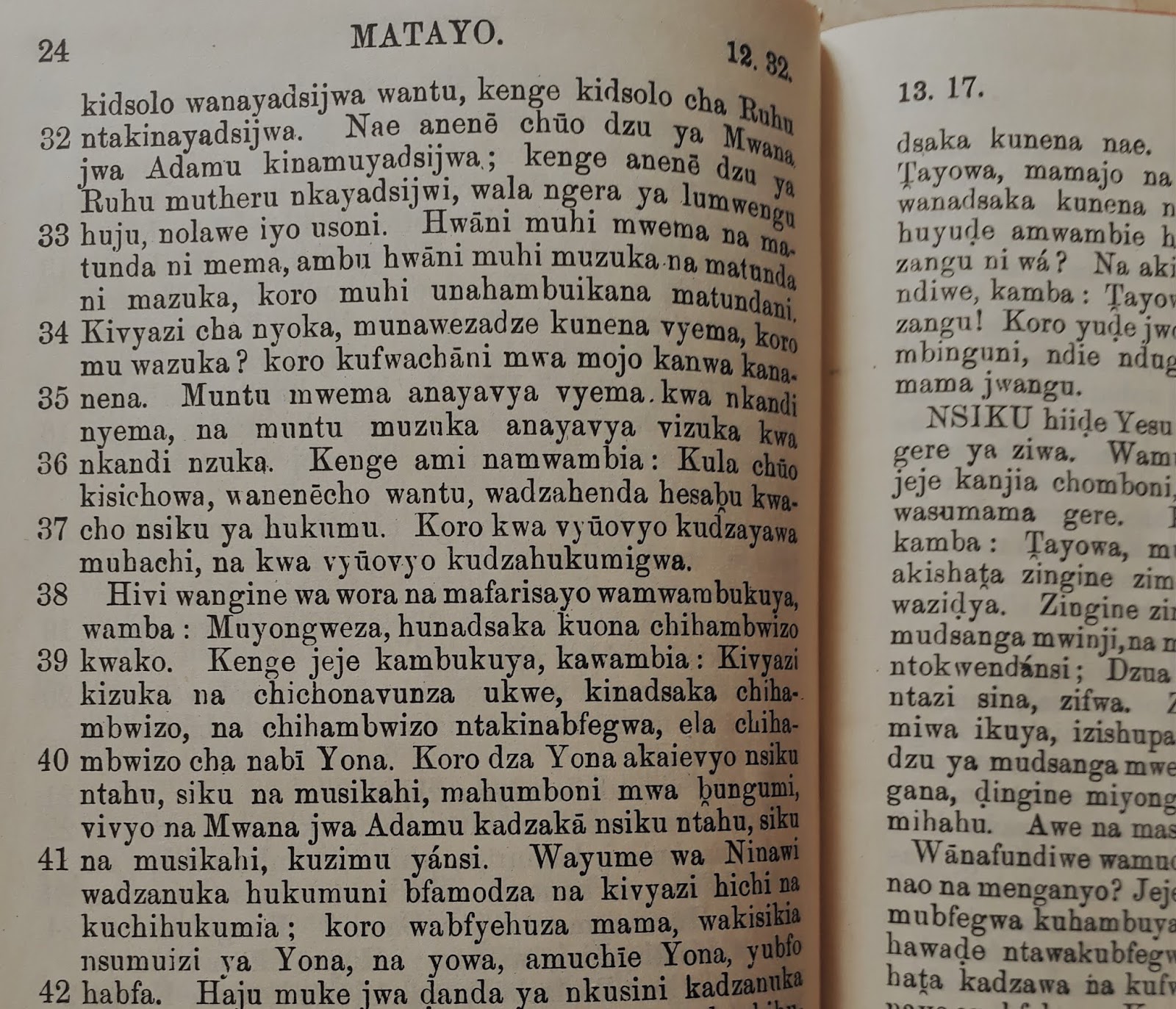
The British and Foreign Bible Society 1901. Chuo cha Ḍamano Ibfya ḍya Ḇwana na Mubfonya Jwehu Yesu Kristo [Pokomo New Testament]. London: The British and Foreign Bible Society.

'Whale' in Pokomo, Matthew 12: 40

TUKI 1981. Kamusi ya Kiswahili Sanifu. Dar es Salaam: Oxford University Press.

TUKI 2019. Kamusi ya Kiswahili-Kiingereza. Online at http://www.elimuyetu.co.tz/subjects/arts/swa-eng/index.html.

TUKI 2019. English-Swahili Dictionary. Online at http://www.elimuyetu.co.tz/subjects/arts/eng-swa/index.html.

Walsh, Martin T. 1995/96. The ritual sacrifice of pangolins among the Sangu of south-west Tanzania. Bulletin of the International Committee on Urgent Anthropological and Ethnological Research 37/38: 155-170. Online at https://www.academia.edu/708993/The_ritual_sacrifice_of_pangolins_among_the_Sangu_of_south-west_Tanzania.

Walsh, Martin T. 2004. Variability and compounding of affixes in Hehe animal names (Tanzania). Paper presented to the 34th Colloquium on African Languages and Linguistics (CALL 34), Leiden University, 23-25 August. Online at https://www.academia.edu/1691467/Variability_and_compounding_of_affixes_in_Hehe_animal_names_Tanzania_.

Walsh, Martin T. 2007. Pangolins and politics in the Great Ruaha valley, Tanzania: symbol, ritual and difference / Pangolin et politique dans la vallée du Great Ruaha, Tanzanie: symbole, rituel et différence. In E. Dounias, E. Motte-Florac and M. Dunham (eds.) Le symbolisme des animaux: L'animal, clef de voûte de la relation entre l'homme et la nature? / Animal Symbolism: Animals, Keystone of the Relationship between Man and Nature? Paris: Éditions de l’IRD. 1003-1044. Online at http://horizon.documentation.ird.fr/exl-doc/pleins_textes/divers16-08/010041952.pdf.

Walsh, Martin T. 2018. The Swahili language and its early history. In S. Wynne-Jones and A. LaViolette (eds.) The Swahili World. Abingdon and New York: Routledge. 121-130. Online at https://www.academia.edu/36719077/The_Swahili_language_and_its_early_history.

Sunday, 27 February 2011

LITTLE FURRY MEN (AND WOMEN)

Greg Forth at work
I had a stimulating lunch last week with Gregory Forth, Professor of Anthropology in the University of Alberta in Canada. Greg's regional specialisation is Southeast Asia, and the Indonesian archipelago in particular, where he's undertaken long-term ethnographic research on the islands of Sumba and Flores. He's written extensively about indigenous religion and ritual, and more recently ethnozoology and cryptozoology, as the following passage outlines:

In addition to numerous journal articles, this research has resulted in a monograph on folk ornithology (Nage birds, 2004) and has contributed substantially to another book entitled Images of the wildman in Southeast Asia (2008). [...] A major focus of the latter work is indigenous representations, found on Flores island and elsewhere, of hominoid creatures bearing a remarkable resemblance to palaeoanthropological reconstructions of pre-sapiens hominins. While conducting fieldwork on Flores in the 1980s, Professor Forth recorded information concerning a putative beings, now reputedly extinct but surviving in historical memory of local people; these have since been hypothetically linked with the fossil hominin, interpreted as a new species, Homo floresiensis, discovered by palaeoanthropologists working in western Flores in 2003. (University of Alberta Field Research Office: links added)

In more ways than one this is a fantastic subject, and Images of the Wildman a fascinating study (for an informed assessment see Andrew Strathern and Pamela Stewart's review in Anthropos 105 (2) (2010)). A significant part of the book is devoted to a survey of wildman rumours and traditions outside Southeast Asia, including a section on East Africa. I was fortunate to be one of the scholars Greg consulted when he was writing this, though we hadn't met until he visited Cambridge last week. With his blessing this section is copied in full below.


East Africa and the 'little furry men'

[from Gregory Forth, Images of the Wildman in Southeast Asia: An Anthropological Perspective (Routledge, 2008), pp. 217-220 (main text), p. 307 (footnotes).]

Besides Southeast Asia, Africa is the only region of the world that is home to great apes, including chimpanzees (Pan troglodytes), bonobos (Pygmy chimpanzees, Pan paniscus) and Lowland and Highland Gorillas (Gorilla gorilla and Gorilla beringei). The continent is also the site of possible early or ancient encounters of European and circum-Mediterranean peoples with large primates, perhaps most famously exemplified by Hanno's periplus (Yerkes and Yerkes 1929: 2-3; Reynolds 1967: 29-31). If apes are a significant source of wildman images, therefore, one might expect Africa to provide numerous exemplars. And if surviving or remembered pre-sapiens hominins were their hypothetical origin, then Africa, as the major locus of human evolution, should be prominent for this reason as well.

Unabridged English translation (1958)
Recorded both in areas where apes are attested and in regions where they are not, reports of African hominoids have been comprehensively reviewed by Bernard Heuvelmans (1980). One source is a report by Captain William Hichens, an Englishman and former civil servant, who in the 1920s, while hunting lions in the Wembere region of west central Tanzania, observed two creatures emerging from dense forest. Resembling 'little men', the creatures were tailless, covered in 'russet' hair, stood about 1.2 metres tall and walked erect (Hichens 1937: 373). Evidently familiar with local primate life, Hichens remarks that the creatures may have been monkeys, but 'were no ordinary monkeys, nor baboons, nor colobus, nor Sykes, nor any other kind found in Tanganyika' (ibid.). Wembere, it should be noted , lies east of the normal range of chimpanzees and gorillas. Hichens' efforts to follow the hominoids were in vain. Reacting with 'mingled fear and amazement', a native hunter accompanying the Englishman also saw the creatures. He identified them as 'agogwe', rarely encountered beings which, according to what villagers later told Captain Hichens, will weed and hoe people's gardens at night in exchange for food and millet beer.

These particulars suggest that the 'little furry men' are a category recognized by local Tanzanians. Yet available ethnography does not confirm that East Africans maintain a representation labelled 'agogwe' which substantially accords with the physical image reported by Hichens. Nor is it entirely clear from which language the name 'agogwe' derives. Hichens briefly mentioned his sighting in an earlier article, where he writes the name as 'ngogwe'. He appears to gloss this term as 'little men of the trees' and to identify it as a usage of the Iramba (or Nilamba) people (1928: 176). It is also in this article that Hichens specifies the creatures as tailless. Evidently drawing on Iramba lore, he further describes the 'ngogwe' as 'wailing a strange chant' as they travel (ibid.).[13]

Heuvelmans compares Hichens' report to two other accouts of East African hominoids. One refers briefly to 'little red men' inhabiting the eastern Kenyan region of Embu. According to an African who claimed to have seen 'scores' of these beings, they will pelt human intruders with small stones (S.V. Cook 1924: 25); but noticeably missing from this account is any explicit reference to body hair. The same omission characterizes a later report from Mozambique. Writing in response to Hichens' article, another Briton described how, from the deck of a cargo boat in 1937 and with the aid of a telescope, he was able to observe two 'little brown men' between 1.2 and 1.5 metres tall walking on a beach among a troop of baboons (Burgoyne 1938: 51).[14] The baboons appeared undisturbed by their presence. Referring to a similar sighting by an unnamed friend, the author vaguely refers to a native injunction on shooting the little men.

Mt. Longonot crater
A somewhat more detailed sketch of putative hominoids is offered by a professional big-game hunter, Roger Courtney (1940: 37-49) and concerns apelike creatures called 'mau men'. Found in the vicinity of Mount Longenot [Longonot] in Kenya, the beings were described to Courtney by his guide, a Muslim of mixed Boran and Mkamba descent named Ali (1940: 37-49). Ali had heard the story from his then deceased father, who claimed to have been struck over the head and abducted by a group of mau men while tending sheep on the slopes of the mountain, described as an old volcano full of caves. In this account, the mau are characterized as small, apparently tailless creatures resembling 'monkeys' more than humans. While their skin was 'white', their bodies were covered in long 'black' hair. Hair also hung over the eyes. The reputed eyewitness encountered the mau sitting on ledges inside a cave, around a central fire. Characterized as forest dwellers, the creatures are further described as reaching their caves by way of long underground passages. Apart from the fire and sticks and stones which they employed as weapons, the mau appeared to possess no technology; as Ali points out, they may even have obtained the fire from a natural volcanic source. Chattering like monkeys, they also seem to have lacked an intelligible language. The only indication of their diet is the sheep stolen from Ali's father.

Ali's father explicitly distinguished the mau from less 'wild' pygmies residing in the forests to the west of Lake Victoria, whom he had encountered in his travels. Indeed, in all respects except the use of fire and occupation of caves, the beings sound very much like chimpanzees, which can be similarly light-skinned and with which the shepherd may also have been familiar from his westward journeys. Although caution is always required in translating local colour terms, the long 'black' hair of the mau contrasts with that of the russet-haired agogwe. Even so, since normally dark-haired chimpanzees occasionally possess brown or reddish pelage, wayward chimps, straying some 200 kilometres beyond the eastern limit of their normal range in western Kenya, could conceivably explain Hichen's experience as well. Less readily accounted for is the hair hanging over the eyes of the mau. However, it is a point of interest that exactly the same feature is attributed to hominoidal beings reported from Central Africa.

Maasai X-files
Different from other East African images are hominoids - most of them apparently quite human (see Heuvelmans 1990a) - that numerous Maasai and other Kenyan tribesmen described in the 1970s to the French anthropologist Jacqueline Roumeguère-Eberhardt (1990). Among these is a figure Roumeguère designates anonymously as 'XI' (there are five Xs altogether) and describes as hairy-bodied, possessing long head hair and huge feet, heavy set and extremely strong. The head hair is dark; the body hair is reddish-brown or fawn among younger specimens (who could conceivably be of a size comparable to Hichens' agogwe) but darker or sometimes grey in adults. Standing as tall as a human (1.3-1.85 metres) and occasionally taller, the creatures are further depicted as wielding huge clubs, killing buffalo and carrying away the carcasses, consuming raw flesh and possibly employing a language. Despite their size and strength, they are not aggressive towards humans. These reports, Roumeguère suggests, could reflect a surviving non-sapiens hominin such as Homo habilis or Homo erectus. In his Preface to Roumeguère's book, Heuvelmans (1990a: 26-34), on the other hand, suggests a robust Australopithecine (presumably a Paranthropus).

For a student of Florenese representations, probably the most remarkable feature of Roumeguère's book is a Maasai report of one sort of Kenyan hominoid (distinguished as 'X4') being offered milk in a gourd container and, 'perhaps mistaking it for a fruit', attempting to eat the gourd. It is perhaps curious that, unlike the agogwe and similarly small creatures, nothing like Roumeguère's anonymous hominoid was reported during the colonial period in East Africa. On the other hand, there is arguably some resemblance to the 'Nandi bear', an early twentieth-century British term for a mysterious creature named 'chimoset' by the Nandi of Kenya and sometimes described by European eyewitnesses as a 'big hairy biped' or 'an enormous baboon' (Heuvelmans 1995: 490).[15]


Notes

[13] I am grateful to [x1] of Cambridge University for alerting me to Hichens' 1928 article. As is general in Bantu languages, the initial /a/ in 'agogwe' would appear to be the general noun class prefix for humans or humanlike beings. But since this is also applied to animals in some Bantu languages, it is not certain that the word denotes something locally classified as human, or even hominoid (Walsh, pers. comm., September 2006). On the other hand, the initial /n/ in 'ngogwe' is the usual Bantu prefix for nouns denoting animals; and in this connection, Walsh has suggested that, if 'agogwe' is not a misprint, Hichens may have substituted this for 'ngogwe', perhaps by way of correctio, in his 1937 piece. Referring to the Tanzanian Ihanzu people, Todd Sanders of the University of Toronto mentions as a possible comparison the term 'ahing'wi', denoting aboriginal but now invisible 'bush-dwelling creatures' that Ihanzu describe as having bodies divided laterally between a human half and a wooden half consisting of a log. The figure thus suggests the widespread image of the 'half-man' (see Needham 1980) and the partly vegetal 'green man', often considered a variant of the European wildman. Sanders further remarks that, as the Ihanzu word for 'log' is 'igogo', this image could conceivably be the source of Hichens' 'agogwe'. Another peculiarity of ahing'wi is their ability to produce porridge, milk, or meat from rocks, which they then leave in the bush for humans they favour (Sanders, pres. comm., September 2006) - an idea that suggests an inversion of the agogwe practice of receiving beer from people for whom they perform agricultural labours.

[14] Although Burgoyne entitles his article 'little furry men', this simply replicates Hichens' usage and Burgoyne does not actually describe the figures he saw as hairy.

[15] As the English name should suggst, other colonials likened the animal to a bear (no species of which is found in Africa). Heuvelmans reviews evidence suggesting that the Nandi Bear may indeed be a member of the Cynocephala (baboons and allies) of an unknown species (1995: 473-75); but in the end he favours an old and rather large ratel, or 'honey badger' (family Mustelidae), as the main source of the representation.


 References

Burgoyne, Cuthberet 1938. Little furry men. Discovery 19: 51.

Cook, S. V. 1924. The leprachauns of Kwa Ngombe. Journal of the East [Africa and Uganda Natural] History Society 20: 24.

Courtney, Roger 1940. A Greenhorn in Africa. London: Herbert Jenkins Limited.

[Forth, Gregory. 2004. Nage Birds: Classification and Symbolism among an Eastern Indonesian People. London and New York: Routledge.]

[Forth, Gregory. 2008. Images of the Wildman in Southeast Asia: An Anthropological Perspective. London and New York: Routledge.]

Heuvelmans, Bernard 1980. Les bêtes humaines d'Afrique. Paris: Plon.

Heuvelmans, Bernard 1990a. Preface to Roumeguère-Eberhardt.

Heuvelmans, Bernard 1995. On the Track of Unknown Animals. Revised third English edition. London and New York: Kegan Paul International.

Hichens, William 1928. Africa's mystery beasts. The World Wide Magazine 62 (no. 369): 171-76.

Hichens, William 1937. African mystery beasts. Discovery 18: 369-73.

Reynolds, Vernon 1967. The Apes: The Gorilla, Chimpanzee, Orangutan and Gibbon - their History and their World. New York: E.P. Dutton & Co.

Roumeguère-Eberhardt, Jacqueline 1990. Le dossier X: les hominidés non identifiés des forêts d'Afrique. Paris: Editions Robert Laffont.

[Strathern, Andrew J. and Pamela J. Stewart. Review of Forth 2008. Anthropos 105 (2): 636-637.]

Yerkes, Robert M. and Ada W. Yerkes 1929. The Great Apes: A Study of Anthropoid Life. New Haven, CT: Yale University Press.