Showing posts with label Zanzibar. Show all posts

Saturday, 10 April 2021

A CIVET HUNT IN PEMBA

by Helle V. Goldman

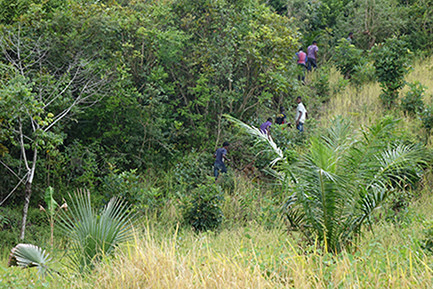
The hunters heading back to Tandavili after our first encounter (photo Helle V. Goldman)
The Small Indian Civet (Viverricula indica) is widespread in Asia, from Pakistan in the west to easternmost China, and from the Sundaic region in the south to the Himalayan foothills in the north (Choudhury et al. 2015). Its perineal gland secretions prized as a perfume and medicinal ingredient in southern Asia, the Small Indian Civet was imported – most likely from the Indian subcontinent – by traders to various places in the Western Indian Ocean (Gaubert et al. 2017). At some unknown point in the past, this included Pemba, the northern island in the Zanzibar archipelago (Moreau & Pakenham 1941; Pakenham 1984; Walsh 2007; Choudhury et al. 2015).

Like other species of mammals introduced to Pemba, Small Indian Civets became naturalised on the island. These crepuscular–nocturnal small carnivores were frequently observed early in the morning or late in the evening by Pakenham, a colonial officer stationed in Zanzibar from the late 1930s through WWII; “if one stood motionless it would pass very close”, he wrote (Pakenham 1984: 46). (What some Zanzibaris made of Pakenham’s keen interest in observing wildlife and collecting animal specimens may be surmised on the basis of the account of an elderly Pemban, who told me in 1993 that Pakenham was remembered for catching spirits in bottles. It is likelier that he was after insects.) According to Pakenham, Small Indian Civets were common on both Unguja and Pemba, the main islands of the archipelago. Yet I never caught sight of one during my anthropological fieldwork in Pemba in the early 1990s, and camera-trapping on Unguja in 2003 (Goldman & Winther-Hansen 2003), 2017, 2018 (Goldman & Walsh 2019a) and 2019 (unpublished) turned up no traces of Small Indian Civets.

Mauwa and her aunt Raya in 1993 (photo: Helle V. Goldman)
When I returned in July 2019 to Mzambarauni, in north-central Pemba, to follow up on my earlier studies with additional anthropological research, I did not anticipate that the opportunity to observe a civet hunt would come my way. The chance presented itself when I tagged along with Mauwa and a handful of her younger kin to her rice field south of Mzambarauni. I had first known her in 1992, when I lived in the thatched wattle-and-daub house across from Mauwa’s aunt. 

On our way to the rice farm, we walked in single file on the path as we headed south from the village, exchanging greetings with folks encountered en route. Some worked singly or in twos in their fields. Others collected fruit or firewood. A few led zebu cows. We passed through a patchwork of small cultivated fields and forest – a hodge-podge of wild trees and shrubs and clove, fruit and lumber trees. Some of the cultivated trees appeared well tended; most were overrun by wild vegetation.

Mauwa and her adult daughter harvest rice (photo: Helle V. Goldman)
At Mauwa’s rice plot, we deposited our gear in the small patch of shade offered by the low open-sided thatched hut beside the field. I made myself useful by planting the spinach seedlings that Mauwa had brought with her in a sack, putting them in the ground that she had previously prepared for this purpose. While the women set to work in the rice field, Rayani – the young daughter of Mauwa’s eldest son – and I played a game with twigs and pebbles that we invented on the spot. A soft-spoken settler from the mainland who cultivated a nearby field came by to exchange pleasantries and drink from the muddy spring next to Mauwa’s field. One of the women harvesting rice found the nest of a Black-winged Red Bishop (kweche; Euplectes hordeaceus) in the field. The red bishop feeds on rice and farmers consider the bird a pest.

Black-winged Red Bishop nest and eggs (photo: Helle V. Goldman)
Mauwa took a short break to boil a small pot of thin rice gruel. I took a few sips of the refreshing porridge from my cup and gave the remainder to Rayani, who seemed to be hungry. Back in the field again, the women chatted non-stop while the heaps of rice ears grew high on the mats. They were periodically carried to the side of the field, stuffed into a sack and beaten with a stout stick to separate the rice grains from the stalks. (The husks would be removed later.) I worked much less efficiently than my companions, though Mauwa heartily extolled my rice-harvesting skills to passersby, which made me laugh.

Suddenly the chaotic sounds of people whooping, dogs yipping and branches crackling reached us from the forest edging the rice field. “What’s going on?” I asked Mauwa. Her small knife never slowing as she clipped off ears of rice from the tall stalks, she told me that it was just youths out after wadudu.

Mauwa harvesting rice (photo: Helle V. Goldman)
Depending on the context, wadudu (singular mdudu) is a term for insects and other small invertebrates (including disease-causing parasites), small reptiles or undesirable wildlife of various sizes, and unspeakable creatures whose names can’t be mentioned. For example, on Unguja, Leopards (Panthera pardus) are sometimes referred to cagily as wadudu, the speakers avoiding explicitly naming the greatly feared animal, which has now in all likelihood been extirpated from the island (Goldman & Walsh 2019b). There is no single English equivalent that covers all these senses of the Swahili word, but “varmints” conveys what Mauwa meant in this case.

When I asked her to clarify which wadudu the boys were hunting, she said they were going for ngawa. On Unguja, ngawa refers to the African Civet (Civettictis civetta), a small carnivore species that I camera-trapped in 2003 in Jozani–Chwaka Bay National Park (Goldman & Winther-Hansen 2003, 2007). On Pemba, where there are no African Civets, ngawa refers to the Small Indian Civet (Viverricula indica).

Small Indian Civet, camera-trapped near Ngezi (photo: Helle V. Goldman)
A few days before, I had asked Ilaria Pretelli, a friend doing research in a village at the edge of Ngezi Forest, near the north-western tip of Pemba, to set up my camera trap near her house for a couple of nights. The trap netted a single video of a Small Indian Civet. Later, the trap was moved to inside Ngezi, where another civet was captured on video.

As I snatched up my notebook and camera and dashed off into the bush to find the hunters, Mauwa called out to give them a head’s up: a European was coming to talk to them. I found the youths close by. They had killed a civet just minutes before. One of the young hunters held up the specimen for me to photograph. The group comprised about ten youths in their teens and early twenties, accompanied by their dogs. Having successfully bagged a civet, the boys were eager to go home and rest but some of them allowed me to briefly detain them so I could ask some questions.

Three of the young hunters and their catch (photo: Helle V. Goldman)
I learned that they hailed from Tandavili, which was the closest village. They comprised a loosely organised group of friends that had started out by catching the civets that bothered their household chickens. Later they expanded their activities to the bush surrounding the settlement. Every three or four days they set out to hunt Small Indian Civets, Marsh Mongooses (chonjwe; Atilax paludinosus), Vervet Monkeys (tumbili; Chlorocebus pygerythrus) and snakes of any variety. These are all animals deemed harmful to people (snakes), crops (vervets) or poultry (civets and mongooses). Sometimes they also go out singly or in pairs to hunt birds with slingshots.

The dead civet (photo: Helle V. Goldman)
Whatever the hunters catch, they feed to the dogs, they said. None of the targeted species contains anything of medicinal value, they told me, and none of the meat is consumed by people in the area. (Although there are local exceptions (Walsh 2007), Islam prohibits the consumption of reptiles, monkeys and animals bearing fangs, i.e. carnivores.) The dead civet whose killing I had arrived just too late to witness was going to be roasted over a fire to remove the fur and then given to the dogs. (The dogs looked like they would have benefited from a good meal.) I gave the most talkative of the youths the telephone number of my hostess in Mzambarauni and he agreed to call the next time they were going hunting.

Hunting (photo: Helle V. Goldman)
According to Walsh (2007), clubs that hunted civets were active at least up to the 1990s. Information about such groups and their activities is scant. During his stay on Pemba over a hundred years ago, Craster heard of Wild Boar (nguruwe; Sus scrofa) hunts there: “they told me that a party of men armed with big knives would start out with as many dogs as they could collect, and walk through the bush till the dogs found a pig” (1913: 284). The boars, which had been introduced centuries earlier by the Portuguese, were not eaten by Muslim islanders; the flesh was given to the dogs, and non-Muslim Africans ate it too. Other species taken opportunistically, such as the Blue Duiker (paa; Cephalophus monticola), were eaten irrespective of religion (Walsh 2007: 88).

Hunting dogs (photo: Helle V. Goldman)
Writing about 20 years after Craster, Wilson observed that the main method of hunting pigs – animals viewed by the colonial authorities as a serious impediment to agricultural production – was with spears and dogs; pit-traps and snares may also have been used (1939: 48). He complained that hunting was “often regarded [by Zanzibaris] more as a sport than the reduction of a pest”. Along with setting out poison to reduce the pig population, the British “encouraged the various pig hunting clubs by the offer of prizes and rewards” (Wilson 1939: 49). Although the resulting boost in hunting activity was short-lived, hunting continued on both islands. By the time of my visit in 2019, Pembans whom I asked said that all, or almost all, of the island’s boars had all been killed and consumed by villagers of Makonde origin, whose roots lay in south-east Tanzania and northern Mozambique.

Hunters crossing Mauwa's rice field (photo: Helle V. Goldman)
After answering my questions, the band of youths crossed Mauwa’s rice field and vanished among the trees on the opposite hillside. Days passed while I investigated family histories and other matters that had nothing to do with wildlife in Mzambarauni. Two days before my departure from Pemba, when I had given up hope of hearing from the young hunters, one of them rang my hostess in the evening with a message for me: the boys were going hunting the next morning. I was to meet them in Tandavili at six if I wanted to come along.

With considerable reluctance, my hostess unbarred and unlocked the front doors of her house and let me outside at 5.30 the following morning. She wasn’t happy about me setting off in the predawn dark and “cold” (it was about 18°C). I knew that she was concerned for my safety. In Pemba, malevolent spirits, often operating at the command of witches, are believed to be common. To walk alone in the night invites trouble. She was only slightly reassured by the knowledge that I was going to meet up with my assistant on the way.

Two of the hunting dogs, one with an amulet (photo: Helle V. Goldman)
It was light by the time we reached Tandavili. With the kind assistance of several villagers, we located the dozen or so youths who were setting out to hunt that day: some were just tumbling out of bed and pulling shirts over their heads upon our arrival, while the others had already loosely assembled at the edge of the forest. The informal leader of the group was a young man who went by the moniker Maasai. Another member was nicknamed Tekno. He brought his dogs Fanta, Ready and Simba. Another boy was known as Taekwondo, who came with his dog Ashoo. Then there was Abdalla and his dog Sharo. Ahmed, otherwise known as Hosama, and his friend Hamadi brought their shared dog Firimbo. Unlike the other dogs, Firimbo was on a lead because she had pups and would peel off to rejoin them if given half a chance. The dogs were small and nervous and some of them were thin. They seemed accustomed to ungentle handling.

The hunters pause to consider their next move (photo: Helle V. Goldman)
The group moved almost without pause, up steep forested hills, down into rice valleys, through mud and streams, across humpy cassava fields, and into dense stands of trees and undergrowth. The morning dew made the going slippery in places. Striving to keep up with lean young men one-third of my age (none of whom had my complement of double hip replacements and a reconstructed anterior cruciate knee ligament), I took photographs and video only when the group slowed down and was in fairly open, flat terrain. When I lost sight of the hunters in the thicket or they temporarily broke apart, the dogs’ yapping and the racket the youths made – a continuous stream of whoops, exhortations and loud popping vocalisations (alveolar clicks?) aimed at exciting the dogs – allowed me to keep tabs on them.

Early on, excitement ran high as the dogs surrounded an animal in a clump of thicket (this occurs in the video below at about the 48-second mark). When the hunters realised it was a bushbaby (komba; Otolemur garnettii, aka Greater Galago) they left it and drew the dogs away. They don’t bother with bushbabies – not even to feed to the dogs – since these small nocturnal primates are not considered pests.

The hunt was called off about an hour and a half later. There had been no takings that day. According to the youths, this is not an uncommon outcome: on some hunts they kill one or two civets or other varmints, but more often they go home empty-handed. They attributed this to the effectiveness of their hunting forays. There was more I would have liked to inquire about, but I could not keep the young men from their breakfasts any longer. 

References

Choudhury A., Duckworth J.W., Timmins R., Chutipong W., Willcox D.H.A., Rahman H., Ghimirey Y. & Mudappa D. 2015. Viverricula indica. The IUCN Red List of Threatened Species 2015: e.T41710A45220632. https://dx.doi.org/10.2305/IUCN.UK.2015-4.RLTS.T41710A45220632.en. Downloaded on 12 March 2021.

Craster J.E.E. 1913. Pemba, The Spice Island of Zanzibar. London: T. Fisher Unwin.

Gaubert P., Patel R.P., Veron G., Goodman S.M., Willsch M., Vasconcelos R., Lourenço A., Sigaud M., Justy F., Joshi B. D., Fickel J. & Wilting A. 2017. Phylogeography of the Small Indian Civet and origin of introductions to Western Indian Ocean islands. Journal of Heredity 108: 270–279.

Goldman H.V. & Walsh M.T. 2019a. First videos of endemic Zanzibar servaline genet Genetta servalina archeri, African palm civet Nandinia binotata (Mammalia: Carnivora: Viverridae) and other small carnivores on Unguja Island, TanzaniaJournal of Threatened Taxa 11(10), 14292-14300.

Goldman H.V. & Walsh M.T. 2019b. Classifying, domesticating and extirpating the Zanzibar leopard, a transgressive felidNorsk Antropologisk Tidsskrift (Norwegian Journal of Anthropology) 30 (3-4): 205-219.

Goldman H.V. & Winther-Hansen J. 2003. First photographs of the Zanzibar servaline genet Genetta servalina archeri and other endemic subspecies on the island of Unguja, TanzaniaSmall Carnivore Conservation 29: 1–4.

Goldman H.V. & Winther-Hansen J. 2007. Lights, camera, actionAfrica Geographic 15: 24–25.

Moreau R.E. & Pakenham R.H.W. 1941. The land vertebrates of Pemba, Zanzibar, and Mafia: a zoogeographical study. Proceedings of the Zoological Society of London 110: 97-128. 

Pakenham R.H.W. 1984. The Mammals of Zanzibar and Pemba Islands. Harpenden: privately printed.

Walsh M.T. 2007. Island subsistence: hunting, trapping and the translocation of wildlife in the Western Indian Ocean. Azania 42: 83-113.

Wilson F.B. 1939. Notes on Peasant Agriculture and Industries in Zanzibar Island. Zanzibar. National Archives, File no. AU2/54.


Monday, 22 February 2021

ZANZIBAR'S VIRAL UNDERGROUND

by Martin Walsh

The walkway between caves at Mchekeni, Zanzibar (photo: Martin Walsh)

I worry about caves. I’ve been worrying about them ever since reading about the role played by Kitum Cave in the known history of Marburg virus disease. In the 1980s, two separate visitors to this “elephant cave” in Mount Elgon National Park were infected and subsequently died. Egyptian fruit bats (Rousettus aegyptiacus) have since been identified as a reservoir host for marburgviruses, and it may well be that the inhalation of microbes from bat guano was the means by which these unfortunate tourists contracted the deadly disease.

I’m also fascinated by caves: they’re contagious in more ways than one. The islands of the Zanzibar archipelago, with their extensive limestone reef terraces, are riddled with caves and sinkholes. They’re a distinctive feature of the coral rag or karst landscape of both Unguja and Pemba, though often hidden from sight by thick vegetation, especially along the forested scarps in the south and east of the main island. Many of the caves have cultural significance as mizimu, the abodes of spirits that are regularly propitiated by the local guardians who have inherited this responsibility.

Entering one of the caves at Ufufuma (photo: Martin Walsh)

I wasn’t really aware of either the abundance of caves or the extent of this practice until Helle Goldman and I began researching knowledge and beliefs about the Zanzibar leopard (Panthera pardus adersi) in 1996. There’s a strong association between leopards and caves, because of the spiritual significance of both and the fact that leopards were believed to be often found in and around them. In some cases, leopards themselves are the spirits that subterranean offerings are made to. 

More recently, Maximilian Chami and others have begun documenting these and other sacred sites, though we’re far from possessing anything like an inventory or gazetteer. Following his father Felix Chami’s pioneering excavations, caves have also been providing us with remarkable insights into Zanzibar’s past, including the people and fauna of Unguja before it became an island. I’ve been a minor contributor to discussions about some of the emerging zooarchaeological evidence – and I look forward to more.

Unsurprisingly, some of the limestone caves on the eastern side of Unguja are now tourist venues. The impressive Mchekeni Caves, in the Kiwengwa-Pongwe Forest Reserve, have been open since 2006, though visitor numbers can be very low. Other caves have been developed privately. Kuza Cave in north Jambiani is more like a rock shelter or overhang (presumably exposed by an earlier collapse), with a beautiful turquoise pool that tourists are encouraged to swim in. The caves at Ufufuma, roughly halfway between Mchekeni and Kuza, are used by a traditional healer (mganga), who also entertains fee-paying tourists.   

Bats in the south cave at Mchekeni (photo: Martin Walsh)
Whenever I’ve visited Mchekeni, I’ve felt distinctly uneasy penetrating deep into the southern cave. This is not because there’s no path and it’s unlit, it’s because I’m thinking about bats. There are plenty of small bats clinging to the walls, harmless enough. But I can’t help but wonder about the viruses they might be carrying. Spillover events may be rare, but as the ongoing global pandemic has painfully reminded us, they can happen, and bats are, for better or worse, the reservoir hosts of numerous viruses, SARS-CoV-2 included.

Perhaps I should be more worried about the fruit bats hanging in the trees, and the fruit that they may have slobbered or defecated on. Or fretting about Pemba, where flying foxes (Pteropus voeltzkowi) and other bats have traditionally been hunted as bushmeat. Who knows what harms this may have caused in the longue durée of island history? Of course, Zanzibar has more pressing public health problems to deal with in the present. Sooner or later, though, Zanzibar and Tanzania will have to start thinking about the biosecurity of the growing number of caves on the tourist trail. Next time I go down there, I’m wearing a mask.

Further reading

Bardenwerper, Julie 2009. Spirits and Sacred Sites: A Study of Beliefs on Unguja Island. SIT Study Abroad, Independent Study Project (ISP) Collection. Paper 759.

Chami, Maximilian F. 2019. “Sacred Limestone Caves”: Management and the Use of Sacred Heritage Places in Limestone Cave Areas along the Swahili Coast of Indian Ocean in Tanzania. Unpublished PhD dissertation, Brandenburg University of Technology Cottbus–Senftenberg.

Chami, Maximilian F. & Felix A. Chami 2020. Management of sacred heritage places in Tanzania: a case of Kuumbi limestone cave, Zanzibar island. Journal of Heritage Management 5 (1): 71-88.

From the Kuza Cave website, www.kuzacave.com
Faulkner, Patrick et al. 2019. Long-term trends in terrestrial and marine invertebrate exploitation on the eastern African coast: insights from Kuumbi Cave, Zanzibar. The Journal of Island and Coastal Archaeology 14: 479–514.

Goldman, Helle & Martin Walsh 2019. Classifying, domesticating and extirpating the Zanzibar leopard, a transgressive felid. Norsk Antropologisk Tidsskrift 30 (3-4): 205-219.

Prendergast, Mary E. et al. 2016. Continental island formation and the archaeology of defaunation on Zanzibar, eastern Africa. PLoS One 11 (2): e0149565.

Quammen, David 2012. Spillover: Animal Infections and the Next Human Pandemic. London: Vintage Books.

Walsh, Martin 1995. Eating bats on Pemba island: a local innovation or cultural borrowing? Mvita: Newsletter of the Regional Centre for the Study of Archaeology in Eastern and Southern Africa 6: 15-18.

Walsh, Martin 2011. From green monkey disease to fruit bat viruses. East African Notes and Records, 26 December 2011.

Walsh, Martin & Helle Goldman 2007. Killing the king: the demonization and extermination of the Zanzibar leopard. In E. Dounias, E. Motte-Florac & M. Dunham (eds.) Le symbolisme des animaux: L'animal, clef de voûte de la relation entre l'homme et la nature? Paris: Éditions de l’IRD. 1133-1182.

Saturday, 20 February 2021

JOZANI-CHWAKA BAY NATIONAL PARK AND COVID-19

by Jonathan Walz

Evidence of beach erosion due to climate change at Paje (photo: J. Walz)


In Zanzibar, 2020 was a unique and impactful year. Covid-19 raised challenges for the state and its communities and environments. Compounded climate change and the national elections in October added stresses. The spring high tide event in mid-October (4.68m tidal change amplified by sea level rise) demonstrated that incremental increases to sea level during the last two decades have real world effects, including breached beach crests, saline wells, and inundated agricultural fields. Dramatically reduced tourism on Unguja and tourist revenue, alongside the aforementioned stresses, influenced biodiversity and the management of protected areas.

National parks around the world face multiple challenges during the global pandemic. For instance, significantly reduced staffing due to a decline in income from tourism influences parks’ capacities and plans to effectively enforce protections, facilitate scientific research, and ensure upkeep. In addition, and as a core threat to global biodiversity, administrators and observers of protected areas cite a parallel uptick in illicit activities that continue to degrade environments, species, and the human-environment interface: land grabs, deforestation for firewood and charcoal-making, animal poaching, an intensification of the illicit trade in wildlife and wildlife products, and the illegal mining of rare minerals and construction materials.

Burned bee honeycomb at Jozani (photo: J. Walz
“Biodiversity” is high species richness and evenness, which is equated with ecosystem health, productivity, stability, and resistance to disturbances, including disease. In general, biodiversity hotspots in Zanzibar – terrestrial and marine – are understudied (scholarly investigations in the archipelago being skewed to social and historical topics). Thus, biodiversity in the archipelago faces threats even before its is thoroughly understood. The sickness, death, and social disruption of the pandemic continue to act on the economically impoverished society and on the uncertainties spurred by climate change. Impacts from climate change are apparent: temperature increase (1.2 degrees Celsius since 1997), reduced rainfall with uncertain distribution, consistent sea level rise (0.28 cm/per year since 2009), and coastline and reef degradation. During the pandemic, pressures on the urban economy and food security in Zanzibar City have increased human and environmental vulnerability and changed behavior.

Up to January 2021, although human mortality and Covid-19 infections seemingly have been lower across eastern Africa than in areas of the Americas, Europe, and South Asia, nevertheless there have been negative outcomes in the region, for instance increased food insecurity and growing strains on health systems and natural resources. However, generalized statements about the pandemic’s impacts to nature conservation in Africa and the Global South more broadly deserve scrutiny and critique. What negative impacts to protected areas are being underemphasized in reports and what conservation positives have arisen during the pandemic?

Red colobus monkeys at Jozani (photo: J. Walz)
The Zanzibar archipelago, a semi-autonomous region of Tanzania, has a single national park which serves as a useful case for analysis: Jozani-Chwaka Bay National Park and Biosphere Reserve. Jozani (for short) is an accessible park which in the last two years (2018 and 2019) has received more than 60,000 visitors per year. In April 2020 (during the first global peak in Covid-19), there were 14 total visitors to the park: less than 0.5% the number of visitors in April 2019. Diminished tourism revenue resulted in a temporary 50% reduction in park staff which influenced monitoring and enforcement, park upkeep, and public engagement. Urban job loss and modest food insecurity on Unguja redistributed some residents from nearby Zanzibar City to the countryside near the national park. Schools were closed which left children at home throughout the day to help gather natural resources for these larger households at the park’s edges. In addition, poachers used the ocean – not just land – to access remote areas, a practice previously documented primarily on Unguja’s sister island to the north: Pemba. Ad hoc observations and interviews with rangers documented that illicit activity increased, the evidence of which included tree stumps, cuttings from medicinal plants, shotgun shells, burned bee honeycombs, and traces of sand mining along the bay front.

However, positives for conservation and biodiversity have been lost in caricatures of the impacts of Covid-19. Absent tourists, monkey troops (especially Red colobus monkeys) at the national park reverted to less habituated behaviour. Farmers at the edges of the protected area reported fewer cases of damage to crops from park wildlife. Domesticated and feral animals were more visible, making them easier to humanely capture and relocate outside of park boundaries. In Chwaka Bay, intertidal species like octopus, a popular food served at tourist hotels, rebounded. On June 29, schools reopened; school groups became the primary park visitors and the focus of environmental education programs rather than secondary to the attention of overseas tourists. With few foreign-led NGOs in operation during the pandemic, a few of Zanzibar’s citizens stepped-in as agents of conservation at the park but also in Zanzibar City. They tended to public green spaces, outdoor areas less prone to transmit Covid-19.

Octopus and fisherman at Chwaka Bay (photo: J. Walz)
Biodiversity loss and socio-ecological instability increase vulnerability to on-going and future disasters. To overcome the disabling effects of Covid-19 and the compounding threats of climate change and other influential factors better promotion of evidence-based interdisciplinary study of coupled natural and human systems should be a priority. The multiple invested stakeholders should enforce protections to areas and species through standing or new policies, enhance resources for in-country experts to conduct and communicate research, bolster the health and wealth-being of people and environments through community “green” strategies, and collaborate with mindfulness to improve human livelihoods. The protection and restoration of biodiversity will improve adaptability to threats.

The public should be wary of simple narratives about Covid-19 and its impacts in Zanzibar and elsewhere. Covid-19 has not put threats to biodiversity “on hold”. However, at the same time, Covid-19’s outcomes have not been wholly negative.  As noted, during the pause in tourism, citizens of Zanzibar have initiated and developed conservation practices outside the orbit of ex-patriots, many of whom returned to their home countries due to the pandemic. At national parks in Africa and Indian Ocean island states, Covid-19 produces mixed conservation outcomes. Evidence builds more balanced and meaningful narratives that recognize the vulnerability and adaptability of people, ecosystems, and parks in an era of change.

Saturday, 17 October 2020

A FALLEN TREE IN STONE TOWN

by Jonathan Walz 

Forodhani Gardens, Zanzibar (photo: Martin Walsh)
I
On July 9, 2020, a large tree fell in the Vuga area of Stone Town, Zanzibar.* Its collapse was sudden and loud. People quickly gathered. The tree’s meaning to different people emerged in the subsequent three days as the tree was discussed, disassembled, hauled-off, reflected-on, and mourned. Clarity about the tree’s meaning and social role emerged from its death.

II
Unique trees are essential to societies in eastern Africa and throughout the world. From mainland Africa to Seychelles, the baobab, coco de mer, fig, and mango play roles in story-telling and ritual practice, not to mention their contributions to sustenance and medicine. Common English names for other trees with distinct uses and cultural significance – all found in contemporary Zanzibar – include, but are not limited to, the bodhi, breadfruit, camphor, cassia, cinnamon, clove, coconut, date, ebony, euphorbia (succulent), false ashoka, ficus, frangipani, Indian almond, kapok, mahogany, mangrove, neem, peepal, saman, tamarind, and teak.

Trees serve a multitude of purposes. Particular species provide shade or windbreaks. Trees can be ornamental. Large or old trees serve as shrines, house ancestors, or, for some societies, they can represent the center of the symbolic universe (i.e. an axis mundi). Trees can obscure visibility and sound, facilitating secrecy. The wood of some species can be used to make objects: posts, flooring, utensils, beehives, weapons, watercraft, musical instruments, and carvings. Many trees produce edible fruits, seeds, roots, leaves, saps, or gums or are consumed as timber for construction projects or for firewood, charcoal, or animal fodder. Extracts from trees can be employed as latexes, oils, dyes, hunting poisons, or incense. The cosmetic cabinets of Swahili women contain an assortment of tree products revered for their affordances.

Trees in Stone Town (photo: Jonathan Walz)
Large trees are visible and prominent, with high crowns that mark places of importance on the countryside or in cities. In Stone Town, multi-story architecture often obstructs viewsheds. There are no natural features other than trees to distinguish places from a distance, especially when viewed from the perspective of a pedestrian in the alleyways. In parts of Tanzania, forests serve as sacred groves or identify ancient settlements (see the scholarship of Elgidius Ichumbaki (2015), who suggests reconsidering the meaning of “archaeological site” using trees). Trees have meanings that stretch beyond their immediate times and locations; they can live on in place names, for example throughout Zanzibar (Myers 2016). 

III
The tree that fell in Vuga had a social life. It was planted by Khamis Salum in 2000. The Ficus benjamina - Weeping or Java Fig - has an origin in India, Malaysia, and Indonesia. This species is a large evergreen tree, 10-20 meters in height with drooping foliage. Hardy and fast-growing, it has a strong root system and bears orange to red berries (Dharani 2002).

The Weeping Fig functioned as a shade tree for nearby offices. Taxi drivers wedged everyday items in the openings in its trunk and among its lower branches. It was an attractive destination for urban animals, including a pair of Broad-billed Rollers, a colony of Yellow-headed Dwarf Geckos, and a Great Plated Lizard that lived in a stone wall at the base of its trunk. When it fruited, the tree attracted Greater Galagos and two species of fruit bat.

All of this ended when the tree fell. When it collapsed across a dirt road it landed without injury to people or property. Community members in the area gathered, taking photos in awe.

(photo: Jonathan Walz)
IV
After the tree’s collapse, three entities were contacted because each has purview over the trees of Stone Town, a World Heritage Site: the Stone Town Conservation and Development Authority, Urban Municipal Council, and Department of Forests and Non-Renewable Natural Resources. Discussions with the authorities documented the details of the tree and offered guidelines for the removal of its remains. Photographs were taken by authorities and its species confirmed. Then, clearance began. A representative from the Urban Municipal Council arrived on-site to observe a hired worker with a permitted chainsaw disassemble the tree. At 12 meters in height and almost a meter thick at breast height, the removal process of the tree spanned two days. This species produces soft wood useful as firewood (not charcoal), so its trunk and branches were carried away by community members. 

V
During subsequent days, two individuals independently visited the site of the tree fall and performed rites. The individuals were older men who discretely left items at its stump and spoke inaudible words. They stayed in the vicinity briefly. The Weeping Fig was a shrine to a spirit. The two visitors each left an offering (sadaka), including a small white cloth. This interpretation also explains the appearance of eggs and vials of rosewater at the base of the tree in previous years. The rite maintains harmony for an individual or community by preventing evil or pollution as a result of the demise of the mzimu, the Swahili name for a spirit dwelling.

Trees have specific meanings and uses to different stakeholders. This event should inspire conversations about the roles of trees, their socio-nature, urban environmental histories, and the symbolic and spiritual character of cities (Myers 2016: 83). Trees are physical and metaphysical anchors. Western perspectives on trees delimit and can erase other cultural meanings and uses of trees. While the built environment of Stone Town may be “of elsewhere” (Meier 2016), trees and green spaces in Zanzibar still yield deep significances that draw heavily from the African and Indian Ocean cultural intersections in Zanzibar. For instance, the words jini and shetani have Arabic roots, but pepo and mzimu have Bantu roots. These terminologies are variously used to indicate spirits or spirit dwellings among the Swahili. The cultural significance of these terms and the context of use are obscured when trees or green spaces and districts on the island are framed simply as areas of public enjoyment (or “parks”), which embraces a Western concept of nature and green spaces for urban Africa.

(photo: Jonathan Walz)
VI
The words, performances, and objects associated with special trees are essential for comprehension of their significance as heritage. The material approach to the fallen Weeping fig and its consumption (as firewood, and so forth) is understandable in a comparatively impoverished setting that has been culturally degraded by tourism. Yet, the performance of rites shows that even under these less than ideal circumstances, or, better yet, because of the circumstances, meaning persists. Using a case from Transkei, Throop (2003) articulates that from on-the-ground treatments of trees there is the potential to distil the surrounding power relations. In Zanzibar, this postulate applies to trees as central places of social practice that respond to colonial experience, the intersection of town-and countryside, and environmental change. Contradictions exist in the “heritagization” of Stone Town (Sheriff 2019). One everyday tension is the disproportionate emphasis placed by conservators on architecture (already questioned for its “authenticity”) as compared against, for example, intangible practices that surround trees that endure at prominent points or in place names in Stone Town.

*Note that the tree that is the subject of this post is not shown for ethical reasons. All of the images included here are of other trees in Zanzibar.

References

Dharani, N. 2002. Field Guide to the Common Trees and Shrubs of East Africa. Cape Town: Struik Publishers.

Ichumbaki, E. 2015. Monumental Ruins, Baobab Trees and Spirituality: Perceptions on Values and Uses of Built Heritage along the East African Coast. Unpublished PhD Dissertation, University of Dar es Salaam, Tanzania.

Meier, P. 2016. Swahili Port Cities: The Architecture of Elsewhere. Bloomington: Indiana University Press.

Myers, G. 2016. Urban Environments in Africa: A Critical Analysis of Environmental Politics. Chicago: Policy Press.

Rival, L (ed.) 1998. The Social Life of Trees: Anthropological Perspectives on Tree Symbolism. London: Routledge.

Sheriff, A. 2019. Contradictions in the heritagization of Zanzibar ‘Stone Town’. In B. Schnepel and T. Sen (eds.) Travelling Pasts: The Politics of Cultural Heritage in the Indian Ocean World. Leiden: Brill. 221-245.

Throop, J. 2003. The python and the crying tree: interpreting tales of environmental and colonial power in Transkei. International Journal of African Historical Studies 36 (3): 511-532.

Sunday, 21 July 2019

A RECIPE FOR DISPELLING NIGHTMARES

by Martin Walsh

Mhamadi Khamis Makame
My last post, ‘Burning the Golden weaver’s nest’, was about an unusual ingredient in the treatment of possession-related  illness in Makunduchi, in the south-east of Unguja island. Fumigation and steaming are common components in traditional medical practice in Zanzibar. They are also essential in the invocation of possessory spirits, as Hassan Gora Haji describes in his recent PhD dissertation on the songs that accompany spirit possession rituals on Tumbatu island and elsewhere in northern Unguja.

Here is part of his description of kupigwa nyungu, ‘to be given a vapour-bath’:

Nyungu [literally ‘clay pot’] is a mixture of medicinal plants which are boiled together and used to fumigate oneself […]. But according to waganga, traditional doctors, nyungu is a kind of medicine for steaming which is made with a mix of the leaves of seven different plants. These plants vary from mganga to mganga or from one kind of spirit possession treatment to another. […] The nyungu medicine is used to attract the spirit so that it comes as soon as it is called.” (Haji 2018: 54; my translation).

Crouching under a mat
On 18 October 2007, when working on the Gray Brothers’ documentary The Nightmare (Para Docs Productions, 2008), I took the crew to film a series of interviews about a recent Popobawa panic in Potoa. Afterwards, one of my in-laws demonstrated the use of nyungu medicine for the camera. His patient was a young boy who had been sent to him for treatment, and had been staying there for some time. As both of them crouched under a mat, Mzee Mhamadi held a bunch of steaming leaves under the boy’s nose and encouraged him to inhale the vapour.
 
After this demonstration, Mzee Mhamadi listed the seven plants that he would have used if he had been doing this for real. He described this as a nyungu mix for treating treating jinamizi, which is loosely translated as ‘nightmare’, but often refers to more specific phenomena, such as the frightening hallucinations that can accompany sleep paralysis and manifest as incubi or succubi.

Inhaling the vapour
Here are the seven ingredients, listed in the order in which he gave them and identified with the help of available botanical glossaries of Swahili plant names in Zanzibar:

1. muwakikali, Horsewood, Clausena anisata (Willd.) Hook.f. ex Benth. (family Rutaceae).
2. mnanuzi, Orange Climber, Toddalia asiatica (L.) Lam. (family Rutaceae).
3. mchakuzi, Uvaria acuminata Oliv. (family Annonaceae).
4. mbaazi, Pigeon Pea, Cajanus cajan (L.) Millsp. (family Leguminosae).
5. kivumbazi, Ocimum spp. including Basil, Ocimum basilicum L. (family Lamiaceae).
6. mpera, Guava, Psidium guajava L. (family Myrtaceae).
7. mchakati, Mallotus oppositifolius (Geiseler) Müll.Arg. (family Euphorbiaceae).

The last of these botanical identifications is the least certain: Heine and Legère (1995: 107) also record mchakati as Leucas sp. (family Lamiaceae) and Acalypha ornata Hochst. ex A.Rich. (family Euphorbiaceae).

The nyungu medicine
Most of these plants, including the cultigens, are used in a variety of medicinal and ritual preparations in Zanzibar, and some are well known as traditional medicines more widely. According to Heine and Legère, waganga consider Horsewood to be “one of their most useful plants” (1995: 244), while they and other authors give different examples of its use.

Ingrams describes the use of Orange Climber roots in a “Hadimu” (south and east Unguja) ritual for “Calling a devil for possession” that is somewhat different from the northern Unguja (Tumbatu) practices already described:

“Take a piece of mnanuzi root, and three of muiza jini [mwizajini, Coffee senna, Senna occidentalis] […] and boil together in a new pot. When it boils, place a pad on the patient’s head (to stop burning) and place the pot on top of it. The patient will then shake her head, but the pot will not fall down. The medicine man then gives the patient some of the mixture to drink. The devil will now come, and though he may go away for short periods, will always come back. After this the medicine man will drop the muiza jini down a ruined well, so that it is out of the way of mischief-makers, and the other root will be fastened to the leg of the possessed person, where it will stay for seven days.” (1931: 453)

Listing the ingredients
Elsewhere Ingrams discusses the magical significance of the numbers 3, 4, and 7 in Zanzibar, and parallels further afield (1931: 478).

As Hassan Gora Haji makes clear in his dissertation, the herbal steam bath is only one part of a spirit possession or healing ritual, which may also involve specific incantations. Ingrams also records a sample of these. I didn’t get another opportunity to ask Mzee Mhamadi more about this, and alas he is no longer with us, though I’m told that at least some of his medicinal knowledge has been passed on.

Acknowledgements
In memory of Mhamadi Khamis Makame, and with thanks to Adam Gray for sending me unused footage from the filming of The Nightmare. All of the images in this post are taken from that footage.

References

Haji, Hassan Gora 2018. Uchambuzi wa Nyimbo za Uganga wa Pepo Zanzibar: Mtindo na Dhima Zake. Unpublished PhD dissertation, Chui Kikuu cha Taifa cha Zanzibar (SUZA).

During filming
Heine, Bernd and Karsten Legère 1995. Swahili Plants: An Ethnobotanical Survey. Köln: Rüdiger Köppe Verlag.

Ingrams, W.H. 1931. Zanzibar: Its History and People. London: H.F. & G. Witherby.

Kombo, Yussuf H. 2017. Jozani Natural Forest: Zanzibar Treasures in Wild (2nd edition). Zanzibar.

Legère, Karsten 2003. Plant names from north Zanzibar. Africa & Asia (Göteborg) 3: 123-146.

Williams, R.O. 1949. The Useful and Ornamental Plants in Zanzibar and Pemba. Zanzibar: Zanzibar: Protectorate.

Thursday, 18 July 2019

BURNING THE GOLDEN WEAVER'S NEST

by Martin Walsh

On a recent trip to Zanzibar, one of the books I picked up at the incomparable Masomo Bookshop was a primer of Kae (Kikae), the dialect of Makunduchi on the south of Unguja island. Rukia M. Issa’s Chowea: Kifahamu Kikae Lugha ya Wamakunduchi was published in Zanzibar last year. It’s a fascinating addition to the literature on this local idiom, which is now better known than most rural Swahili dialects.

The main title, Chowea, is the equivalent of Standard Swahili sema, and literally means “speak!” – by implication in Kae. It’s written in Teach Yourself style, with each chapter focusing on a particular aspect of village life and the vocabulary associated with it, beginning with everyday greetings and ending with the language of Makunduchi’s famous New Year ritual, Mwaka Kogwa.

It’s this organisation by lexical fields that I find most appealing, not least because it allows for the introduction of words and phrases that don’t find their way into the more conventionally ordered vocabularies of Kae.

The chapter on traditional medicine is a case in point, and full of intriguing information. My favourite so far is the phrase “Jumba la ndege Mnana”, “The weaver bird’s nest” (literally “large house”), which is glossed “Likichomwa hufanywa mafusho na kufukizwa mgonjwa mwenye maradhi hasa yanayo ambatana na shetani”, “When burnt it produces healing vapours used to fumigate a sick person, especially someone with an illness associated with a possessory spirit” (p. 91).

A subsequent example corrects and expands the phrase and illustrates its use: “Jumba lya ndege ya mnana kavu hutendwa mafuso ya wana. Jumba la ndege aina ya mnana lililo kavu hufanyiwa mafusho ya watoto” (p. 96). In other words, “The dry weaver bird’s nest produces medicinal fumes for treating children”.

African Golden Weaver in the Zanzibar Museum (photo: Martin Walsh)
Mnana is the name of the African or Eastern Golden Weaver, Ploceus subaureus Smith 1839. The subspecies aureoflavus is a highly gregarious and common bird on the island that typically builds a tightly-woven oval or spherical nest with grass or reed strips. Breeding can occur at any time of the year, and disused dry nests are presumably readily available. I’m unaware of any other record of their use for fumigation, or indeed similar practices being reported elsewhere.

Fumigation with the steam from herbal concoctions is a regular feature of exorcism and healing rituals in Zanzibar, but I’ve no idea why this brightly-coloured weaver’s nest is used in some contexts, and what those circumstances are. I presume that there is much more to be learned about this.

As the cover of Chowea reminds us, the culmination of the public festival of Mwaka Kogwa is the burning of a hut (kibanda) constructed of dry palm leaves or crop residues for this purpose. It is set alight by an elder of ceremonies – the mkuu wa Mwaka in Rukia Issa’s account – who immediately rushes out and runs into the bush, while people set about extinguishing the fire. The idea is that the evil spirits at the heart of Makunduchi will follow after him, thus cleansing the village for another year.

It’s tempting to see a parallel between the burning of the weaver’s nest and the community purification ritual, though there’s no evidence that participants draw any comparison between them, either consciously or subconsciously.  As already noted, we lack information on this kind of exorcism, and while existing descriptions of Mwaka Kogwa focus on its history and politics, they are comparatively weak on the analysis of its symbolism and local significance.

Photo 776701, (c) Peter Steward, some rights reserved (CC BY-NC)
 http://www.flickr.com/photos/pete_steward/10315455745/
References

BAKIZA 2012. Kamusi la Lahaja ya Kimakunduchi. Zanzibar: Baraza la Kiswahili la Zanzibar (BAKIZA).

Chum, Haji 1994. Msamiati wa Pekee wa Kikae: Kae Specific Vocabulary. Uppsala: Nordic Association of African Studies.

Echtler, Magnus 2008. Changing Rituals: The New Year's Festival in Makunduchi, Zanzibar, Since Colonial Times. Unpublished PhD dissertation, University of Bayreuth.

Issa, Rukia M. 2018. Chowea: Kifahamu Kikae Lugha ya Wamakunduchi. Zanzibar: Intercolor Printers.

Pakenham, R.H.W. 1959. Kiswahili names of birds and beasts in the Zanzibar Protectorate. Swahili 29 (1): 34-54.

Pakenham, R.H.W. 1979. The Birds of Zanzibar and Pemba. B.O.U. Check-list No. 2. London: British Ornithologists' Union.

Racine-Issa, Odile 2002. Description du Kikae, parler Swahili du sud de Zanzibar, suivi de cinq contes. Leuven and Paris: Éditions Peeters.

Walsh, Martin 2011. Elephant dung and expelling spirits. East African Notes and Records, 13 February 2011. Online at https://notesandrecords.blogspot.com/2011/02/elephant-dung-and-expelling-spirits.html.

Sunday, 12 May 2019

DOCKERS IN MALINDI PORT, ZANZIBAR

Dockers unloading cement, Malindi, Zanzibar, July 2006 (photo: Martin Walsh)
Continuing the theme of recent posts (‘An orange seller in Zanzibar’, ‘The political cover that wasn’t’), here’s another of my favourite snaps, also taken in July 2006. I’d been on a short dhow trip with other participants in the conference ‘Sails of History: Citizens of the Sea?’, coordinated by Professor Abdul Sheriff as part of the Zanzibar International Film Festival (ZIFF), and this was part of the scene that greeted us as we returned to the port at Malindi: dockers unloading dusty bags of Simba cement from a rusting boat dubbed the Arafat, which had presumably brought them across from the works at Tanga.

The Arafat in port (photo: Martin Walsh)
This photo once featured on the website of the Department of Social Anthropology in the University of Cambridge. I was teaching there at the time, and offered it when staff and students were asked to submit images to illustrate the diversity of places in which they worked. The department now has a photographic competition for graduate students: I doubt that this image or any of the others shown here would be shortlisted for any kind of prize, and not just because they were taken with a relatively inexpensive Olympus camera. I like it, however, because it shows people at work in one of Zanzibar Town’s most important occupations: loading and unloading goods at the port.

This is not the Zanzibar of picture-postcards and coffee-table books (I’ve got lots of those images too), but the hard grind of manual labour on the waterfront that many visitors will only catch a glimpse of when porters hustle for their trade as they step off the ferry from Dar es Salaam. What they may not know is that dockworkers have played a critical role in the political as well as economic history of Zanzibar. Action by employees of the African Wharfage Company (AWC) which began in August 1948 led to a General Strike that only ended in mid-September when efforts to suppress it failed and the colonial authorities and British-owned AWC began to give in to the strikers’ demands.

Dockers in close-up (photo: Martin Walsh)
As Andrew Coulson has remarked, the Zanzibar General Strike represented the most effective challenge to colonial authority in the pre-Independence period. It was a vital moment in the development of organised labour and political consciousness in Zanzibar, especially for the many mainlanders in the urban workforce. It is probably no accident that the man who emerged as the leader of the Zanzibar Revolution in January 1964 and who became the islands’ first President, Abeid Amani Karume, came from the same immigrant and urban milieu, having been a sailor and then the leader of a syndicate of small boat owners.

What the dockers in my photo thought about this history, and now it translated into their own political affiliations, I can only guess. Given current sensitivities, these are not topics that can be easily studied and written about by academic researchers and journalists.

Further reading

Clayton, Anthony 1976. The general strike in Zanzibar, 1948. Journal of African History 17 (3): 417-434.

Clayton, Anthony 1981. The Zanzibar Revolution and its Aftermath. London: Hurst.

Coulson, Andrew 2013. Tanzania: A Political Economy (2nd edition). Oxford: Oxford University Press.

Glassman, Jonathon 2011. War of Words, War of Stones: Racial Thought and Violence in Colonial Zanzibar. Bloomington and Indianapolis: Indiana University Press.

Hadjivayanis, George and Ed Ferguson 1991. The development of a colonial working class. In Abdul Sheriff and Ed Ferguson (eds.) Zanzibar Under Colonial Rule. London: James Currey. 188-219.


Tuesday, 7 May 2019

THE POLITICAL COVER THAT WASN'T

by Martin Walsh

A street scene in Forodhani, Zanzibar, July 2006 (photo: Martin Walsh)
My last post, ‘An orange seller in Zanzibar’, was about an image I’d suggested for the cover of Ahmad Kipacha’s Journal of Humanities, when I was helping him format the first issue so that it could be published online by the University of Dodoma. At the same time, I also proposed a second image: a photograph of what I thought was a fairly typical street scene in Stone Town, Zanzibar. I’d taken this in July 2006 in Forodhani, walking the route that I’d followed countless times in the mid-1990s when I worked in the Ministry of Agriculture offices nearby.

Mock-up of a cover for the first issue
The photo is dominated by the beautiful façade of a building that had clearly seen better days, as had most of those in the surrounding area. The crumbling plaster on its lower walls boasts a few fading political posters that look equally ancient, though they must have been pasted up during a recent election campaign. One of the posters depicts Professor Ibrahim Lipumba, national chairman of the opposition Civic United Front (CUF) and regular candidate for the Tanzanian presidency. Others are graced by the face of Seif Sharif Hamad, his then counterpart and perennial presidential hopeful in Zanzibar. Seif was the darling of CUF-supporting denizens of Stone Town, who had evidently strung up the bunting in party colours that criss-crosses the square in the foreground.
 
I was quite fond of this photograph, and not just because of its allusion to events discussed in my paper on ‘The politicisation of Popobawa’, which was appearing in the journal. But I was naïve to think that it would be a perfect cover for the first issue. Quite the opposite: it was obviously impolitic to associate the new journal, and so the university, with an image of opposition to the ruling party, Chama cha Mapinduzi (CCM), which dominated the national assembly down the road. But no harm was done. My photo was deleted, leaving the journal with a cover that was naked but for a swirl of colour. Ironically, it then transpired that for technical reasons the university was unable to post the issue online. Instead I offered to upload it to my Scribd account, where it’s now been viewed more than 4,500 times.

Acknowledgement
Hats off to the multi-talented Ahmad Kipacha, who had the bright idea and put all the hard work into developing the Journal of Humanities, which was unfortunately short-lived. He had nothing at all to do with my daft choice of image, or indeed anything that I’ve written here.

References

Kipacha, Ahmad (ed.) 2009. Journal of Humanities (Dodoma) 1 (1).

Walsh, Martin 2009. The politicisation of Popobawa: changing explanations of a collective panic in Zanzibar. Journal of Humanities (Dodoma) 1 (1): 23-33.