Showing posts with label politics. Show all posts

Sunday, 12 May 2019

DOCKERS IN MALINDI PORT, ZANZIBAR

Dockers unloading cement, Malindi, Zanzibar, July 2006 (photo: Martin Walsh)
Continuing the theme of recent posts (‘An orange seller in Zanzibar’, ‘The political cover that wasn’t’), here’s another of my favourite snaps, also taken in July 2006. I’d been on a short dhow trip with other participants in the conference ‘Sails of History: Citizens of the Sea?’, coordinated by Professor Abdul Sheriff as part of the Zanzibar International Film Festival (ZIFF), and this was part of the scene that greeted us as we returned to the port at Malindi: dockers unloading dusty bags of Simba cement from a rusting boat dubbed the Arafat, which had presumably brought them across from the works at Tanga.

The Arafat in port (photo: Martin Walsh)
This photo once featured on the website of the Department of Social Anthropology in the University of Cambridge. I was teaching there at the time, and offered it when staff and students were asked to submit images to illustrate the diversity of places in which they worked. The department now has a photographic competition for graduate students: I doubt that this image or any of the others shown here would be shortlisted for any kind of prize, and not just because they were taken with a relatively inexpensive Olympus camera. I like it, however, because it shows people at work in one of Zanzibar Town’s most important occupations: loading and unloading goods at the port.

This is not the Zanzibar of picture-postcards and coffee-table books (I’ve got lots of those images too), but the hard grind of manual labour on the waterfront that many visitors will only catch a glimpse of when porters hustle for their trade as they step off the ferry from Dar es Salaam. What they may not know is that dockworkers have played a critical role in the political as well as economic history of Zanzibar. Action by employees of the African Wharfage Company (AWC) which began in August 1948 led to a General Strike that only ended in mid-September when efforts to suppress it failed and the colonial authorities and British-owned AWC began to give in to the strikers’ demands.

Dockers in close-up (photo: Martin Walsh)
As Andrew Coulson has remarked, the Zanzibar General Strike represented the most effective challenge to colonial authority in the pre-Independence period. It was a vital moment in the development of organised labour and political consciousness in Zanzibar, especially for the many mainlanders in the urban workforce. It is probably no accident that the man who emerged as the leader of the Zanzibar Revolution in January 1964 and who became the islands’ first President, Abeid Amani Karume, came from the same immigrant and urban milieu, having been a sailor and then the leader of a syndicate of small boat owners.

What the dockers in my photo thought about this history, and now it translated into their own political affiliations, I can only guess. Given current sensitivities, these are not topics that can be easily studied and written about by academic researchers and journalists.

Further reading

Clayton, Anthony 1976. The general strike in Zanzibar, 1948. Journal of African History 17 (3): 417-434.

Clayton, Anthony 1981. The Zanzibar Revolution and its Aftermath. London: Hurst.

Coulson, Andrew 2013. Tanzania: A Political Economy (2nd edition). Oxford: Oxford University Press.

Glassman, Jonathon 2011. War of Words, War of Stones: Racial Thought and Violence in Colonial Zanzibar. Bloomington and Indianapolis: Indiana University Press.

Hadjivayanis, George and Ed Ferguson 1991. The development of a colonial working class. In Abdul Sheriff and Ed Ferguson (eds.) Zanzibar Under Colonial Rule. London: James Currey. 188-219.


Tuesday, 7 May 2019

THE POLITICAL COVER THAT WASN'T

by Martin Walsh

A street scene in Forodhani, Zanzibar, July 2006 (photo: Martin Walsh)
My last post, ‘An orange seller in Zanzibar’, was about an image I’d suggested for the cover of Ahmad Kipacha’s Journal of Humanities, when I was helping him format the first issue so that it could be published online by the University of Dodoma. At the same time, I also proposed a second image: a photograph of what I thought was a fairly typical street scene in Stone Town, Zanzibar. I’d taken this in July 2006 in Forodhani, walking the route that I’d followed countless times in the mid-1990s when I worked in the Ministry of Agriculture offices nearby.

Mock-up of a cover for the first issue
The photo is dominated by the beautiful façade of a building that had clearly seen better days, as had most of those in the surrounding area. The crumbling plaster on its lower walls boasts a few fading political posters that look equally ancient, though they must have been pasted up during a recent election campaign. One of the posters depicts Professor Ibrahim Lipumba, national chairman of the opposition Civic United Front (CUF) and regular candidate for the Tanzanian presidency. Others are graced by the face of Seif Sharif Hamad, his then counterpart and perennial presidential hopeful in Zanzibar. Seif was the darling of CUF-supporting denizens of Stone Town, who had evidently strung up the bunting in party colours that criss-crosses the square in the foreground.
 
I was quite fond of this photograph, and not just because of its allusion to events discussed in my paper on ‘The politicisation of Popobawa’, which was appearing in the journal. But I was naïve to think that it would be a perfect cover for the first issue. Quite the opposite: it was obviously impolitic to associate the new journal, and so the university, with an image of opposition to the ruling party, Chama cha Mapinduzi (CCM), which dominated the national assembly down the road. But no harm was done. My photo was deleted, leaving the journal with a cover that was naked but for a swirl of colour. Ironically, it then transpired that for technical reasons the university was unable to post the issue online. Instead I offered to upload it to my Scribd account, where it’s now been viewed more than 4,500 times.

Acknowledgement
Hats off to the multi-talented Ahmad Kipacha, who had the bright idea and put all the hard work into developing the Journal of Humanities, which was unfortunately short-lived. He had nothing at all to do with my daft choice of image, or indeed anything that I’ve written here.

References

Kipacha, Ahmad (ed.) 2009. Journal of Humanities (Dodoma) 1 (1).

Walsh, Martin 2009. The politicisation of Popobawa: changing explanations of a collective panic in Zanzibar. Journal of Humanities (Dodoma) 1 (1): 23-33.

Sunday, 24 February 2013

NYERERE'S SECRETS

by Martin Walsh

Nyerere as leader of the Legislative Council of Tanganyika
The dead can't slap super-injunctions on the living, but being the much-revered first President and 'Father of the Nation' provides fairly good insurance against scurrilous gossip, especially when your party is still in power, the Roman Catholic church is proposing your beatification, the national airport is named after you, and hip-hop artists continue to sing your praises. Julius Kambarage Nyerere continues to enjoy a very positive image, and hagiographies have proliferated in this era of the 50th anniversaries of the transition to Tanganyika's Independence and the political Union with Zanzibar. None of this is surprising, though I've always been dismayed by the extent to which older academics and Tanzaphiles have bought into the Nyerere Narrative. The good news is that a younger generation of scholars has been less willing to accept the received image (e.g. Fouéré 2009).

In Tanzania itself, multi-party politics, a freer press, and the new medium of the internet, have introduced alternative views and started to lead to the recovery of old histories as well as the invention of some new ones. This is especially so in Zanzibar, where there are even more political secrets to hide about the circumstances of the Revolution and the Tanganyika Mutiny, the hurried Union agreement, and the way in which political enemies were dealt with (cf. Fouéré 2010). During the Popobawa panic on Pemba island in 1995 it was said that trapped spirits, manifestations of the shape-shifting evil genie, had declared that they had come from Butiama, Nyerere's home village (Walsh 2009: 28). This provided cause for pointing the finger of blame at Chama cha Mapinduzi (CCM), the ruling party, and was just one part of a counter-narrative that demonised Nyerere and his political heirs as the enemies of democracy and Pemban self-determination under the banner of the opposition Civic United Front (CUF).

My favourite popular pricking of the Nyerere balloon is a book I picked up in Iringa town in February 2000, a few month's after Mwalimu's death the previous October. Munga Tehenan's Siri za Nyerere, 'Nyerere's Secrets', is undated; the author himself died in 2008. His chapter headings give the flavour:

Nyerere's Secrets
1. Nyerere alikuwa ni Mrundi? [Was Nyerere a Rundi?]
2. Roho yake ilikoswa mara tano [His heart stopped five times]
3. Nyerere hakuwajali wanaye [Nyerere didn't care for his children]
4. Watoto wake ni walalahoi [His children are homeless]
5. Kifimbo chake na nguvu za kichawi [His stick and the power of witchcraft]
6. Kwa nini Mwalimu aliitwa 'Haambiliki' [Why is Mwalimu called 'He-can't-be-told']
7. Maisha yake Butiama yalishangaza zaidi [His life at Butiama was even more astonishing]
8. Butiama: mkulima halisi [Butiama: the dedicated farmer]
9. Nyerere na Waislamu wa Butiama [Nyerere and the Muslims of Butiama]
10. Mama wa Nyerere alikuwa mchawi [Nyerere's mother was a witch]
11. Mwalimu kama rafiki wa wote [Mwalimu as everyone's friend]
12. Mali zake Butiama [His wealth in Butiama]
13. Mwalimu: maradhi na utani [Mwalimu: illnesses and joking]
14. Nyerere alikuwa mdini [Nyerere was a religious person]

A lot of this is tittle-tattle about Nyerere's home life in Butiama. I've no doubt that more could be dredged up about his life abroad. But Nyerere's worst kept secrets were his Machiavellian political machinations and the economic ruin of the country in the name of Ujamaa, his personal version of state socialism. I first lived in Tanzania in 1980-82 when the ill effects of Nyerere's hubris and pernicious policies were all too evident. Whether or not he and others around him dabbled in the dark arts, it's difficult to forget the corruption and the queues, and especially the shortage of essential medical supplies and the consequent lack of basic healthcare, with all the deleterious consequences that this had and continues to have. Although I touched on some aspects of this in publications that arose from my doctoral research in Usangu (e.g. Walsh 1983; 1985), I haven't really written much about it. Perhaps I should.

Acknowledgement
Tom Molony is to blame for setting me thinking about the public and private images of Nyerere, but bears no responsibility for the rest. See also my earlier post about 'Okello, Babu, Mo, and photographic propaganda' (14 March 2011).

References

Fouéré, Marie-Aude 2009. J. K. Nyerere entre mythe et histoire: analyse de la production d’une mémoire publique officielle en Tanzanie post-socialiste. Les commémorations de la disparition du père de la nation. Les Cahiers d’Afrique de l’Est 41: 197-224.

Fouéré, Marie-Aude 2010. Sortie de clandestinité des années sombres à Zanzibar (1964-1975). Cahiers d'Études africaines 50 (1): 95-121.

Tehenan, Munga Undated. Siri za Nyerere. Dar es Salaam: M & N Publishers.

Walsh, Martin 1983. Fanta, Coca Cola and tea (three sugars) in the political economy of rural Tanzania: notes from Utengule-Usangu. Cambridge Anthropology 8 (3): 69-75.

Walsh, Martin 1985. Village, state and traditional authority in Usangu. In R. G. Abrahams (ed.) Villagers, Villages and the State in Modern Tanzania. Cambridge: African Studies Centre. 135-167.

Walsh, Martin 2009. The politicisation of Popobawa: changing explanations of a collective panic in Zanzibar. Journal of Humanities 1 (1): 23-33.

Sunday, 10 October 2010

ALI SULTAN ISSA AND THE DAYS OF THE CANE

Ali Sultan Issa in 1970 (from Burgess 2009)
I've lost count of the number of times I travelled on the overnight train between Mombasa and Nairobi in the second half of the 1980s and the early '90s.When I could afford it, and tickets were available, I booked first class, which meant sharing with just one other passenger, or, if I was lucky, having a compartment all to myself. I met some interesting people on these journeys, not to mention one or two with unendearing habits (I tried to avoid second class travel because it increased the chances of having to share with a group of late-night boozers and/or early-morning throat-clearers). The most memorable of my companions was Ali Sultan Issa, who drank and smoked freely on our journey out of Nairobi while entertaining me with the abridged story of his life as a revolutionary, Zanzibar government minister, long-term detainee, and investor in the fledgling tourist industry. I'd never been to Zanzibar or read up on its history, and took less note of his beery boasts and confessions than I might have done if I'd known that in a few years time I'd be living and working there myself. He left me with a copy of his business card, advertising one of his business ventures and inviting me to visit. But I didn't look him up when I arrived in Zanzibar in 1994, and haven't seen him since the night we spent together on the train to Mombasa.

This week I've been dipping into Thomas Burgess' Race, Revolution, and the Struggle for Human Rights in Zanzibar (2009), which twins the memoirs of Ali Sultan Issa, revolutionary-turned-capitalist, with those of Seif Sharif Hamad (Maalim Seif), also a former government minister, and now leader of the opposition Civic United Front (CUF). It's a fascinating contrast, and there are many aspects of their accounts that invite further comment. It was clear when we met that Ali Sultan relished his self-image as a likeable rogue, and the edited memoir captures this perfectly. Despite eventually becoming a victim of the regime that he served, he looks back fondly at his radical past and role in the events that preceded and followed the Zanzibar Revolution in 1964. We must be grateful, I suppose, for his candid discussion of particular episodes in his political career, while wondering what grisly details he has omitted in his description of the Terror that he was complicit in. Here he is, for example, talking about the brief period he spent as area commissioner in Chake Chake on Pemba island in the early days of the Revolution:

     There was a breakdown of law and order; people would not take their cases to court, only to administrators like me from the revolutionary government. At the time, a decision came from Zanzibar Town that was sent to the regional commissioner in Pemba, Rashid Abdalla. Instead of putting people in jail, all offenders were to be flogged and then released. That was the decision. I thought it better than sending them to prison because if you send a bread earner to prison, you ruin the whole family. When he is gone, the family invariably disintegrates. When the man is inside, people can do anything to his family, like rape his wife and plunder his goods.
    So I sat in a chair in the marketplace, and I dispensed punishments. We did the caning openly, for people to see, so they would behave themselves. Any offense would lead to flogging. I prescribed a maximum of twenty-one strokes, mostly for thieving, not for political reasons. I never caned a woman, but I did order seven strokes for a homosexual who dressed like a woman and even wore beads around his waist. This was an open violation of our customs. We have a saying here: Ukifanya kwa siri, Mungu atakuhukumu kwa siri. If you do something in secret, God will judge you in secret. He was openly dressing like a woman, so I ordered him to be publicly caned.
    I tried in most cases to reconcile those who came to report offenses... (Burgess 2009: 91)

Despite this conciliatory impulse, he also describes using the cane elsewhere:

    Sometime I would even take a cane through the streets and chase away anyone not working, not building the nation. So many people in Pemba just sit under their clove trees and wait for the harvest time to come. I would first speak to them and try to mobilize them through words; but after that, I did not hesitate to cane people if I found them sitting around when it was time to work. (Burgess 2009: 95)

Contrast this with Maalim Seif's recollection of the terror on Pemba, including its origins in the unpredictable behaviour of 'Field Marshal' John Okello and a different take on Ali Sultan's role:

    When Okello arrived in Pemba, he moved with a contingent of heavily armed followers in about three land rovers. They were a mixed group of mainlanders and Shirazi but mostly ASP [Afro-Shirazi Party] supporters from Unguja. Okello started the punishment of caning and whipping people; he would give orders, and his proteges would obey. Okello liked, in particular, to humiliate Arabs from Oman, called Manga Arabs. The sultans and the ruling class were of mostly Omani origins, so Okello believed it was their turn to be humiliated. Okello rounded up Arabs and ordered them to sing words like uhuru na jamhuri, meaning freedom and the republic, over and over again. They were forced to praise Karume, and then he would order their beards to be shaved without water, just dry. I personally saw this take place in Wete in February 1964.
    Even when Okello passed by on the road, all the people had to come out and wave, and often when he saw an Arab with a beard, he would immediately stop his car and start to abuse him. For Arabs from Oman, their beards were a status symbol and a sign of respect; if they were shaved dry and in public, it was a great humiliation. Under normal circumstances, they would have fought to defend their honor, but at the time they were subdued and forced just to take it.
    Karume's government soon appointed new government officers in Pemba. They began to announce public floggings, encouraging people to attend. These were always political floggings: for not standing up when an official passed, for not showing up for nation-building projects, or for not attending public rallies. But if you cannot flog your own child, how can you flog someone older than you? It was especially wrong for a young guy like Ahmed Hassan Diria, district commissioner in Wete, to order the flogging of his elders. Ali Sultan Issa, the district commissioner in Chake Chake, was there for only two months, but in those days, he also really abused his power. His successor, Issa Shariff Musa, never flogged anybody. (Burgess 2009: 187-188)

Ali Sultan also refers to Okello's capriciousness ("...there was even a point when he threatened to have all us area commissioners flogged") while denying, like official government sources, his importance to the Revolution (Burgess 2009: 87, 93). And he further downplays his own part in the Terror by emphasising that the rot didn't really set in until after his departure:

After I left, I heard that, in Pemba over the years, the political die-hards suffered hardships depending on their status in the society. The higher they were before the revolution, the lower they were brought, even, say, to sweep the streets. Men had their beards shaved, just to humiliate them. It was rather excessive, and had I been there, I would have protested. (Burgess 2009: 97).

But as Maalim Seif makes clear (and Burgess in a footnote), these excesses were already taking place, and Ali Sultan was not an innocent bystander. Here is the CUF leader's account of the continuing Terror on Pemba:  

Maalim Seif (source: Zanzibar Daima blog)
    Although more people died in Unguja than in Pemba during the revolution, in the years afterward, the people of Pemba suffered more. We called Rashid Abdalla, our regional commissioner during those years, Mamba, meaning crocodile in Swahili. When a mamba eats you, tears come to his eyes, showing his pity as he kills you. Sometimes Mamba would call for a public rally, and if anybody did not attend, the whole village would be punished. Such punishments took place only in Pemba, not in Unguja. The authorities instituted public floggings for the most trivial offenses, for example, if the regional commissioner passed in his car and you did not stand up. After a while, the students in Pemba learned by reflex to stand at attention whenever they saw any car, assuming a party dignitary was passing.
    All the colonial sheha were terminated, including my father. ASP branch chairmen assumed their administrative duties, and sometimes they would put an entire village under curfew and require every male to go to the marketplace to be flogged, especially if that community formerly supported the ZNP [Zanzibar Nationalist Party] or ZPPP [Zanzibar and Pemba People's Party]. My own village [Mtambwe] was once put under curfew, and the police came there and dragged all the men from their homes, including my father. They were led to the school where the police stood in two lines facing each other. Each man was told to pass through the lines, and every policeman beat him with a club or anything that was handy. My father was beaten in this way and afterward was bleeding seriously. Nobody was allowed in or out of the village, so all the beaten men were denied medical treatment. My own brother had to come secretly by canoe to smuggle medicine to my father. Unfortunately, my father never fully recovered from that experience; for him, that was the beginning of years of poor health and sickness. (Burgess 2009: 197-198)

Pembans still refer to the period from the Revolution to around 1968 as 'siku za bakora', 'the days of the cane', describing this as a systematic campaign of humiliation by a government that was bent on disciplining the island's population and quelling perceived resistance to the Revolution (Arnold 2003: 292-297). Ali Sultan was a willing participant in the early days of this campaign, which he justifies with reference to the need to restore social discipline and establish the new socialist paradise. As a minister in Karume's government he was both unwilling and unable to resist its perpetuation, except by undertaking individual acts of leniency, one of which Maalim Seif describes (Burgess 2009: 200). And although he correctly identifies some of the disastrous political and economic decisions that the dictatorial Karume made, his understanding of their causes and consequences remains questionable. This is particularly evident in his account of the policies that led to recurrent food shortages, when he says that "I believe that Karume had the right intentions, but the results were negative. There was widespread hunger, although no one actually died because in the rural areas people had cassava and bananas" (Burgess 2009: 127). This is not how Pembans remember the suffering that culminated in the island-wide famine of 1971-72, and Maalim Seif's description of their resort to famine foods and smuggling is echoed in other accounts (Arnold 2003: 332-337; Walsh 2009b; Burgess 2009: 195-196). Memories of these and other insults are integral components of contemporary traumas (cf. Walsh 2009a) and the anger that sustains the political opposition in Pemba. As Lord Acton's (corrupted) saying goes, power corrupts, and absolute power corrupts absolutely. And, I might add, its corrosive effects can't be shrugged off in a memoir or drunk away on an overnight train.

References

Arnold, Nathalie 2003. Wazee Wakijua Mambo / Elders Used to Know Things! Occult Powers and Revolutionary History in Pemba, Zanzibar. Unpublished Ph.D. dissertation, Indiana University.

Burgess, Thomas G. 2009. Race, Revolution, and the Struggle for Human Rights in Zanzibar: The Memoirs of Ali Sultan Issa and Seif Sharif Hamad. Athens: Ohio University Press.

Walsh, Martin 2009a. The politicisation of Popobawa: changing explanations of a collective panic in Zanzibar. Journal of Humanities 1 (1): 23-33.

Walsh, Martin 2009b. The use of wild and cultivated plants as famine foods on Pemba island, Zanzibar. Études Océan Indien (Special issue: Plantes et sociétés dans l’océan Indien occidental) 42/43: 217-241.

Saturday, 3 July 2010

OKELLO ON WASINI ISLAND

The Zanzibar Revolution is very poorly documented, and its unexpected instigator, the self-styled Field Marshal John Okello, remains its most enigmatic figure. What little we know about his life before the night of 11-12th January 1964 is largely derived from his own unreliable account, written after he had been barred from Zanzibar less than two months later.* Okello’s later life has been the subject of even more rumour and speculation, and the circumstances of his presumed disappearance and death in Idi Amin’s Uganda are still shrouded in mystery (Clayton 1981: 94; Petterson 2002: 176-177).

In his book Okello claimed to have been born in Lango District in northern Uganda in 1937, and to have led the life of an itinerant labourer, micro-entrepreneur, and local political activist in the decade before the Zanzibar Revolution. His search for new opportunities and better conditions took him from Uganda to Kenya and on to Zanzibar, where he spent three and a half years on Pemba before moving to the main island of Unguja. It’s a plausible account, at least the parts that Okello chooses to tell, and is full of detail about particular jobs and incidents on the way. Here he is describing the events that took him from Ramisi Sugar Factory on the south Kenya coast to Pemba:

  On the 2nd of June, 1959 I met Peter Oloo, a Luo, another mason of about my own age, who told me about Pemba Island, its cloves and the prospect of getting jobs easily. I agreed to accompany him there, and we went one day to Shimoni, on the coast, to find out how we could leave Kenya without being arrested. At Shimoni we met seven Giriama also preparing to go to Pemba. A short, stout brown man offered to take us along for Shs. 25/00 a head. We returned to Ramisi to get ready for the journey. On the 11th of June I returned to Shimoni, and decided with my friends that the best way to avoid the Kenya Customs Officers watching for illegal attempts to sail to Pemba was to go first to a small island in the Indian Ocean called Mukwire. We remained in hiding on this island for a week, and were forced to drink and cook with brackish water which we found near the seashore. (1967: 67).

According to Okello, they finally set sail for Pemba “[s]hortly after midnight on 21st of June, 1959” (1967: 68). The “small island in the Indian Ocean called Mukwire” is almost certainly Wasini Island, to the south of the Shimoni Peninsula. “Mukwire” is evidently a misspelling of Mkwiro, the name of the fishing and farming village on the eastern end of the island whose inhabitants speak a distinctive variety of the Chifundi dialect of Swahili (Walsh 1993).

I stayed in Mkwiro for a number of weeks in early 1986, studying the history and enterprises of Mkwiro Women’s Group, its members and their households, and other aspects of village society and the local political economy (Walsh 1986). I wasn’t asking questions about Okello, and it seems unlikely that his fleeting and furtive presence would have registered in 1959, let alone be remembered more than a quarter of a century later. But I did learn enough to add a footnote or two to Okello’s own cursory account of his sojourn on Wasini.

The fact that he calls the island by the name of Mkwiro suggests that he and his companions were more familiar with this village than the larger settlement of Wasini after which the island is usually named. In 1986 I was told that fishermen and smugglers from Tanzania often hid their boats on the southern side of the island, near a small hamlet called Nyuma ya Maji, literally “behind the water”. I walked there one hot day in January, cutting across the island from Mkwiro to (uninhabited) Bogoa, before following the shoreline westwards. The sandy beach at Bogoa changed into a landscape of coral outcrops and then the mud and mangroves in which it was easy to conceal outriggers and other craft. It may well be that Okello and his fellow travellers laid low in this area, waiting for their onward ride to Pemba.

Wherever they were, it’s not surprising that they were reduced to drinking and cooking with brackish water. Apart from rainwater Wasini island has no natural sources of fresh water: villagers harvest the rain in large cement-lined tanks and when these run dry they are forced to rely on water ferried across from Shimoni on the mainland. The main wet season usually begins in March and can last until June, when Okello was there. When it’s not raining there’s relatively little chance of finding standing water, unless it’s seawater that hasn’t seeped into the ground or evaporated away. Okello doesn’t record what food they cooked with the water they found, whether they had brought it with them or obtained it on the island itself.

At least June is one of the cooler months, and this would have provided Okello, Oloo and their Giriama friends with some relief before their perilous crossing to Pemba. Okello relates that their “dhow” was almost swamped by rough seas in the middle of the Pemba Channel. The southeast monsoon is usually blowing with all its force at this time of year, and it is presumably this that put the wind up Okello and his fellow passengers and threatened to scupper their boat. But, as he tells us in a characterstically messianic passage, he resorted to loud prayer and the waters subsided. It’s common knowledge that Okello wasn’t the only person dreaming of revolution in Zanzibar in January 1964, but who knows what turn it would have taken had he never made it from Wasini to Pemba?

---------------
* Okello’s prologue to Revolution in Zanzibar is dated “Kamiti Prison, Kenya / June, 1966” (1967: 26). But at least part of the manuscript was drafted much earlier: the CIA study of the revolution refers to ““Field Marshall Okello’s Story,” written by Okello himself in late 1964” (Hunter 1966: 40).

References

Clayton, Anthony 1981. The Zanzibar Revolution and its Aftermath. London: C. Hurst & Co.

Hunter, Helen-Louise 1966. Zanzibar: The Hundred Days’ Revolution (ESAU Working Paper XXX). Intelligence Study, Directorate of Intelligence, Central Intelligence Agency, 21 February 1966.

Okello, John 1967. Revolution in Zanzibar. Nairobi: East African Publishing House.

Petterson, Don 2002. Revolution in Zanzibar: An American’s Cold War Tale. Boulder: Westview Press.

Walsh, Martin 1986. Mkwiro Women’s Group, Pongwe-Kidimu Location. In Martin Walsh, Interim Report for a Study of Income Generation and its Effects among Women’s Groups in Kenya’s Coast Province (Report to World Education Inc., Boston). Mombasa, June 1986. 77-108.

Walsh, Martin 1993. Mwaozi Tumbe and the Rain-making Rites of Wasini Island: A Text in the Chifundi Dialect of Swahili, Études Océan Indien 16: 60-85.

Saturday, 26 June 2010

KOJANI VERSUS POPOBAWA

One of the places I now wish I’d visited when I lived on Pemba island in 1994-96 is Kojani. It's one of the least accessible villages, located on an islet off the eastern coast of the main island. At the last count Kojani was home to more than nine thousand people. New arrivals are liable to be met by throngs of excited children wading into the water to ogle at them. The menfolk of the village are often absent for months on end fishing up and down the East African coast, while their wives and other family members are left behind to farm and eke out a bare living. And bare it is, because this is the region of Pemba most prone to periodic drought and famine and recurrent problems of public health and nutrition (Walsh 2009b).

Kojani is one of a handful of comparatively remote Pemban villages that has resisted the spread of Kiunguja, the dialect of Swahili that is spoken in Zanzibar town and throughout the plantation areas of both Unguja and Pemba (Whiteley 1958: 8). When the late John Middleton surveyed the systems of land tenure in Zanzibar in 1958 he thought that Kojani was probably the part of Pemba “least affected by clove growing and modern change” (1961: 56). Another mark of this is the survival of various aspects of traditional political organisation and community ritual. A few days ago I stumbled across Odile Racine-Issa’s (2001) fascinating description of the annual mwaka or New Year ceremony in Kojani, a three-day rite of passage and communal cleansing during which the islet is effectively closed to visitors.

One of the explicit purposes of this and other Swahili mwaka ceremonies is to refresh the relationship between the community and its guardian spirits. Interestingly, Kojani was one of the few villages on Pemba that resisted penetration by Popobawa, the malevolent entity that caused mass panic on the island in the run-up to the first multi-party national elections in 1995 (Walsh 2009a). I heard two different versions of what had happened. The first was related by Salim, my watchman-cum-gardener in Limbani, who’d been told this story at Chwale junction. A mainlander from the Tanga area had appeared there one day asking the way to Kojani. He had a scar right round his neck and spoke in a faint throaty voice. People asked him who he was going to see in Kojani and he said a local mganga or healer. But no one believed this and they accused him of being Popobawa, following which he was seized and brought to the police at Wete. Salim didn’t know what had subsequently happened to him, but thought it likely that he really was an innocent visitor in search of traditional treatment.

The second, much longer version, was recorded by my research assistant, Jamila. On this account a stranger had appeared one day on the shore by the ferry crossing to Kojani. For a long time he just stayed there watching people being ferried to and fro. Eventually an old man approached him and asked if he wanted to go across to Kojani himself. “Yes, I do want to go there” he replied, pointing towards Kojani. But he didn’t budge, and was still there clutching his bag when the sun went down. Meanwhile, in Kojani itself, a local man had fallen into a possession trance and his possessory spirit announced that Popobawa was trying to cross to the village. However, the benevolent spirits of Kojani had tied up his tongue and the rest of his body, and he was unable to move. “If you want to confirm that he really is Popobawa, then go and open his bag and look inside!”

Hearing this the men of Kojani jumped into their canoes and sped across to the main island. Without further ado they laid into the stranger on the shore, some with sticks and stones, and he was thoroughly beaten. Some of his assailants grabbed hold of his bag and found that it was full of the paraphernalia of local medicine and perhaps sorcery: the roots of plants, charms, and something that looked like a face-mask. Eventually sailors from the local detachment of the Anti-Smuggling Unit (KMKM, Kikosi Maalum cha Kuzuia Magendo) intervened to stop him from being beaten further.

The Kojani men wanted to finish him off, and told the sailors to examine the contents of his bag. They were shocked by the horrible smell of one of the charms: the same stinking odour that was said to follow Popobawa during his nocturnal assaults. When the sailors quizzed the roughed-up stranger he claimed to be on his way to Kojani to seek traditional treatment after a long period of hospitalisation and the prescription of modern medicines had failed to cure him of illness. But he was unable to name anyone in Kojani or explain satisfactorily why he hadn’t crossed to the islet. And he was unable to explain the contents of his bag, claiming that he hadn’t visited any mganga since falling ill.

Following this the local KMKM commander decided that he should be handed over to the police, and his staff telephoned the station in Wete. The police came in a vehicle at around 9 o’clock at night and interviewed everyone present before taking the stranger away. Afterwards it was said that the police only kept him in gaol overnight for his own safety. He was released early the next morning and – or so many people thought – allowed to continue his nefarious activities as a manifestation of Popobawa. This just helped to confirm the widespread belief that the authorities were themselves responsible for bringing Popobawa to the island, to punish Pembans for supporting the opposition and distract them from political campaigning.

Thus ends Jamila’s account. This wasn’t the only occasion in 1995 when a stranger was identified as Popobawa and attacked by a mob. In Zanzibar town and elsewhere on Unguja island this led to a number of deaths, the most notorious of which was widely reported (Jansen 1996). Whatever the truth behind the Pemban narratives of victimisation and/or political conspiracy that I’ve paraphrased here, it’s striking that they support the perception that Kojani is indeed a spiritual fortress, guarded by the very spirits that the annual mwaka rituals are intended to appease. And they carry a warning to would-be travellers to Kojani: don’t go there without good reason, especially if you look weird and have strange stuff in your bag.

References

Jansen, Henriette 1996. Popobawa is Dead! Tanzanian Affairs 53: 22-24.

Middleton, John 1961. Land Tenure in Zanzibar (Colonial Research Studies No. 33). London: Her Majesty’s Stationery Office.

Racine-Issa, Odile 2001. Le Mwaka de Kojani (Pemba). In Bridget Drinka and Derek Nurse (eds) African Language and Culture in Historical Perspective: Essays in Memory of Edgar C. Polome. Special Issue of General Linguistics 38: 199-229.

Walsh, Martin 2009a. The Politicisation of Popobawa: Changing Explanations of a Collective Panic in Zanzibar. Journal of Humanities 1 (1): 23-33.

Walsh, Martin 2009b. The Use of Wild and Cultivated Plants as Famine Foods on Pemba Island, Zanzibar. Etudes Océan Indien 42-43: 217-241.

Whiteley, W. H. 1958. The Dialects and Verse of Pemba: An Introduction (Studies in Swahili Dialect IV). Kampala: East African Swahili Committee.

Sunday, 6 June 2010

EPONYMY IN BONGOLAND

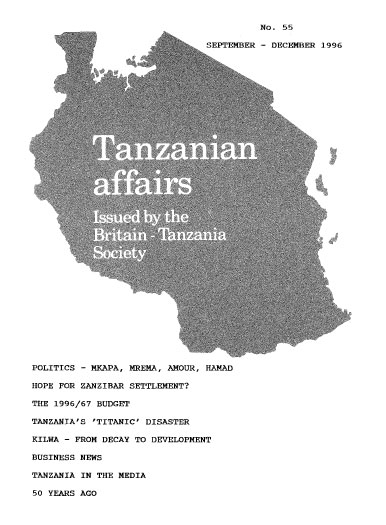
One of my favourite examples of linguistic innovation in Tanzania was the rapid transformation in 1996 of a politician’s name into a term of ridicule in Swahili. Ramadhani Kihiyo became CCM MP for Temeke constituency in Dar es Salaam in the first multi-party general elections in October 1995. But his election was challenged, and in the subsequent petition hearing it emerged that he had lied about his academic qualifications (there’s a nice summary of these proceedings in Tanzanian Affairs, No.55). Kihiyo resigned his seat at the end of May 1996, and his name became a byword for fake certificates and invented resumés.

I remember this well because it was the running joke among my travelling companions (government officials and a driver from Dar) when I was visiting villages in Pawaga, in Iringa District, in September 1996. ‘Fulani ana kihiyo’, and the plural form ‘Fulani ana vihiyo’, ‘So-and-so has bogus qualifications’, was the expression I heard in endless variations and hilarious applications as we drove along the dusty dry-season roads. As this became widespread usage in the country it was said that people who shared Kihiyo’s Sambaa name were dropping it to avoid its unfortunate associations and the embarrassment thus caused.

Fortunately for them, time has since begun to erase memories of the Kihiyo scandal, and many Tanzanians don’t know what a kihiyo is, though the practice it refers to is all-too familiar. A quick search of the internet produces a few examples, all of them using kihiyo as a term for the person with the invented qualifications (e.g. ‘huyo kihiyo!’, ‘that faker!’) rather than the made-up achievements (paper or otherwise) themselves.

The only other example of eponymy in Swahili that I can think of was coined during the Lewinsky scandal in 1998, when US President Bill Clinton’s extra-marital relationship with White House intern Monica Lewinsky was a major international news story. Among at least some urban Tanzanians kumk(i)linton mtu, ‘to “clinton” someone’, is now a jocular euphemism for fellation, kunyonya (lit. ‘sucking’) in everyday Swahili.

If this was an English expression you’d expect it to be a reference to whatever the president did to his young intern. But as Clinton told the courts, he didn’t really do anything, and the Swahili slang refers to the act that Monica is alleged to have performed on him. So while it would be correct to say that Monica “clintoned” Bill (Monica alimklinton Bill), you can’t use this eponymous verb to say that he had “clintoned” her – or indeed any other woman. It is possible, however, for one man to “clinton” another, linguistically-speaking that is.

It’s perhaps no coincidence that these two examples of contemporary eponymy derive from political scandals and the prominence given to them in the newly-liberalised Tanzanian media. But the first seems not to have stuck and I don’t know how widely used or understood the second is, beyond the circle of Zanzibari women and Bongo dwellers that I’ve heard it from. I can’t imagine seeing the likes of ‘kihiyo, n. vi-’ or ‘k(i)linton, v.’ in a printed Swahili dictionary anytime soon, but would love to be proved wrong.

Friday, 3 July 2009

SCRIBD AND, FOR EXAMPLE, LEOPARDS

I started this occasional blog by posting short articles that I'd already written and (in all but one case) published. 'Occasional' became an understatement when I started scanning and posting papers and other miscellaneous writings to the document-sharing website Scribd. I've now uploaded more than 170 files to Scribd, including my doctoral dissertation (1984) about Usangu and a collection of research assistants' notebooks from western and central Kenya. I've still got a way to go, and haven't begun to scan notebooks written in Swahili by assistants in Zanzibar and mainland Tanzania.

One of the advantages of doing this is that I can now link directly to files on Scribd and/or embed them in the text of this blog. Here's an example, a poster shown at a conference in Oxford in 2007:


And here's a paper about the Zanzibar leopard:


To view and/or download these (and other documents) use the Scribd toolbar at the top of the windows.