Showing posts with label Zanzibar town. Show all posts

Sunday, 12 May 2019

DOCKERS IN MALINDI PORT, ZANZIBAR

Dockers unloading cement, Malindi, Zanzibar, July 2006 (photo: Martin Walsh)
Continuing the theme of recent posts (‘An orange seller in Zanzibar’, ‘The political cover that wasn’t’), here’s another of my favourite snaps, also taken in July 2006. I’d been on a short dhow trip with other participants in the conference ‘Sails of History: Citizens of the Sea?’, coordinated by Professor Abdul Sheriff as part of the Zanzibar International Film Festival (ZIFF), and this was part of the scene that greeted us as we returned to the port at Malindi: dockers unloading dusty bags of Simba cement from a rusting boat dubbed the Arafat, which had presumably brought them across from the works at Tanga.

The Arafat in port (photo: Martin Walsh)
This photo once featured on the website of the Department of Social Anthropology in the University of Cambridge. I was teaching there at the time, and offered it when staff and students were asked to submit images to illustrate the diversity of places in which they worked. The department now has a photographic competition for graduate students: I doubt that this image or any of the others shown here would be shortlisted for any kind of prize, and not just because they were taken with a relatively inexpensive Olympus camera. I like it, however, because it shows people at work in one of Zanzibar Town’s most important occupations: loading and unloading goods at the port.

This is not the Zanzibar of picture-postcards and coffee-table books (I’ve got lots of those images too), but the hard grind of manual labour on the waterfront that many visitors will only catch a glimpse of when porters hustle for their trade as they step off the ferry from Dar es Salaam. What they may not know is that dockworkers have played a critical role in the political as well as economic history of Zanzibar. Action by employees of the African Wharfage Company (AWC) which began in August 1948 led to a General Strike that only ended in mid-September when efforts to suppress it failed and the colonial authorities and British-owned AWC began to give in to the strikers’ demands.

Dockers in close-up (photo: Martin Walsh)
As Andrew Coulson has remarked, the Zanzibar General Strike represented the most effective challenge to colonial authority in the pre-Independence period. It was a vital moment in the development of organised labour and political consciousness in Zanzibar, especially for the many mainlanders in the urban workforce. It is probably no accident that the man who emerged as the leader of the Zanzibar Revolution in January 1964 and who became the islands’ first President, Abeid Amani Karume, came from the same immigrant and urban milieu, having been a sailor and then the leader of a syndicate of small boat owners.

What the dockers in my photo thought about this history, and now it translated into their own political affiliations, I can only guess. Given current sensitivities, these are not topics that can be easily studied and written about by academic researchers and journalists.

Further reading

Clayton, Anthony 1976. The general strike in Zanzibar, 1948. Journal of African History 17 (3): 417-434.

Clayton, Anthony 1981. The Zanzibar Revolution and its Aftermath. London: Hurst.

Coulson, Andrew 2013. Tanzania: A Political Economy (2nd edition). Oxford: Oxford University Press.

Glassman, Jonathon 2011. War of Words, War of Stones: Racial Thought and Violence in Colonial Zanzibar. Bloomington and Indianapolis: Indiana University Press.

Hadjivayanis, George and Ed Ferguson 1991. The development of a colonial working class. In Abdul Sheriff and Ed Ferguson (eds.) Zanzibar Under Colonial Rule. London: James Currey. 188-219.


Friday, 15 February 2013

BEIT EL AMANI – A MUSEUM CONSERVATION CHALLENGE IN ZANZIBAR

by Jonathan R. Walz

Beit el Amani in July 2011, before renovation (copyright Martin Walsh)
Public engagement and conservation are two principal concerns of the African Studies community in general. However, more often than not, those interested in conservation in Africa emphasize natural history, national parks, and wildlife. As recent events in Timbuktu in Mali demonstrate, historical sources, archaeological remains, and architectural legacies also deserve robust and sustained commitment. Governments, museums (and other institutions), and scholars play key roles in this endeavor, as the parties who ensure the responsible conservation of cultural heritage in Africa and who facilitate public education about African history and contemporary societies.

There is broad recognition that African archives and museums are in a poor state. A visit to the Swaziland National Archives in Mbabane, for instance, reveals insufficient infrastructure, financial resources, and staff to meet the basic conservation needs of the unique and remarkable historical sources housed there. The archives and museums in much of Sub-Saharan Africa, like other states in the global tropics and sub-tropics, suffer from multiple legacies. Among other factors, these include regional impoverishment, insufficient leadership and staff training, and a gaping disconnect between scholars and such heritage institutions. International scholars in particular often conduct research and then depart countries without attending to the further management of the materials they collect. Recent adjustments to antiquities research fees in many countries, including Tanzania, are beginning to rectify this problem by collecting monies intended for curation.

Beit el Amani in July 2012, after renovation (copyright J. R. Walz)
Of course there are exceptions to the tendencies of poor management in museums and archives outlined above. Notable success stories include the Hargeisa Provincial Museum in Somalia (Mire 2007) and various branch museum organizations in Niger and Senegal (see Merrick Posnansky’s comments in Walz 2010: 208-209). And the International Council of African Museums (AFRICOM), as well as other international, continental, and national working groups and funds are making headway in the struggle to improve heritage training and awareness. However, the destruction in Timbuktu shows how quickly a success story – the South Africa-Mali Timbuktu Manuscripts Project – can turn. There is much serious work to be done in partnership among stakeholders.

Tanzania faces challenges similar to other African countries (see Schmidt and McIntosh 1996). A 2001 conference in Dar es Salaam celebrated the growth in historical scholarship and heritage studies in Tanzania since mainland independence in 1961. But at the same time attendees bemoaned the many significant impediments to heritage development (Mapunda and Msemwa 2005). Zanzibar Town and other historical places of Tanzania’s offshore islands also face threats to heritage as well as the institutions that enable the conservation of historical sources and public engagement.
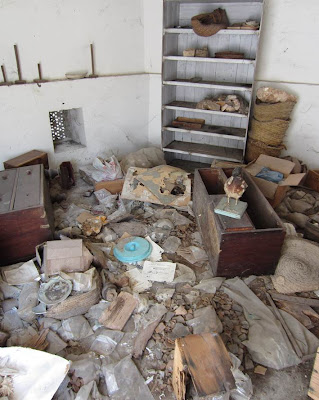
Disarray in Storage D, Beit el Amani, July 2012 (copyright J. R. Walz)
In July 2012 I visited Beit el Amani – the Peace Memorial Museum (aka the Zanzibar Museum) – in Zanzibar Town. Lying at the intersection of Benjamin Mkapa and Kaunda roads, it contains artifacts and other historical sources of Zanzibar’s long-term history, from great antiquity up to and through the early twentieth-century: archaeological remains of Swahili urbanism, relics of the Omani sultanate, material culture from European exploration, items of railroad and postal history, and crafts common to Zanzibari households (for the early history of the museum see Longair 2012). The museum was under structural renovation when I visited in July (and had been for more than a year previously) and therefore the material collections and displays were off limits to the general public. Aesthetic and structural improvements appear to have been successful (as the museum’s façade has been renewed), but they conceal striking problems.

A museum official kindly agreed to show me the archaeological collections in ‘storage,’ some of which had been relocated due to the ongoing renovations. Storage Room D is demonstrative. Disarray and destruction (surely unintentional) of this type should elicit great concern. Storage boxes and bags are broken or otherwise disintegrating in Storage Room D and the original provenance of a proportion of material has been lost. Most apparent are ceramics, beads of glass and semi-precious stone, and even non-archaeological materials, including a stuffed duck. Sadly, my photos illustrate this desecration of history. Relevant objects include those excavated in the 1990s from Unguja Ukuu and other regionally important archaeological sites located on Unguja (Zanzibar) Island and its smaller sister, Tumbatu.

Another view of the jumble in Storage D (copyright J. R. Walz)
After speaking with a Zanzibari official, I contacted numerous international heritage groups and funds, including the U.S. Embassy in Tanzania. However, for various reasons – including surpassed funding deadlines – no monies were available for immediate improvements. Then I approached the Office of Community Engagement at my academic institution, Rollins College (in Florida). Thankfully, I was granted a small sum to clean and organize the materials in Storage Room D, a task I will complete during July 2013 with Rollins students. This scheduled activity integrates well the engaged liberal arts and two courses I teach: “Cultural Heritage and Museums” and “Heritage and the Politics of Now.” Zanzibari museum staff and students in new archaeology and heritage management programs at the State University of Zanzibar (SUZA) will work alongside us to improve circumstances at Beit el Amani. Stay tuned for a follow-up blog as the case progresses.

The archives and museums of eastern Africa, and all of Africa, deserve greater care. In this instance, archaeologists who work in Zanzibar and wider Tanzania should step forward and find more concrete ways to ensure proper curation of materials. Although Rollins College supplied funding to launch this project in Zanzibar, donations, volunteer support, and suggestions for additional funding are much appreciated.

Acknowledgements
Thanks to Martin Walsh for facilitating this blog post. I further appreciate the support of Abdul Sheriff during my stay in Zanzibar in 2012. Many commentators offered assistance through a previous online post about Beit el Amani.

References

Longair, S. C. 2012. ‘A Gracious Temple of Learning’: The Museum and Colonial Culture in Zanzibar, 1900-1945. Unpublished Ph.D. dissertation, Birkbeck College, University of London.

Mapunda, B. and P. Msemwa (eds.) 2005. Salvaging Tanzania’s Cultural Heritage. Dar es Salaam: Dar es Salaam University Press.

Mire, S. 2007. Preserving knowledge, not objects: a Somali perspective for heritage management and archaeological research. African Archaeological Review 24 (3-4): 49-71.

Schmidt, P. and R. McIntosh (eds.) 1996. Plundering Africa’s Past. Bloomington: Indiana University Press.

Walz, J. 2010. An interview with Merrick Posnansky. African Archaeological Review 27 (3): 177-210.


Sunday, 14 October 2012

FLYING FROM DAR TO ZANZIBAR AGAIN

I can't resist posting a few more photos taken on a flight from Dar to Zanzibar, adding to those I put up earlier this year under the heading Flying from Dar to Zanzibar. The following shots were taken on a Coastal Aviation flight on 22nd September this year: we left Dar half an hour after midday and arrived in Zanzibar about twenty minutes later. This time my camera didn't run out of memory and I managed to get some images of the final stages of the flight.

Mlimani: the University of Dar es Salaam
Coastline north of Dar es Salaam
The sea, mid-channel
Controls in mid-flight (flight path and location on the screens)
Submerged island and reef
Chumbe island and lighthouse
Ras Shangani from the south
Zanzibar town from the south
suburbs of Zanzibar town

Sunday, 13 February 2011

ELEPHANT DUNG AND EXPELLING SPIRITS

Postcard from the Humphrey Winterton Collection
I've just added a visual postscript - the postcard picture of a pet rhino - to last September's post on the 'Imaginary Animals of Zanzibar'. I came across this while looking for photographs to illustrate a seminar on 'Images and counter-images of the Zanzibar Revolution' that I'm giving in Edinburgh next month. In preparation for this I've also been rereading one of my favourite books about the islands, Esmond Bradley Martin's Zanzibar: Tradition and Revolution (1978). This is unrivalled as a description of the foibles and follies of the Revolutionary Government at a time when there wasn't always a lot to laugh about. It includes the following vignette about the presence of another exotic beast in Zanzibar, or to be precise a pair of them: 

1992 reprint (Nairobi: Book Corner Ltd.)
 "On holidays such as Idd, those who remain in Zanzibar town dress up in their finest clothes and there is dancing and singing in the streets. The two Indian elephants at the Bwawani Hotel then receive great attention from the populace, and children even bring nuts and bread to them. The history of these elephants is an amusing tale. In 1974, the Indian government gave them to the government of Zanzibar as a present. They arrived on the Mapinduzi's maiden voyage. When this ship anchored in the harbour, the elephant handlers cermoniously presented them to the Africans who were supposed to take care of them. But there was one major problem: the elephants would only respond to commands in Hindi, and resolutely refused to learn Swahili. Rather embarrassed, the government decided that the Bwawani Hotel should provide for these two gentle but obstinate pachyderms, named Indirani and Govindon. The Bwawani now gives elephant rides for fifteen shillings, but there are few Zanzibaris prepared to pay the price. They like watching them, though; and these are the only Indian elephants in all East Africa. In the mornings, they are walked from their enclosure near the Marahubi Palace by a couple of attendants to the kitchen area of the Bwawani Hotel, where the hotel's staff feed them left-over food and lots of bread. They stand idly around the hotel until around 11 a.m., when their attendants walk them back to their enclosure, and their hard day's work is completed. Karume would not have approved of their example." (1978: 107)

Postcard showing Bwawani swimming pool
The reference here is to the first president of Zanzibar, Abeid Amani Karume, who planned the Bwawani Hotel before his assassination in 1972. The management of the hotel was handed over to an Indian hotel chain, Oberoi (Martin 1978: 4), and it was the Hindi-speaking staff who were later asked to look after the two monolingual elephants. These tuskers may have lived the life of Riley, but apart from providing entertainment and occasional rides, they had a more practical use to Zanzibaris at the time, unmentioned by my good friend Esmond (who is now an expert on the illegal ivory trade, but not quite as inactive as his Wikipedia article implies). It seems that their dung was in much demand as a fumigant (mafusho) for expelling (or perhaps merely calming down) spirits (mashetani), in particular those that caused certain kinds of illness in children. Boys and girls from the town collected the fresh elephant dung from Maruhubi (near the veterinary clinic, where the elephants were kept overnight), from outside the Bwawani (by the hotel's rubbish dump, where they were fed), and from the road between the two. My wife remembers doing this with others when she was in her early teens (around the time that Esmond Bradley Martin wrote his book): they used sticks to collect and bag the dung, took it home, and then left it out in the sun to dry. When the dung was dessicated one of the boys would take it and sell it to Saleh Madawa, Stone Town's principal supplier of traditional potions and charms, who would sell it on to his customers in turn -- presumably at a good profit.

Saleh Madawa's shop in July 2006
I don't know whether elephant dung can still be bought in Saleh Madawa's shop: if so then it must be sourced from the mainland, because the two Indian elephants are long gone. My guess is that recipes for elephant dung fumigant also originate on the nearby continent. It is widely used in eastern Tanzania to treat degedege (e.g. Makundi et al. 2006; Warsame et al. 2007; Foster and Vilendrer 2009), which is the Swahili name for the illness believed to cause infant convulsions, often identified as cerebral malaria. Mama J recalls that in Zanzibar town the dried elephant dung is mixed together with onion and garlic skins before being used to fumigate (kufukiza) a poorly child, and garlic is among a number of additional ingredients mentioned in the literature. The understanding and treatment of degedege is a subject all in itself, and I'll no doubt return to it in future posts. Given his antipathy to other machinations of the devil (Walsh and Goldman 2007: 1149), I like to think that Sheikh Karume would have approved of this particular use of the Revolutionary Government's elephants, and not just because it helped to keep the road to Maruhubi clean. 

References

Foster, Deshka and Stacie Vilendrer 2009. Two treatments, one disease: childhood malaria management in Tanga, Tanzania. Malaria Journal 8: 240 (online).

Makundi, Emmanuel, Hamisi Malebo, Paulo Mhame, Andrew Kitua and Marian Warsame 2006. Role of traditional healers in the management of severe malaria among children below five years of age: the case of Kilosa and Handeni Districts, Tanzania. Malaria Journal 5: 58 (online).

Martin, Esmond Bradley 1978. Zanzibar: Tradition and Revolution. London: Hamish Hamilton.

Walsh, Martin and Helle Goldman 2007. Killing the king: the demonization and extermination of the Zanzibar leopard. In Edmond Dounias, Elisabeth Motte-Florac and Margaret Dunham (eds.) Le symbolisme des animaux: l'animal, clef de voûte de la relation entre le homme et la nature? Paris: Éditions de l'IRD. 1133-1182.

Warsame, Marian, 
Omari Kimbute, Zena Machinda, Patricia Ruddy, Majaja Melkisedick, Thomas Peto, Isabela Ribeiro, Andrew Kitua, Goran Tomson and Melba Gomes 2007. Recognition, perceptions and treatment practices for severe malaria in rural Tanzania: implications for accessing rectal artesunate as a pre-referral. PLoS ONE 2 (1): e149 (online).

Saturday, 27 November 2010

SWAHILI LESSON No.1: LOVE GARDENS AND ANGELS

Watching an old James Bond film last night, conversation in our bilingual household naturally turned to hairy chests. You mean "garden love", said Mama J, "bustani ya mapenzi" (lit. 'garden of love'). I'd never heard this expression before, let alone any special term or euphemism for chest hair in Swahili, so made a beeline for the nearest search engine. I missed the ending of Thunderball, but did find a handful of examples on the Swahili blogs, which have become a fascinating source for exploring contemporary Tanzanian usage. The form in general use, it seems, is English 'love garden', Swahili-ised as lavu gadeni. Mama J confirmed that in her experience it's the English expression (back-to-front or otherwise) that's widely used, rather than its literal Swahili translation, bustani ya mapenzi. "Why 'love garden'?", I asked, and she mimed the act of a love-struck woman caressing the luxuriant growth on her lover's chest. Unfortunately my own weedy patch is no match for Sean Connery's chest wig (aka rug), and I was rejected as a subject for further live demonstration.

Setting aside my disappointment, I'm still intrigued by the origin of this euphemism, whose closest equivalent in modern British parlance is 'love rug', though we also employ horticultural metaphors when describing chest hair, as indeed I've just done myself. I guess it says something that our own mocking idioms are based on the image of manufactured products (rugs and wigs) rather than natural and organic processeses (wild and cultivated growth). It isn't difficult to spot the difference and imagine how a cultural theorist might explain it. (Suggested reading: La pensée sauvage (trans. The Savage Mind) and subsequent works by Claude Lévi-Strauss, Lakoff and Johnson's Metaphors We Live By, and any number of articles produced by The Postmodern Generator.)

Searching the Internet Living Swahili Dictionary for bustani ya mapenzi (no luck) and related terms, I stumbled across the likely etymology of another fuzzy euphemism that's always puzzled me. I also first heard this from Mama J, who uses malaika, lit. 'angel(s)' (originally a loanword from Arabic), to describe fine body hair or down, like the wispy hairs on a woman's arm. (For the sake of linguistic precision I should have said earlier that Mama J speaks the Unguja dialect of Swahili, having grown up and spent half of her adult life in Zanzibar town.) From angels to body hair seems like a big conceptual leap, but the online dictionary supplies the missing link by indicating that babies and small children are referred to as angels (malaika) as well as the soft downy hair on their bodies. So it's a simple extension of meaning that had been eluding me all these years since Mama J became the mama of our own little angel (not a pet name that I'd normally use in English, but I use it to bring home the linguistic parallel), malaika and all.

References

Lakoff, George and Mark Johnson 1980. Metaphors We Live By. Chicago: The University of Chicago Press.

Lévi-Strauss, Claude 1962. La pensée sauvage. Paris: Librarie Plon. (trans. 1966. The Savage Mind. London: Weidenfeld and Nicolson.)