Showing posts with label ethnography. Show all posts

Saturday, 17 October 2020

A FALLEN TREE IN STONE TOWN

by Jonathan Walz 

Forodhani Gardens, Zanzibar (photo: Martin Walsh)
I
On July 9, 2020, a large tree fell in the Vuga area of Stone Town, Zanzibar.* Its collapse was sudden and loud. People quickly gathered. The tree’s meaning to different people emerged in the subsequent three days as the tree was discussed, disassembled, hauled-off, reflected-on, and mourned. Clarity about the tree’s meaning and social role emerged from its death.

II
Unique trees are essential to societies in eastern Africa and throughout the world. From mainland Africa to Seychelles, the baobab, coco de mer, fig, and mango play roles in story-telling and ritual practice, not to mention their contributions to sustenance and medicine. Common English names for other trees with distinct uses and cultural significance – all found in contemporary Zanzibar – include, but are not limited to, the bodhi, breadfruit, camphor, cassia, cinnamon, clove, coconut, date, ebony, euphorbia (succulent), false ashoka, ficus, frangipani, Indian almond, kapok, mahogany, mangrove, neem, peepal, saman, tamarind, and teak.

Trees serve a multitude of purposes. Particular species provide shade or windbreaks. Trees can be ornamental. Large or old trees serve as shrines, house ancestors, or, for some societies, they can represent the center of the symbolic universe (i.e. an axis mundi). Trees can obscure visibility and sound, facilitating secrecy. The wood of some species can be used to make objects: posts, flooring, utensils, beehives, weapons, watercraft, musical instruments, and carvings. Many trees produce edible fruits, seeds, roots, leaves, saps, or gums or are consumed as timber for construction projects or for firewood, charcoal, or animal fodder. Extracts from trees can be employed as latexes, oils, dyes, hunting poisons, or incense. The cosmetic cabinets of Swahili women contain an assortment of tree products revered for their affordances.

Trees in Stone Town (photo: Jonathan Walz)
Large trees are visible and prominent, with high crowns that mark places of importance on the countryside or in cities. In Stone Town, multi-story architecture often obstructs viewsheds. There are no natural features other than trees to distinguish places from a distance, especially when viewed from the perspective of a pedestrian in the alleyways. In parts of Tanzania, forests serve as sacred groves or identify ancient settlements (see the scholarship of Elgidius Ichumbaki (2015), who suggests reconsidering the meaning of “archaeological site” using trees). Trees have meanings that stretch beyond their immediate times and locations; they can live on in place names, for example throughout Zanzibar (Myers 2016). 

III
The tree that fell in Vuga had a social life. It was planted by Khamis Salum in 2000. The Ficus benjamina - Weeping or Java Fig - has an origin in India, Malaysia, and Indonesia. This species is a large evergreen tree, 10-20 meters in height with drooping foliage. Hardy and fast-growing, it has a strong root system and bears orange to red berries (Dharani 2002).

The Weeping Fig functioned as a shade tree for nearby offices. Taxi drivers wedged everyday items in the openings in its trunk and among its lower branches. It was an attractive destination for urban animals, including a pair of Broad-billed Rollers, a colony of Yellow-headed Dwarf Geckos, and a Great Plated Lizard that lived in a stone wall at the base of its trunk. When it fruited, the tree attracted Greater Galagos and two species of fruit bat.

All of this ended when the tree fell. When it collapsed across a dirt road it landed without injury to people or property. Community members in the area gathered, taking photos in awe.

(photo: Jonathan Walz)
IV
After the tree’s collapse, three entities were contacted because each has purview over the trees of Stone Town, a World Heritage Site: the Stone Town Conservation and Development Authority, Urban Municipal Council, and Department of Forests and Non-Renewable Natural Resources. Discussions with the authorities documented the details of the tree and offered guidelines for the removal of its remains. Photographs were taken by authorities and its species confirmed. Then, clearance began. A representative from the Urban Municipal Council arrived on-site to observe a hired worker with a permitted chainsaw disassemble the tree. At 12 meters in height and almost a meter thick at breast height, the removal process of the tree spanned two days. This species produces soft wood useful as firewood (not charcoal), so its trunk and branches were carried away by community members. 

V
During subsequent days, two individuals independently visited the site of the tree fall and performed rites. The individuals were older men who discretely left items at its stump and spoke inaudible words. They stayed in the vicinity briefly. The Weeping Fig was a shrine to a spirit. The two visitors each left an offering (sadaka), including a small white cloth. This interpretation also explains the appearance of eggs and vials of rosewater at the base of the tree in previous years. The rite maintains harmony for an individual or community by preventing evil or pollution as a result of the demise of the mzimu, the Swahili name for a spirit dwelling.

Trees have specific meanings and uses to different stakeholders. This event should inspire conversations about the roles of trees, their socio-nature, urban environmental histories, and the symbolic and spiritual character of cities (Myers 2016: 83). Trees are physical and metaphysical anchors. Western perspectives on trees delimit and can erase other cultural meanings and uses of trees. While the built environment of Stone Town may be “of elsewhere” (Meier 2016), trees and green spaces in Zanzibar still yield deep significances that draw heavily from the African and Indian Ocean cultural intersections in Zanzibar. For instance, the words jini and shetani have Arabic roots, but pepo and mzimu have Bantu roots. These terminologies are variously used to indicate spirits or spirit dwellings among the Swahili. The cultural significance of these terms and the context of use are obscured when trees or green spaces and districts on the island are framed simply as areas of public enjoyment (or “parks”), which embraces a Western concept of nature and green spaces for urban Africa.

(photo: Jonathan Walz)
VI
The words, performances, and objects associated with special trees are essential for comprehension of their significance as heritage. The material approach to the fallen Weeping fig and its consumption (as firewood, and so forth) is understandable in a comparatively impoverished setting that has been culturally degraded by tourism. Yet, the performance of rites shows that even under these less than ideal circumstances, or, better yet, because of the circumstances, meaning persists. Using a case from Transkei, Throop (2003) articulates that from on-the-ground treatments of trees there is the potential to distil the surrounding power relations. In Zanzibar, this postulate applies to trees as central places of social practice that respond to colonial experience, the intersection of town-and countryside, and environmental change. Contradictions exist in the “heritagization” of Stone Town (Sheriff 2019). One everyday tension is the disproportionate emphasis placed by conservators on architecture (already questioned for its “authenticity”) as compared against, for example, intangible practices that surround trees that endure at prominent points or in place names in Stone Town.

*Note that the tree that is the subject of this post is not shown for ethical reasons. All of the images included here are of other trees in Zanzibar.

References

Dharani, N. 2002. Field Guide to the Common Trees and Shrubs of East Africa. Cape Town: Struik Publishers.

Ichumbaki, E. 2015. Monumental Ruins, Baobab Trees and Spirituality: Perceptions on Values and Uses of Built Heritage along the East African Coast. Unpublished PhD Dissertation, University of Dar es Salaam, Tanzania.

Meier, P. 2016. Swahili Port Cities: The Architecture of Elsewhere. Bloomington: Indiana University Press.

Myers, G. 2016. Urban Environments in Africa: A Critical Analysis of Environmental Politics. Chicago: Policy Press.

Rival, L (ed.) 1998. The Social Life of Trees: Anthropological Perspectives on Tree Symbolism. London: Routledge.

Sheriff, A. 2019. Contradictions in the heritagization of Zanzibar ‘Stone Town’. In B. Schnepel and T. Sen (eds.) Travelling Pasts: The Politics of Cultural Heritage in the Indian Ocean World. Leiden: Brill. 221-245.

Throop, J. 2003. The python and the crying tree: interpreting tales of environmental and colonial power in Transkei. International Journal of African Historical Studies 36 (3): 511-532.

Sunday, 21 July 2019

A RECIPE FOR DISPELLING NIGHTMARES

by Martin Walsh

Mhamadi Khamis Makame
My last post, ‘Burning the Golden weaver’s nest’, was about an unusual ingredient in the treatment of possession-related  illness in Makunduchi, in the south-east of Unguja island. Fumigation and steaming are common components in traditional medical practice in Zanzibar. They are also essential in the invocation of possessory spirits, as Hassan Gora Haji describes in his recent PhD dissertation on the songs that accompany spirit possession rituals on Tumbatu island and elsewhere in northern Unguja.

Here is part of his description of kupigwa nyungu, ‘to be given a vapour-bath’:

Nyungu [literally ‘clay pot’] is a mixture of medicinal plants which are boiled together and used to fumigate oneself […]. But according to waganga, traditional doctors, nyungu is a kind of medicine for steaming which is made with a mix of the leaves of seven different plants. These plants vary from mganga to mganga or from one kind of spirit possession treatment to another. […] The nyungu medicine is used to attract the spirit so that it comes as soon as it is called.” (Haji 2018: 54; my translation).

Crouching under a mat
On 18 October 2007, when working on the Gray Brothers’ documentary The Nightmare (Para Docs Productions, 2008), I took the crew to film a series of interviews about a recent Popobawa panic in Potoa. Afterwards, one of my in-laws demonstrated the use of nyungu medicine for the camera. His patient was a young boy who had been sent to him for treatment, and had been staying there for some time. As both of them crouched under a mat, Mzee Mhamadi held a bunch of steaming leaves under the boy’s nose and encouraged him to inhale the vapour.
 
After this demonstration, Mzee Mhamadi listed the seven plants that he would have used if he had been doing this for real. He described this as a nyungu mix for treating treating jinamizi, which is loosely translated as ‘nightmare’, but often refers to more specific phenomena, such as the frightening hallucinations that can accompany sleep paralysis and manifest as incubi or succubi.

Inhaling the vapour
Here are the seven ingredients, listed in the order in which he gave them and identified with the help of available botanical glossaries of Swahili plant names in Zanzibar:

1. muwakikali, Horsewood, Clausena anisata (Willd.) Hook.f. ex Benth. (family Rutaceae).
2. mnanuzi, Orange Climber, Toddalia asiatica (L.) Lam. (family Rutaceae).
3. mchakuzi, Uvaria acuminata Oliv. (family Annonaceae).
4. mbaazi, Pigeon Pea, Cajanus cajan (L.) Millsp. (family Leguminosae).
5. kivumbazi, Ocimum spp. including Basil, Ocimum basilicum L. (family Lamiaceae).
6. mpera, Guava, Psidium guajava L. (family Myrtaceae).
7. mchakati, Mallotus oppositifolius (Geiseler) Müll.Arg. (family Euphorbiaceae).

The last of these botanical identifications is the least certain: Heine and Legère (1995: 107) also record mchakati as Leucas sp. (family Lamiaceae) and Acalypha ornata Hochst. ex A.Rich. (family Euphorbiaceae).

The nyungu medicine
Most of these plants, including the cultigens, are used in a variety of medicinal and ritual preparations in Zanzibar, and some are well known as traditional medicines more widely. According to Heine and Legère, waganga consider Horsewood to be “one of their most useful plants” (1995: 244), while they and other authors give different examples of its use.

Ingrams describes the use of Orange Climber roots in a “Hadimu” (south and east Unguja) ritual for “Calling a devil for possession” that is somewhat different from the northern Unguja (Tumbatu) practices already described:

“Take a piece of mnanuzi root, and three of muiza jini [mwizajini, Coffee senna, Senna occidentalis] […] and boil together in a new pot. When it boils, place a pad on the patient’s head (to stop burning) and place the pot on top of it. The patient will then shake her head, but the pot will not fall down. The medicine man then gives the patient some of the mixture to drink. The devil will now come, and though he may go away for short periods, will always come back. After this the medicine man will drop the muiza jini down a ruined well, so that it is out of the way of mischief-makers, and the other root will be fastened to the leg of the possessed person, where it will stay for seven days.” (1931: 453)

Listing the ingredients
Elsewhere Ingrams discusses the magical significance of the numbers 3, 4, and 7 in Zanzibar, and parallels further afield (1931: 478).

As Hassan Gora Haji makes clear in his dissertation, the herbal steam bath is only one part of a spirit possession or healing ritual, which may also involve specific incantations. Ingrams also records a sample of these. I didn’t get another opportunity to ask Mzee Mhamadi more about this, and alas he is no longer with us, though I’m told that at least some of his medicinal knowledge has been passed on.

Acknowledgements
In memory of Mhamadi Khamis Makame, and with thanks to Adam Gray for sending me unused footage from the filming of The Nightmare. All of the images in this post are taken from that footage.

References

Haji, Hassan Gora 2018. Uchambuzi wa Nyimbo za Uganga wa Pepo Zanzibar: Mtindo na Dhima Zake. Unpublished PhD dissertation, Chui Kikuu cha Taifa cha Zanzibar (SUZA).

During filming
Heine, Bernd and Karsten Legère 1995. Swahili Plants: An Ethnobotanical Survey. Köln: Rüdiger Köppe Verlag.

Ingrams, W.H. 1931. Zanzibar: Its History and People. London: H.F. & G. Witherby.

Kombo, Yussuf H. 2017. Jozani Natural Forest: Zanzibar Treasures in Wild (2nd edition). Zanzibar.

Legère, Karsten 2003. Plant names from north Zanzibar. Africa & Asia (Göteborg) 3: 123-146.

Williams, R.O. 1949. The Useful and Ornamental Plants in Zanzibar and Pemba. Zanzibar: Zanzibar: Protectorate.

Saturday, 17 August 2013

THE WRATH OF THE ANCESTRAL SPIRITS

by Martin Walsh

I've just finished The Wrath of Koma, Maurice Kambishera Mumba's entertaining tale about tradition and tragedy among the Kauma, published by Heinemann Kenya in 1987. The back-cover blurb of the paperback introduces the story:

Old Chembe, a Kauma man from the Am[i]dzichenda people of the Kenya coast, is gravely worried about his son, Dundu, who appears to be going mad. He travels across many ridges to see Mokoli Mwiru, the famous medicineman, for a diagnosis of his son's problem. Mokoli Mwiru gives his diagnosis: Dundu, born after intercession to the ancestral sprits, is under the wrathful attack of the spirits who resent the ingratitude of Chembe's family. Mokoli Mwiru prescribes a ceremony of appeasement.

Old Chembe, weak and irresolute, botches the ceremony... What tragic fate awaits him, his son and his larger family as the unappeased spirits seeks their revenge?

I won't spoil the plot here. Although I bought this short novel in Mombasa shortly after it came out, this is the first time that I've read it from cover to cover. It may not be great literature, but I've enjoyed Mumba's story-telling, the tales-within-tales, the dissolution of the text into poetry, and his wry description of rural life and morality in the waning years of colonial rule. The Wrath of Koma is especially interesting for its anthropology, and not just because the Kauma are among the least written about of the Mijikenda. I've mined Mumba's tale in the past for ethnographic and in particular ethnoornithological tidbits (as in my 'Birds of omen and little flying animals with wings'), but there's much more in it that deserves to be exposed and analysed anthropologically. This includes passages that revolve around the gendered perceptions and motivations of spirit possession and the sometimes violent reactions of men to the claims made upon them. Hearing the distant sound of an exorcism ritual (kupunga pepo), the protagonist reflects on his own experience:

As the sound of the pepo drums faded in the background, becoming less and less audible as he plodded on, Old Chembe thought of the costs he had incurred in having pepo [possessory spirits] exorcised from his four wives.

  There were moments when Old Chembe wondered whether his wives had not conspired to feign that they were possessed by pepo so that they could acquire items which he had refused to buy for them. But Old Chembe was not like his eastern neighbour Jaramba, who once flogged his wives with his walking stick to exorcise the demons in them--none of them 'dared' to be possessed by pepo again after that! (p.29)

The text goes on to detail how Jaramba came to administer this punishment, and how Old Chembe acceded to requests for the treatment of his possessed wives despite his scepticism. This is literature grounded in the observation of everyday life, a fictionalised account that conjures up the so-called 'deprivation theory' of spiritual affliction (Lewis 1971: 72-89), and invites further analysis with reference to current understandings of gender-based violence and its genesis in the imbalances of power and gendered patterns of inequality in the domestic and public spheres. It's a pity that The Wrath of Koma isn't more widely known. Maurice Mumba was the Town Clerk of Mombasa when it was published, and didn't follow it up with another novel. I don't know what has become of him since. When I lived in Mombasa I actually bought three copies of his book, one to give to another anthropologist. Although I only used it for many years as a work of reference, I'm glad that I finally got round to reading it.

References

Lewis, Ioan M. 1971. Ecstatic Religion: An Anthropological Study of Spirit Possession and Shamanism. Harmondsworth: Penguin Books.

Mumba, Maurice Kambishera 1987. The Wrath of Koma. Nairobi: Heinemann Kenya.

Walsh, Martin 1992. Birds of omen and little flying animals with wings. East Africa Natural History Society Bulletin 22 (1): 2-9.

Monday, 18 March 2013

GOODBYE TO ALISON REDMAYNE, MUNG'ANZAGALA SEMUGONGOLWA

by Martin Walsh

Alison Redmayne, Utengule, Usangu, December 1981
I've mentioned Alison Redmayne a number of times in this blog and will again, I hope. We first met at her house in north Oxford in February 1980 when I was planning doctoral research in Usangu, in south-west Tanzania. She became my ethnographic mentor and a lifelong friend. I last spoke to her in January, when she rang me from the Churchill Hospital in Oxford -- she'd been in and out with various complaints, but nothing that made me think that I wouldn't see or speak to her again. However, she didn't leave the hospital this time, but succumbed to a recurrence of lymphoma, a cancer that she'd beaten off once before. I had no idea until I wrote about her in my last post (Where The Doctor is Ignorant) and today's equivalent of the bush telegraph brought me the sad news.

Alison Hope Redmayne was born on 1 October 1936 and died on 20 February 2013, aged 76. She was buried in Wolvercote Cemetery on Wednesday afternoon (13 March), following an informal graveside ceremony attended by family and friends, who shared recollections of her before continuing to do the same in the more congenial surroundings of the Victoria Arms in Old Marston. It was unexpectedly, but appropriately, sunny when we were in the cemetery. The most poignant moment came when we all gathered around and strained to listen to the start of one of her recordings of Hehe mourning ceremonies, played back by her nephew's son Max over a mobile phone with a small tinny speaker attached.

Alison Redmayne, Oxford, August 2000
I couldn't help but reflect that if she'd been buried in one of the villages in Iringa or Mufindi that she knew so well, we'd have found ourselves in the midst of a multitude, the air filled with heartfelt lamentations and rousing songs in praise of Mung'anzagala Gisakamutemi Msengidunda Semugongolwa (her full name as an adopted member of the Hehe royal family), this extraordinary woman who spoke their language like few other Europeans could, who gave the best years of her life to recording their history and ethnography, and who ignored her own physical suffering to devote herself instead to improving their welfare, saving the lives of who knows how many people as she did so. Here's just one testimony, posted on the Mjengwa blog on 15 March:
I met Semgongolwa while I was a student at Lugalo Secondary School back in 1970. Even though I am Hehe, my Kihehe was far worse than hers. I will always remember her anthropological studies she conducted among the Wahehe; she was one of the few people who entered into the field, and never left!
. . . Alex Mwakikoti 
Alison Redmayne, Luhanga, Usangu, December 1981
Although she also worked in northern Nigeria, Alison Redmayne's name will always be most closely associated with the Hehe and neighbouring peoples in Tanzania, and so it should be. I've spent most of my spare time in the past week sorting through our correspondence, records of her visit to Usangu in December 1981, and searching for photographs, tape recordings, and a short video I made of her at home in Oxford in August 2000 (I've posted stills from this in the sidebar to the right -- scroll down to find them). I'll write more anon, but wanted to begin to say goodbye to her with this (grave) post marking her departure from this life and passage into the world of the ancestors whom she talked and wrote so much about.

Bibiliography of selected works by Alison Redmayne

Sound recordings

Alison Redmayne Collection, British Library, London.
For an introduction, link to the collection catalogue, and sample recordings see:
Topp, Janet 2012. Rare Tanzanian music recordings preserved. Music in the British Library Blog, 13 July 2012.

Photographing the Sangu chief Alfeo Merere, Luhanga, December 1981
Unpublished dissertations

Redmayne, Alison 1961. The Concept of Feudalism in African Ethnology. Unpublished B.Litt. dissertation, University of Oxford.

Redmayne, Alison 1964. The Wahehe People of Tanganyika. Unpublished D.Phil. dissertation, University of Oxford.

Published papers, articles, book chapters

Lee, Annabelle [= Alison Redmayne] 1968. African nuns: an anthropologist’s impressions. New Blackfriars 49 (576, May): 401-409. Also in 1968. Exchange. New Blackfriars 49 (579, August): 614-616.

Redmayne, Alison 1968. Mkwawa and the Hehe wars. Journal of African History 9 (3): 409-436.

Redmayne, Alison 1968. The Hehe. In Andrew Roberts (ed.) Tanzania Before 1900: Seven Area Histories. Nairobi: East African Publishing House. 37-58.

Redmayne, Alison 1969. Blasius Undole’s History of the Ndamba. Anthropos 64 (5/6): 957-959.

Redmayne, Alison 1969. Hehe medicine. By Dr. Weck, Senior Doctor of the Imperial Colonial Troops in Gerrnan East Africa. Introduced, translated and annotated by Alison Redmayne. Tanzania Notes and Records 70: 29-40.

Redmayne, Alison 1970. The war trumpets and other mistakes in the history of the Hehe. Anthropos 65 (1/2): 98-109.

Redmayne, Alison 1970. Chikanga: an African diviner with an international reputation. In Mary Douglas (ed.) Witchcraft Confessions and Accusations (ASA Monograph No. 9). London: Tavistock Publications. 103-128.

Redmayne, Alison, with Clement MwaNdulute 1970. Riddles and riddling among the Hehe of Tanzania. Anthropos 65 (5/6): 794-813.

Roberts, D. F., J. Chavez, and Alison Redmayne 1974. Dermatoglyphics of the Hehe (Tanzania). Man (N.S.) 9 (1): 31-43.

Following in the footsteps of Chief Alfeo Merere
Redmayne, Alison 1975. The Hehe. In Family of Man: People of the World and Where They Live (Marshall Cavendish Encyclopedia, Vol. 3, Part 41). London. 1138-1140.

Redmayne, Alison 1980. Note on health services and the indigenous population under the German administration (German East Africa). In E. E. Sabben-Clare, D. J. Bradley and K. Kirkwood (eds.) Health in Tropical Africa During the Colonial Period: Based on the Proceedings of a Symposium Held at New College, Oxford, 20-23 March 1971. Oxford: Clarendon Press. 115-117.

Redmayne, Alison, assisted by Christine Rogers 1983. Research on customary law in German East Africa. Journal of African Law 27 (1): 22-41.

Published report

Booth, David, Flora Lugangira, Patrick Masanja, Abu Mvungi, Rosemarie Mwaipopo, Joaquim Mwami and Alison Redmayne 1993. Social, Economic and Cultural Change in Contemporary Tanzania: A People-oriented Focus. Report to SIDA, commissioned through Development Studies Unit, Department of Social Anthropology, Stockholm University.

Her final publication and book review

Redmayne, Alison 2011. Review of Helga Voigt, Letters from Helga 1934-1937: A Teen Bride Writes Home from East Africa (trans. Evelyn Voigt, Renfrew, Ontario: General Store Publishing House, 2008), and Werner Voight, 60 Years in East Africa; Life of a Settler 1926 to 1986 (Renfrew, Ontario: General Store Publishing House, 1995). In Tanzanian Affairs 100 (September-December 2011): 70-71.

Thursday, 23 December 2010

CHILD'S PLAY IN USANGU AND UHEHE

In the good old days of descriptive ethnography children's games and pastimes were treated as a serious matter. The now-defunct handbook Notes and Queries on Anthropology declared games of all kinds to be "worthy of special study", and advised fieldworkers to join in and learn to play them, as well as recording them as fully as possible (1929: 321; 1951: 334). When I began fieldwork in Usangu in 1980, Alison Redmayne encouraged me to collect children's riddles for the linguistic and cultural information they contained, much as she and other Oxford-trained anthropologists of her generation had done. But after a tentative start I switched my attention to the verbal 'games' that adults played, making no more than occasional notes on children's pastimes whenever I came across them. Sometimes they were difficult to ignore, like the boys who playfully parodied the ethnographer-as-photographer with their own clay models of my camera.

I discovered Iona and Peter Opie's The Lore and Language of Schoolchildren (1959) in the mid-1990s and haven't tired of dipping into their work ever since, not least because it brings forth memories of my own childhood in the north-west of England. In 1998 I went through my Sangu dictionary and fieldnotes from Usangu plucking out the snippets that I'd written about children's toys, games and other pastimes. Here are some lightly edited extracts from my compilation:

Counting songs
In 1981 I recorded one childhood counting song from two adult Sangu, a man and a woman, who sang it in unison:
1. mbwe
2. yangaya
3. yapusi
4. yalima
5. tumbwe-tumbwe
6. manguluma
7. kinengu
8. nengulya
9. kilosa
10. chumilya
These apparently nonsensical 'numbers' bear no obvious relation to the Sangu cardinals in everyday use, nor other known Sangu counting systems (a cominatorial verbal sequence in use in the late 19th century and a finger counting system which is still employed). The tenth term, chumilya, appears to be a playful variant of Swahili kumi, 'ten', or one of its Northeast Coast Bantu cognates (/ch/ is not an inherited Sangu phoneme, nor is it usually retained in loanwords except in some proper names). The ninth term is possibly derived from the place name Kilosa, located in Usagara on one of the old caravan routes to the coast, though why it should be so derived is obscure (/ki/ also has a very restricted distribution in Sangu, and is probably indicative of a loan in this case: this also applies to the term for seven, kinengu). The other terms in the list share the regular phonological characteristics of Sangu, and playful etymologies might be suggested for some of them, though this would be no more than guesswork.

Jacks
The Sangu version of jacks (imdodo) that I witnessed on numerous occasions in Utengule in 1980-81 was played with twelve small stones as the jacks and a small round fruit of the ilihuluhulu (Capparis tomentosa) shrub as the ball. The game is played as follows. A small hollow is made in the earth and the stones are placed inside it. The fruit is then thrown up in the air and before it is caught a single stone must be scooped up in the other hand. If more than one stone is scooped up then the extra stone(s) must be returned to the hollow on the next throw. When all twelve stone have been removed one by one in this way, they are returned to the hollow and the same procedure is repeated, this time the stones being removed in twos. Next time they are removed in threes, then fours, and so on, until all twelve stones have to be scooped up in one go. If the player errs at any point (for example by failing to catch the fruit) then it is the turn of another player (or the same player if she is playing alone) to start from the beginning again. This game is most commonly played by girls. A twelve-stone game was also observed and photographed by Kubik in 1976 in the vicinity of Mahango-Mswiswi (1978: 103). This is a version of the game called 'fivestones' by Opie and Opie (1997: 56-72).

Where's the cow?
The following guessing game is one of the most common Sangu children's games, and I watched it being played in both Utengule and Luhanga in 1981. The game is played by two opponents (often accompanied and assisted by other children) who face one another and take turns to guess in which hand the other is concealing a small stone. The stone is referred to as ing'ombe, a cow, and each turn begins with the following exchange:

Player concealing the cow: hilili, hilili (the name of the game)
Player trying to guess where it is: ing'ombe, ing'ombe, 'cow, cow'
First player again: ing'ombe yili kwi?, 'where's the cow?'

If a player guesses correctly, then he or she is entitled to advance his or her counter (also a stone) towards a goal drawn on the ground. This goal takes the form of a circle or small hollow in the middle of a pitch of typically five or six concentric circles (sometimes not completed at the sides, so that the pitch comprises two bands of lines on either side of the goal). The game starts with the two counters at the outer edge of the pitch, being moved progressively towards the centre (across individual lines) at each successful guess. The winner is the player or team whose stone counter reaches the central goal first. When I first recorded this game being played, in Luhanga, children whose turn it was to conceal the 'cow' frequently attempted to cheat by dropping the stone behind their back, so that it was in neither hand. The game is called hilili, presumably after its opening formula, the etymology of which is opaque. The same term is also used in an extended sense by many Sangu speakers to refer to puzzles and riddles in general. Hilili can perhaps be thought of as the quintessential Sangu children's game, not only because of the wider use of its name, but also because it is cast in a bovine idiom.

If I was to rewrite these notes I'd say more about the actual games I watched and the contexts in which they were played. There's a nice account by Marius Fortie (1938: 302-303) of a series of contests and games which he observed being played in the west of Usangu in September 1934, having provided the prize money himself. That's one way of getting people to play games, although it wasn't Fortie's intention to record them in any great detail.  Studying children's games isn't child's play, and I'm not aware of any attempt in East Africa to undertake the kind of research that the Opies did in England, Scotland and Wales, though there are scattered sources from which a compilation might be begun, including the now largely forgotten literature on string figures. In November-December 2002 my Hehe-speaking research assistant, Justin John Kitinye, filled six school exercise books (436 pp.) with descriptions of the games that he knew and had played as a child. I've barely begun to translate these and reflect on their significance, but am very much looking forward to it.

References

Fortie, Marius 1938. Black and Beautiful: A Life in Safari Land. London: Robert Hale.

Kubik, Gerhard 1978. Recording utamaduni in Tanzania - a field report from Iringa and Mbeya regions, Oct 10 - Dec 14, 1976. Review of Ethnology 5 (11-14): 81-107.

Opie, Iona and Peter Opie 1959. The Lore and Language of Schoolchildren. Oxford: Clarendon Press.

Opie, Iona and Peter Opie  1969. Children's Games in Street and Playground. Oxford: Oxford University Press.

Opie, Iona and Peter Opie 1985. The Singing Game. Oxford: Oxford University Press.

Opie, Iona and Peter Opie 1997. Children's Games with Things. Oxford: Oxford University Press.

Redmayne, Alison 1970. Riddles and riddling among the Hehe of Tanzania. Anthropos 65: 719-813.

The Royal Anthropological Institute 1929. Notes and Queries on Anthropology (5th edition). London: The Royal Anthropological Institute.

The Royal Anthropological Institute 1951. Notes and Queries on Anthropology (6th edition). London: Routledge and Kegan Paul Ltd.

Walsh, Martin 1985. Shisango Dictionary. Unpublished ms. (computer printout), Cambridge, June 1985.

Walsh, Martin 1998. Children's toys, games and other pastimes in Usangu. Unpublished ms. (draft).


Sunday, 14 November 2010

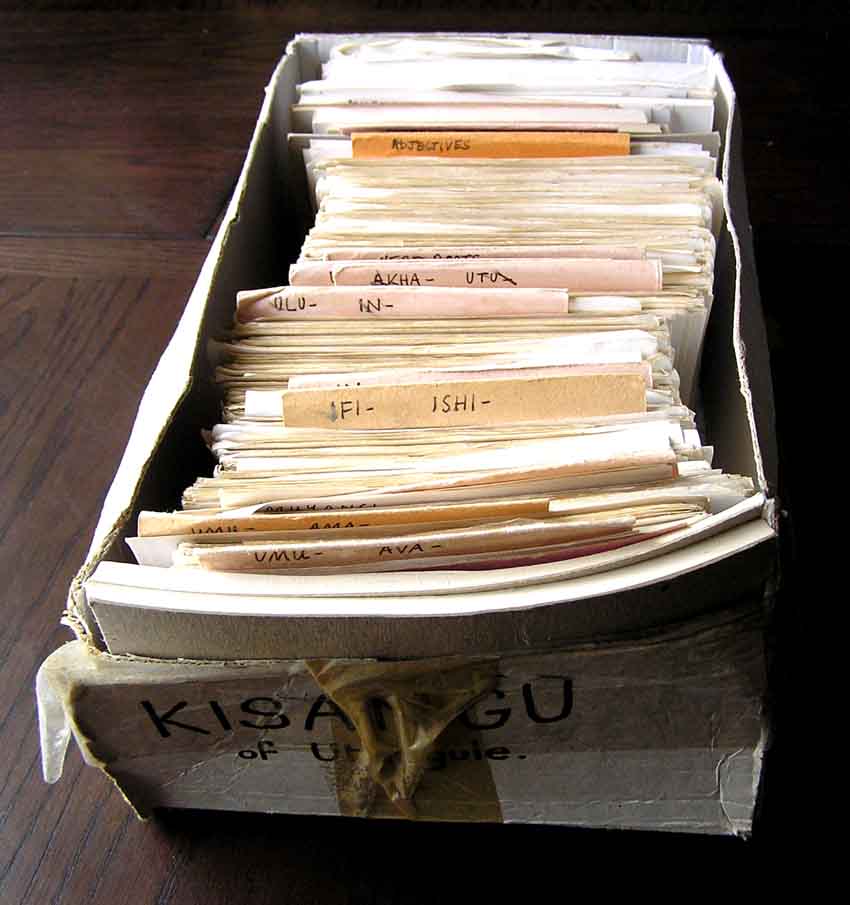
A SHOE BOX FOR SHISANGO

At my desk in Utengule: shoebox in the foreground
Last weekend my daughter asked me if I had any empty shoe boxes: she needed one to fill with odds and sods for an annual charity appeal. There is of course a pile of old shoe boxes in one corner of my study, waiting for the day when I abandon computers and manufactured filing systems in favour of the cheap and cheerful homemade solutions of yore. My most treasured shoe boxes lie at the bottom of the pile. One of them is filled with the slips of paper on which I recorded my Sangu (shisango) dictionary in the field; the other with subject and person indexes of my field notes compiled in the first month or so after my return to Cambridge in early 1982.

I indexed my chronologically written and organised notes at the suggestion of my research supervisor, Ray Abrahams, and having never word-processed them remain eternally grateful for this simple piece of advice. Compiling a dictionary using a card index or slips of paper was a time-tested practice, as afficianados of the making of the Oxford English Dictionary and James Murray's 'quotation slips' will know. Alison Redmayne, my ethnographic mentor, suggested I use index cards for recording Sangu when I first visited her in Oxford in April 1980. She also later recommended that I get hold of a copy of Wilfred Whiteley's 'Suggestions for recording a Bantu language in the field', an article based on a brief study of the Fipa language, in which the same method is suggested  ("It is probably easiest to begin by collecting a word-list on cards", 1964: 2). At the same time she sent me photocopies of the slips of paper on which she'd made her own small collection of Sangu vocabulary in the 1960s. And afterwards she wrote "If you do not have a filing box and cardboard index cards you can make your own index cards and use a biscuit tin - that is how my Kihehe dictionary started" (letter from Oxford dated 11 July 1980). While writing this note I asked Alison for more details: she recalls quartering quarto-sized sheets of paper to make her own cards or rather slips. For many years now she's kept these in a metal index card file drawer. This is the only copy of her Hehe dictionary, a language which very few Europeans can speak like her.  

I ended up with a shoe box. I've forgotten now whether I took this with me to Tanzania in July 1980 or obtained it when I was out there. New shoes were available in the country in 1980 but like a lot of basic goods were in short supply. Stationery, however, was essential to the functioning of the socialist state, and I had no trouble getting hold of pads of plain paper slips. Indeed there are still some unused pads in my Sangu shoe box with the price marked on them: four shillings each. Once I was installed in the village of Utengule-Usangu I set about recording Sangu vocabulary on these slips. At the same time I was learning Swahili, the primary language of my research in this increasingly polyethnic area. But collecting Sangu words and phrases provided me with endless pleasure. Even on the leanest of days I was sure to hear or elicit new items that I scribbled down on scraps of paper before transferring them to the thin slips of paper that were filed away in the box on my desk in alphabetical order within appropriate morphological categories. Let me hasten to add that I didn't study the language as systematically as I might if I knew what I do now, or my research depended on a professional description of it. To make matters worse, I've got cloth ears and struggle to hear vowel-length or distinguish tones and stress, and I didn't mark any of these. Indeed I didn't really understand the pitch accent system of Sangu until the mid-1990s (when I had time to work through and build on the work of my predecessor in Utengule, the White Father-turned-linguist Jacques Bilodeau), and a later attempt to elicit the finer points of tense and aspect in the language fizzled out in frustration. But my rough and ready dictionary was adequate for everyday ethnographic purposes, including the sociolinguistic analysis of Sangu greetings and titles that became one of the chapters of my thesis (Chapter 5, "The theory and practice of misreading greetings", 1984: 126-157).

After I'd written my thesis on the Phoenix mainframe computer in Cambridge, I typed up most of my Sangu dictionary (Walsh 1985), though I didn't get round to including all of the linguistic information from the shoe box and other notes that I'd made on language use, including transcriptions of songs and other tape recordings. And although I've since done further work on particular parts of the lexicon, including Sangu plant and animal names (e.g. Walsh 1995; 1996), I haven't made any attempt to incorporate additional terms and definitions in the dictionary, which I no longer have in electronic form (except as a scan of the computer printout). Nonetheless, I'm pleased that the contents of my old shoe box have been of some use to subsequent researchers, including linguists working for the Summer Institute of Linguistics (SIL) (e.g. Tlustos 2000). For some years SIL researchers have used their own electronic Shoebox, "a computer program that helps field linguists and anthropologists integrate various kinds of text data".  As the blurb says, this programme "is especially useful for helping researchers build a dictionary as they use it to analyze and interlinearize text. The name Shoebox recalls the use of shoe boxes to hold note cards on which definitions of words were written in the days before researchers could use computers in the field." Such is progress, but I'd hate to be parted from my own tatty box of linguistic history.

References

Bilodeau, Jacques 1979. Sept contes Sangu dans leur contexte culturel et linguistique. Elements de phonologie du Sangu, langue Bantou de Tanzania. Textes des contes avec traduction et notes. Thèse de Doctorat de Troisième Cycle, Université de la Sorbonne Nouvelle, Paris.

Tlustos, Martin 2000. Draft Sangu dictionary (incomplete). Unpublished ms., Mbeya, December 2000.

Walsh, Martin. 1984. The Misinterpretation of Chiefly Power in Usangu, South-west Tanzania. Unpublished Ph.D. dissertation, University of Cambridge.

Walsh, Martin 1985. Shisango Dictionary. Unpublished ms. (computer printout), Cambridge, June 1985.

Walsh, Martin 1995. Snakes on the Usangu Plains: an introduction to Sangu ethnoherpetology. East Africa Natural History Society Bulletin 25 (3): 38-43.

Walsh, Martin 1996. Fish and fishing in the rivers and wetlands of Usangu. East Africa Natural History Society Bulletin 26 (3/4): 42-47.

Whiteley, W. H. 1964. Suggestions for recording a Bantu language in the field. Tanzania Notes and Records 62: 1-19.

Saturday, 10 July 2010

FROM RIBE SCRIBE TO NATIONALIST POET

In October 1986, hunting for books in Nairobi, I wandered into a store on Kimathi Street that had clearly seen better days. There, on its dusty and understocked shelves, my eyes alighted on a rare work that I’d seen references to but hadn’t previously been able to get my hands on: William Frank’s Habari na Desturi za Waribe (“History and Customs of the Ribe people of the Coast Province of Kenya”), published in London in 1953. Better still, I was looking at a pile of ten or eleven copies of this slim volume, an ethno-book collector’s treasure-trove that was evidently of little value to the failing shopkeeper. The price was cheap and I bought the whole lot, reasoning that they’d otherwise be lost to scholarship when this dismal shop was closed down (as it subsequently was).

The Swahili and English title pages of the booklet emphasised that William Frank was himself a Ribe (the autonym is arihe, singular murihe). A couple of months later I came across a quite different book by him, a collection of Swahili poems entitled Diwani Yangu (“My Anthology”). Frank’s preface was dated July 1975, but he died the following year and the collection wasn’t published until 1979. The back cover summarises his life and work:

The late William Frank was born in 1922 in Kilifi District on the Kenya coast. In 1949 he joined the publishing department of the East African High Commission and worked there until his death in 1976. When he was there he composed many poems which were published in [the newspapers] ‘Taifa Leo’ and ‘Baraza’ and he won a number of prizes for his poetry. In addition he translated ‘Emil na Wapelelezi’ [Erich Kästner’s 1929 novel, originally published as Emil und die Detektive] and parts of ‘Kenya Farmer’ [Journal of the Agricultural Society of Kenya]. He also wrote ‘Juma Mtoto Yatima’ [“Juma the Orphan-child”, a fiction published in 1974 under the pseudonym Tonge Nyama]. (my translation of the Swahili blurb)

Perhaps not surprisingly, given the very different character of his later work, Frank’s study of his own ethnic group isn’t mentioned in this bio. He went to work at the East African Literature Bureau soon after it was founded, and his Ribe booklet was published in the series of ethnoethnographies and ethnohistories that the EALB itself initiated and organised: Masimulizi na Desturi ya Afrika ya Mashariki – Customs and Traditions in East Africa. When I first read it in 1986 I was disappointed by the relative blandness of Frank’s text and absence of detail about Ribe history and ethnography. But now I wonder more about the circumstances of its production. Was Frank simply making the most an opportunity presented to him at work? To what extent was he influenced by or responding to Ronald Ngala’s Nchi na Desturi za Wagiriama (“The Country and Customs of the Giriama”) published earlier in the same series? What were his own political views?

Like other works of its kind (cf. Maddox 1995; Topan 1997; Geider 2002), Frank’s ethnographic text dangles awkwardly between the conservative and divisive agenda of its colonial sponsors (the promotion of “tribal unity”) and the promise of a more inclusive future (the “detribalised” political consciousness that the British were intent on countering). It was, we should remember, published during the Mau Mau Emergency. Whereas his editors seemed keen to emphasise his Ribe-ness, Frank himself made a point of referring to the generalised “Swahili” or coastal identity of the Ribe and their Mijikenda relatives (“Wote hawa ni Waswahili maana wanaishi pwani”, p.vii). In his later Swahili poetry, published by the EALB’s successor, the Kenya Literature Bureau, Frank eulogised both Ngala and Kenyatta, demonstrating his nationalist credentials. There’s little here that would lead you to identify the author as a Ribe scribe.

References

Frank, William 1953. Habari na Desturi za Waribe (Desturi na Masimulizi ya Afrika ya Mashariki). London: Sheldon Press.

Frank, William 1979. Diwani Yangu (Johari za Kiswahili 19). Nairobi: Kenya Literature Bureau.

Geider, Thomas 2002. The Paper Memory of East Africa: Ethnohistories and Biographies Written in Swahili. In Axel Harneit-Sievers (ed.) A Place in the World: New Local Historiographies from Africa and South Asia. Leiden: Brill. 255-288.

Kästner, Erich 1973. Emil na Wapelelezi (translated by William Frank). Kampala: East African Literature Bureau.

Maddox, Gregory H. 1995. Introduction: The Ironies of Historia, Mila na Desturi za Wagogo. In Mathias E. Mnyampala, The Gogo: History, Customs, and Traditions (translated, introduced and edited by Gregory H. Maddox). Armonk, New York: M. E. Sharpe. 1-34.

Ngala, Ronald G. 1949. Nchi na Desturi za Wagiriama. Nairobi: The Eagle Press.

Nyama, Tonge [William Frank] 1974. Juma Mtoto Yatima. Nairobi: Kenya Literature Bureau.

Topan, Farouk 1997. Biography Writing in Swahili. History in Africa 24: 299-307.