Showing posts with label Sangu. Show all posts

Monday, 18 March 2013

GOODBYE TO ALISON REDMAYNE, MUNG'ANZAGALA SEMUGONGOLWA

by Martin Walsh

Alison Redmayne, Utengule, Usangu, December 1981
I've mentioned Alison Redmayne a number of times in this blog and will again, I hope. We first met at her house in north Oxford in February 1980 when I was planning doctoral research in Usangu, in south-west Tanzania. She became my ethnographic mentor and a lifelong friend. I last spoke to her in January, when she rang me from the Churchill Hospital in Oxford -- she'd been in and out with various complaints, but nothing that made me think that I wouldn't see or speak to her again. However, she didn't leave the hospital this time, but succumbed to a recurrence of lymphoma, a cancer that she'd beaten off once before. I had no idea until I wrote about her in my last post (Where The Doctor is Ignorant) and today's equivalent of the bush telegraph brought me the sad news.

Alison Hope Redmayne was born on 1 October 1936 and died on 20 February 2013, aged 76. She was buried in Wolvercote Cemetery on Wednesday afternoon (13 March), following an informal graveside ceremony attended by family and friends, who shared recollections of her before continuing to do the same in the more congenial surroundings of the Victoria Arms in Old Marston. It was unexpectedly, but appropriately, sunny when we were in the cemetery. The most poignant moment came when we all gathered around and strained to listen to the start of one of her recordings of Hehe mourning ceremonies, played back by her nephew's son Max over a mobile phone with a small tinny speaker attached.

Alison Redmayne, Oxford, August 2000
I couldn't help but reflect that if she'd been buried in one of the villages in Iringa or Mufindi that she knew so well, we'd have found ourselves in the midst of a multitude, the air filled with heartfelt lamentations and rousing songs in praise of Mung'anzagala Gisakamutemi Msengidunda Semugongolwa (her full name as an adopted member of the Hehe royal family), this extraordinary woman who spoke their language like few other Europeans could, who gave the best years of her life to recording their history and ethnography, and who ignored her own physical suffering to devote herself instead to improving their welfare, saving the lives of who knows how many people as she did so. Here's just one testimony, posted on the Mjengwa blog on 15 March:
I met Semgongolwa while I was a student at Lugalo Secondary School back in 1970. Even though I am Hehe, my Kihehe was far worse than hers. I will always remember her anthropological studies she conducted among the Wahehe; she was one of the few people who entered into the field, and never left!
. . . Alex Mwakikoti 
Alison Redmayne, Luhanga, Usangu, December 1981
Although she also worked in northern Nigeria, Alison Redmayne's name will always be most closely associated with the Hehe and neighbouring peoples in Tanzania, and so it should be. I've spent most of my spare time in the past week sorting through our correspondence, records of her visit to Usangu in December 1981, and searching for photographs, tape recordings, and a short video I made of her at home in Oxford in August 2000 (I've posted stills from this in the sidebar to the right -- scroll down to find them). I'll write more anon, but wanted to begin to say goodbye to her with this (grave) post marking her departure from this life and passage into the world of the ancestors whom she talked and wrote so much about.

Bibiliography of selected works by Alison Redmayne

Sound recordings

Alison Redmayne Collection, British Library, London.
For an introduction, link to the collection catalogue, and sample recordings see:
Topp, Janet 2012. Rare Tanzanian music recordings preserved. Music in the British Library Blog, 13 July 2012.

Photographing the Sangu chief Alfeo Merere, Luhanga, December 1981
Unpublished dissertations

Redmayne, Alison 1961. The Concept of Feudalism in African Ethnology. Unpublished B.Litt. dissertation, University of Oxford.

Redmayne, Alison 1964. The Wahehe People of Tanganyika. Unpublished D.Phil. dissertation, University of Oxford.

Published papers, articles, book chapters

Lee, Annabelle [= Alison Redmayne] 1968. African nuns: an anthropologist’s impressions. New Blackfriars 49 (576, May): 401-409. Also in 1968. Exchange. New Blackfriars 49 (579, August): 614-616.

Redmayne, Alison 1968. Mkwawa and the Hehe wars. Journal of African History 9 (3): 409-436.

Redmayne, Alison 1968. The Hehe. In Andrew Roberts (ed.) Tanzania Before 1900: Seven Area Histories. Nairobi: East African Publishing House. 37-58.

Redmayne, Alison 1969. Blasius Undole’s History of the Ndamba. Anthropos 64 (5/6): 957-959.

Redmayne, Alison 1969. Hehe medicine. By Dr. Weck, Senior Doctor of the Imperial Colonial Troops in Gerrnan East Africa. Introduced, translated and annotated by Alison Redmayne. Tanzania Notes and Records 70: 29-40.

Redmayne, Alison 1970. The war trumpets and other mistakes in the history of the Hehe. Anthropos 65 (1/2): 98-109.

Redmayne, Alison 1970. Chikanga: an African diviner with an international reputation. In Mary Douglas (ed.) Witchcraft Confessions and Accusations (ASA Monograph No. 9). London: Tavistock Publications. 103-128.

Redmayne, Alison, with Clement MwaNdulute 1970. Riddles and riddling among the Hehe of Tanzania. Anthropos 65 (5/6): 794-813.

Roberts, D. F., J. Chavez, and Alison Redmayne 1974. Dermatoglyphics of the Hehe (Tanzania). Man (N.S.) 9 (1): 31-43.

Following in the footsteps of Chief Alfeo Merere
Redmayne, Alison 1975. The Hehe. In Family of Man: People of the World and Where They Live (Marshall Cavendish Encyclopedia, Vol. 3, Part 41). London. 1138-1140.

Redmayne, Alison 1980. Note on health services and the indigenous population under the German administration (German East Africa). In E. E. Sabben-Clare, D. J. Bradley and K. Kirkwood (eds.) Health in Tropical Africa During the Colonial Period: Based on the Proceedings of a Symposium Held at New College, Oxford, 20-23 March 1971. Oxford: Clarendon Press. 115-117.

Redmayne, Alison, assisted by Christine Rogers 1983. Research on customary law in German East Africa. Journal of African Law 27 (1): 22-41.

Published report

Booth, David, Flora Lugangira, Patrick Masanja, Abu Mvungi, Rosemarie Mwaipopo, Joaquim Mwami and Alison Redmayne 1993. Social, Economic and Cultural Change in Contemporary Tanzania: A People-oriented Focus. Report to SIDA, commissioned through Development Studies Unit, Department of Social Anthropology, Stockholm University.

Her final publication and book review

Redmayne, Alison 2011. Review of Helga Voigt, Letters from Helga 1934-1937: A Teen Bride Writes Home from East Africa (trans. Evelyn Voigt, Renfrew, Ontario: General Store Publishing House, 2008), and Werner Voight, 60 Years in East Africa; Life of a Settler 1926 to 1986 (Renfrew, Ontario: General Store Publishing House, 1995). In Tanzanian Affairs 100 (September-December 2011): 70-71.

Monday, 27 February 2012

THE CRUMBLING HERITAGE OF THE SANGU

by Martin Walsh

Dancing yailya at mbalino, 7 August 1981
When the first European explorers crossed the mountains to the north of Lake Nyasa in 1877, they found themselves in the thick of a bloody conflict between the Sangu and the Hehe, the most powerful chiefdoms in what are now known as the Southern Highlands of Tanzania. They were welcomed by the Sangu chief Tovelmahamba Merere, who was holed up with his advisors and warriors in a temporary stockade at Mfumbi, at the foot of the escarpment that opens onto the Usangu Plains. After helping to raise the siege Captain Elton and his party then crossed the plains, travelling via the burned-out Sangu capital, Utengule, that had been abandoned by Merere a couple of years before. The Sangu chief didn't live in his old capital again, but died in exile in Usafwa, near modern Mbeya, in 1893. He was succeeded by his son, Mgandilwa Merere (aka Pambalu), who was finally able to return to Usangu at the end of 1896, after the Germans had defeated the Hehe under Mkwawa. In 1899 Mgandilwa went back to live in Utengule, and recruited craftsmen from the coast to build an imposing Swahili-style residence beside the River Mambi, a physical symbol of his authority, albeit circumscribed by German power (Walsh 1984: 42, 47-49).

Malenjela (photo by Alison Redmayne)
When I lived in Utengule-Usangu in 1980-81 Mgandilwa Merere's two-storey 'palace' was still the most impressive building in the village, though political authority now resided with the Village Secretary and other functionaries of the one-party State. The incumbent chief was Mgandilwa's grandson, Alfeo Mgandilwa Merere, and although he preferred to live in comparative isolation in the village of Luhanga, to the north of Utengule, he was regularly persuaded to preside over ritual offerings (mafunyo) to his ancestors at the palace, which everyone knew as mbalino (after, it was said, the name of a village thought to be similarly well-protected, in that case by a surrounding forest). Everyone was invited to these events (once upon a time attendance had been compulsory), the more the merrier, with the merriment provided by copious quantities of local beer and the performance of traditional songs and dances either side of the offerings themselves, which also meant a taste of roasted beef for those taking part. The first of the offerings I attended, at the end of the dry season in 1980, was in many ways the most spectacular, not least because it featured the rarely-heard playing of gourd zither (ligombo) and (separately) the war drums of the Sangu (one large and five small drums known collectively as malenjela). Appropriately enough, this collective offering and celebration was followed immediately by the start of the rains that it was designed to bring.  

Approaching mbalino, 25 August 2007
In all I attended five of these two-day royal rituals at Merere's Utengule residence, two of which were held consecutively. I wrote at some length about one of them in a chapter of my doctoral dissertation and the paper that was based on it (1984: 75-84; 1985). I've always wanted to write more, to try to capture (recover?) something of the emotional impact that these events had upon me, and to record the sights and sounds I witnessed for posterity, including the many banal aspects of these collective rituals and the human interactions that characterised them. More than once, though, I've held back because of discomfort with my evident failure to understand everything that was going on during these events, including the lack of an overall interpretation that would fit readily into the anthropological literature that I was brought up on. It's taken me some years to appreciate that Not Understanding Everything is an inescapable feature of research in Usangu, not to mention in other complex social situations, and not necessarily just a personal failing. My incomplete knowledge and understanding of what has happened in Utengule since I left at the end of 1981 is another case in point, and amply illustrated by the paragraphs that follow.

The crumbling exterior, 25 August 2007
When Alfeo died in 1988 (other dates are available), there was uncertainty over who should inherit the chiefship, and it was offered to two senior members of the royal family, who both turned it down on the grounds (it seems) that they could do without the hassle and not least the expense of having to pay for periodic offerings to their ancestors. The stool was eventually given to Yusuf, Alfeo's eldest son, who wasn't really in a position to sit on it because he lived and worked in Dodoma, the nation's political capital. He was then pushed aside by his younger brother, Ahmed, a schoolteacher who did at least live in Utengule, though not in the palace itself. When I returned to Utengule after a decade and a half absence in February 1997, this was being occupied by his mother Simalisa and her younger children. We sat and chatted in the cloistered baraza, where the large lilenjela drum occupied its traditional position at one end. The building was very evidently starting to crumble, and I made a note of this at the time. The writing was on the wall (quite literally), and Ahmed was subsequently blamed for failing to maintain not only the palace but also the welcoming spirit and traditional practices that had once given it life.

The collapsed wall, 25 August 2007
(Daniel Merere in the foreground, Jonas Mfumbulwa to the left)
I visited Utengule on a number of occasions after 1997, but didn't pay much attention to the Sangu royal residence or even the fate of the chiefship. On my last trip to Usangu in August 2007, I travelled from Rujewa to Utengule with Daniel Merere, whose father Myotishuma (Alfeo's father's brother) had played the ligombo in 1981 (and for anthropologist Alison Redmayne in the late 1960s). We went to see the palace, together with  Maneno Merere, one of Alfeo's sons, Jonas Mfumbulwa, the Mereres' ritual specialist, and Mohammed Mfumbulwa, Jonas' nephew and Chairman of the administrative unit in which the mbalino is now located, Magurula village. I was shocked to see the state of the now unoccupied building, one wall of which had collapsed, exposing its inner chambers and the stairs to the upper floor. I was equally dismayed to see that the large lilenjela drum, once a majestic instrument, had lost its skin and was falling apart. Maneno told me that the four smaller drums had been stolen. The separate kitchen building was also a ruin, and the whole compound, including the nearby royal graves, pervaded with an air of neglect. After inspecting the building and discussing the possibility of raising funds to restore the palace to its former glory -- difficult I thought, without evidence of collective organisation and support for such a project -- I entrusted Daniel with some money for emergency repairs and encouraged him to coordinate with other members of the royal family. He later sent me a detailed estimate of the cost of fixing the whole building, totalling nearly Tshs.3.5 million, but I was at a loss to know what to do with this, other than helping to publicise the plight of the royal palace.    

The neglected lilenjela, 25 August 2007
I haven't followed up until writing this post. Meanwhile, it seems, things have moved on. Ahmed Merere died in the early noughties (or before), and in 2002 (or thereabouts) his elder brother Yusuf returned to live in Utengule and reoccupy the royal stool, though his incumbency wasn't universally accepted. Some people considered the rightful chief to be another brother, Salehe (aka Luvaha), who was a son of Alfeo's by another wife, Simanjaganjali. I was told in 2003 that he had come out on top in the ritual test that was given to Alfeo's sons after his death, a test that was traditionally used to divine who was most suitable to succeed to the chiefship (this ritual and different understandings of it is a subject for another day). At the time he was judged too young to take up the position, hence the accession of his elder half-brothers Yusuf and then Ahmed. Although I can't say exactly how this happened, Salehe Alfeo Merere is now occupying the position that some thought he should have been all along, as chief of the Sangu. He's posted an appeal on a local website, asking for more than Tshs. 43.5 million to renovate the palace and add other buildings and facilities to turn it into a museum. This is an ambitious project, and not well explained or pitched. But it's a sign that there might life yet in the Sangu chiefship and its otherwise crumbling heritage.

Acknowledgement
My thanks to Gundula Fischer at Tumaini University for telling me about a recent joint offering held by Salehe Merere and the Hehe chief, Abdul Mkwawa, at the latter's seat in Kalenga. This started me searching through old correspondence, notes and photos -- I might revise this post if I find more -- and also led me to the online appeal by the Sangu chief. What I know about the events that followed the death of Alfeo Mgandilwa Merere, I owe to one man in particular, his cousin Daniel Merere.

References

Writing on the wall of mbalino
Walsh, Martin 1984. The Misinterpretation of Chiefly Power in Usangu, South-west Tanzania. Unpublished Ph.D. dissertation, University of Cambridge.

Walsh, Martin 1985. Village, state and traditional authority in Usangu. In R. G. Abrahams (ed.) Villagers, Villages and the State in Modern Tanzania (Cambridge African Monograph No. 4). Cambridge: African Studies Centre. 135-167.


Thursday, 23 December 2010

CHILD'S PLAY IN USANGU AND UHEHE

In the good old days of descriptive ethnography children's games and pastimes were treated as a serious matter. The now-defunct handbook Notes and Queries on Anthropology declared games of all kinds to be "worthy of special study", and advised fieldworkers to join in and learn to play them, as well as recording them as fully as possible (1929: 321; 1951: 334). When I began fieldwork in Usangu in 1980, Alison Redmayne encouraged me to collect children's riddles for the linguistic and cultural information they contained, much as she and other Oxford-trained anthropologists of her generation had done. But after a tentative start I switched my attention to the verbal 'games' that adults played, making no more than occasional notes on children's pastimes whenever I came across them. Sometimes they were difficult to ignore, like the boys who playfully parodied the ethnographer-as-photographer with their own clay models of my camera.

I discovered Iona and Peter Opie's The Lore and Language of Schoolchildren (1959) in the mid-1990s and haven't tired of dipping into their work ever since, not least because it brings forth memories of my own childhood in the north-west of England. In 1998 I went through my Sangu dictionary and fieldnotes from Usangu plucking out the snippets that I'd written about children's toys, games and other pastimes. Here are some lightly edited extracts from my compilation:

Counting songs
In 1981 I recorded one childhood counting song from two adult Sangu, a man and a woman, who sang it in unison:
1. mbwe
2. yangaya
3. yapusi
4. yalima
5. tumbwe-tumbwe
6. manguluma
7. kinengu
8. nengulya
9. kilosa
10. chumilya
These apparently nonsensical 'numbers' bear no obvious relation to the Sangu cardinals in everyday use, nor other known Sangu counting systems (a cominatorial verbal sequence in use in the late 19th century and a finger counting system which is still employed). The tenth term, chumilya, appears to be a playful variant of Swahili kumi, 'ten', or one of its Northeast Coast Bantu cognates (/ch/ is not an inherited Sangu phoneme, nor is it usually retained in loanwords except in some proper names). The ninth term is possibly derived from the place name Kilosa, located in Usagara on one of the old caravan routes to the coast, though why it should be so derived is obscure (/ki/ also has a very restricted distribution in Sangu, and is probably indicative of a loan in this case: this also applies to the term for seven, kinengu). The other terms in the list share the regular phonological characteristics of Sangu, and playful etymologies might be suggested for some of them, though this would be no more than guesswork.

Jacks
The Sangu version of jacks (imdodo) that I witnessed on numerous occasions in Utengule in 1980-81 was played with twelve small stones as the jacks and a small round fruit of the ilihuluhulu (Capparis tomentosa) shrub as the ball. The game is played as follows. A small hollow is made in the earth and the stones are placed inside it. The fruit is then thrown up in the air and before it is caught a single stone must be scooped up in the other hand. If more than one stone is scooped up then the extra stone(s) must be returned to the hollow on the next throw. When all twelve stone have been removed one by one in this way, they are returned to the hollow and the same procedure is repeated, this time the stones being removed in twos. Next time they are removed in threes, then fours, and so on, until all twelve stones have to be scooped up in one go. If the player errs at any point (for example by failing to catch the fruit) then it is the turn of another player (or the same player if she is playing alone) to start from the beginning again. This game is most commonly played by girls. A twelve-stone game was also observed and photographed by Kubik in 1976 in the vicinity of Mahango-Mswiswi (1978: 103). This is a version of the game called 'fivestones' by Opie and Opie (1997: 56-72).

Where's the cow?
The following guessing game is one of the most common Sangu children's games, and I watched it being played in both Utengule and Luhanga in 1981. The game is played by two opponents (often accompanied and assisted by other children) who face one another and take turns to guess in which hand the other is concealing a small stone. The stone is referred to as ing'ombe, a cow, and each turn begins with the following exchange:

Player concealing the cow: hilili, hilili (the name of the game)
Player trying to guess where it is: ing'ombe, ing'ombe, 'cow, cow'
First player again: ing'ombe yili kwi?, 'where's the cow?'

If a player guesses correctly, then he or she is entitled to advance his or her counter (also a stone) towards a goal drawn on the ground. This goal takes the form of a circle or small hollow in the middle of a pitch of typically five or six concentric circles (sometimes not completed at the sides, so that the pitch comprises two bands of lines on either side of the goal). The game starts with the two counters at the outer edge of the pitch, being moved progressively towards the centre (across individual lines) at each successful guess. The winner is the player or team whose stone counter reaches the central goal first. When I first recorded this game being played, in Luhanga, children whose turn it was to conceal the 'cow' frequently attempted to cheat by dropping the stone behind their back, so that it was in neither hand. The game is called hilili, presumably after its opening formula, the etymology of which is opaque. The same term is also used in an extended sense by many Sangu speakers to refer to puzzles and riddles in general. Hilili can perhaps be thought of as the quintessential Sangu children's game, not only because of the wider use of its name, but also because it is cast in a bovine idiom.

If I was to rewrite these notes I'd say more about the actual games I watched and the contexts in which they were played. There's a nice account by Marius Fortie (1938: 302-303) of a series of contests and games which he observed being played in the west of Usangu in September 1934, having provided the prize money himself. That's one way of getting people to play games, although it wasn't Fortie's intention to record them in any great detail.  Studying children's games isn't child's play, and I'm not aware of any attempt in East Africa to undertake the kind of research that the Opies did in England, Scotland and Wales, though there are scattered sources from which a compilation might be begun, including the now largely forgotten literature on string figures. In November-December 2002 my Hehe-speaking research assistant, Justin John Kitinye, filled six school exercise books (436 pp.) with descriptions of the games that he knew and had played as a child. I've barely begun to translate these and reflect on their significance, but am very much looking forward to it.

References

Fortie, Marius 1938. Black and Beautiful: A Life in Safari Land. London: Robert Hale.

Kubik, Gerhard 1978. Recording utamaduni in Tanzania - a field report from Iringa and Mbeya regions, Oct 10 - Dec 14, 1976. Review of Ethnology 5 (11-14): 81-107.

Opie, Iona and Peter Opie 1959. The Lore and Language of Schoolchildren. Oxford: Clarendon Press.

Opie, Iona and Peter Opie  1969. Children's Games in Street and Playground. Oxford: Oxford University Press.

Opie, Iona and Peter Opie 1985. The Singing Game. Oxford: Oxford University Press.

Opie, Iona and Peter Opie 1997. Children's Games with Things. Oxford: Oxford University Press.

Redmayne, Alison 1970. Riddles and riddling among the Hehe of Tanzania. Anthropos 65: 719-813.

The Royal Anthropological Institute 1929. Notes and Queries on Anthropology (5th edition). London: The Royal Anthropological Institute.

The Royal Anthropological Institute 1951. Notes and Queries on Anthropology (6th edition). London: Routledge and Kegan Paul Ltd.

Walsh, Martin 1985. Shisango Dictionary. Unpublished ms. (computer printout), Cambridge, June 1985.

Walsh, Martin 1998. Children's toys, games and other pastimes in Usangu. Unpublished ms. (draft).


Sunday, 14 November 2010

A SHOE BOX FOR SHISANGO

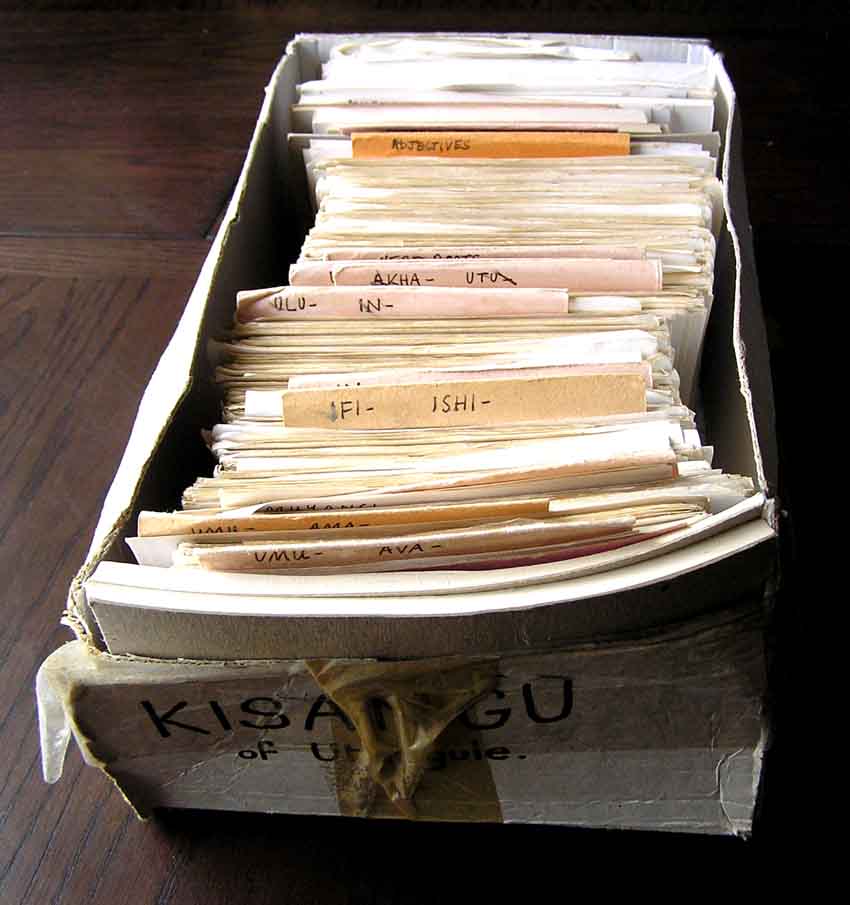
At my desk in Utengule: shoebox in the foreground
Last weekend my daughter asked me if I had any empty shoe boxes: she needed one to fill with odds and sods for an annual charity appeal. There is of course a pile of old shoe boxes in one corner of my study, waiting for the day when I abandon computers and manufactured filing systems in favour of the cheap and cheerful homemade solutions of yore. My most treasured shoe boxes lie at the bottom of the pile. One of them is filled with the slips of paper on which I recorded my Sangu (shisango) dictionary in the field; the other with subject and person indexes of my field notes compiled in the first month or so after my return to Cambridge in early 1982.

I indexed my chronologically written and organised notes at the suggestion of my research supervisor, Ray Abrahams, and having never word-processed them remain eternally grateful for this simple piece of advice. Compiling a dictionary using a card index or slips of paper was a time-tested practice, as afficianados of the making of the Oxford English Dictionary and James Murray's 'quotation slips' will know. Alison Redmayne, my ethnographic mentor, suggested I use index cards for recording Sangu when I first visited her in Oxford in April 1980. She also later recommended that I get hold of a copy of Wilfred Whiteley's 'Suggestions for recording a Bantu language in the field', an article based on a brief study of the Fipa language, in which the same method is suggested  ("It is probably easiest to begin by collecting a word-list on cards", 1964: 2). At the same time she sent me photocopies of the slips of paper on which she'd made her own small collection of Sangu vocabulary in the 1960s. And afterwards she wrote "If you do not have a filing box and cardboard index cards you can make your own index cards and use a biscuit tin - that is how my Kihehe dictionary started" (letter from Oxford dated 11 July 1980). While writing this note I asked Alison for more details: she recalls quartering quarto-sized sheets of paper to make her own cards or rather slips. For many years now she's kept these in a metal index card file drawer. This is the only copy of her Hehe dictionary, a language which very few Europeans can speak like her.  

I ended up with a shoe box. I've forgotten now whether I took this with me to Tanzania in July 1980 or obtained it when I was out there. New shoes were available in the country in 1980 but like a lot of basic goods were in short supply. Stationery, however, was essential to the functioning of the socialist state, and I had no trouble getting hold of pads of plain paper slips. Indeed there are still some unused pads in my Sangu shoe box with the price marked on them: four shillings each. Once I was installed in the village of Utengule-Usangu I set about recording Sangu vocabulary on these slips. At the same time I was learning Swahili, the primary language of my research in this increasingly polyethnic area. But collecting Sangu words and phrases provided me with endless pleasure. Even on the leanest of days I was sure to hear or elicit new items that I scribbled down on scraps of paper before transferring them to the thin slips of paper that were filed away in the box on my desk in alphabetical order within appropriate morphological categories. Let me hasten to add that I didn't study the language as systematically as I might if I knew what I do now, or my research depended on a professional description of it. To make matters worse, I've got cloth ears and struggle to hear vowel-length or distinguish tones and stress, and I didn't mark any of these. Indeed I didn't really understand the pitch accent system of Sangu until the mid-1990s (when I had time to work through and build on the work of my predecessor in Utengule, the White Father-turned-linguist Jacques Bilodeau), and a later attempt to elicit the finer points of tense and aspect in the language fizzled out in frustration. But my rough and ready dictionary was adequate for everyday ethnographic purposes, including the sociolinguistic analysis of Sangu greetings and titles that became one of the chapters of my thesis (Chapter 5, "The theory and practice of misreading greetings", 1984: 126-157).

After I'd written my thesis on the Phoenix mainframe computer in Cambridge, I typed up most of my Sangu dictionary (Walsh 1985), though I didn't get round to including all of the linguistic information from the shoe box and other notes that I'd made on language use, including transcriptions of songs and other tape recordings. And although I've since done further work on particular parts of the lexicon, including Sangu plant and animal names (e.g. Walsh 1995; 1996), I haven't made any attempt to incorporate additional terms and definitions in the dictionary, which I no longer have in electronic form (except as a scan of the computer printout). Nonetheless, I'm pleased that the contents of my old shoe box have been of some use to subsequent researchers, including linguists working for the Summer Institute of Linguistics (SIL) (e.g. Tlustos 2000). For some years SIL researchers have used their own electronic Shoebox, "a computer program that helps field linguists and anthropologists integrate various kinds of text data".  As the blurb says, this programme "is especially useful for helping researchers build a dictionary as they use it to analyze and interlinearize text. The name Shoebox recalls the use of shoe boxes to hold note cards on which definitions of words were written in the days before researchers could use computers in the field." Such is progress, but I'd hate to be parted from my own tatty box of linguistic history.

References

Bilodeau, Jacques 1979. Sept contes Sangu dans leur contexte culturel et linguistique. Elements de phonologie du Sangu, langue Bantou de Tanzania. Textes des contes avec traduction et notes. Thèse de Doctorat de Troisième Cycle, Université de la Sorbonne Nouvelle, Paris.

Tlustos, Martin 2000. Draft Sangu dictionary (incomplete). Unpublished ms., Mbeya, December 2000.

Walsh, Martin. 1984. The Misinterpretation of Chiefly Power in Usangu, South-west Tanzania. Unpublished Ph.D. dissertation, University of Cambridge.

Walsh, Martin 1985. Shisango Dictionary. Unpublished ms. (computer printout), Cambridge, June 1985.

Walsh, Martin 1995. Snakes on the Usangu Plains: an introduction to Sangu ethnoherpetology. East Africa Natural History Society Bulletin 25 (3): 38-43.

Walsh, Martin 1996. Fish and fishing in the rivers and wetlands of Usangu. East Africa Natural History Society Bulletin 26 (3/4): 42-47.

Whiteley, W. H. 1964. Suggestions for recording a Bantu language in the field. Tanzania Notes and Records 62: 1-19.

Saturday, 17 July 2010

THE USANGU METEORITE MYSTERY

One of the most puzzling reports that I heard when I lived in Utengule-Usangu in the early 1980s was that a meteorite had fallen to earth somewhere to the east of the village. This event was supposed to have taken place in the early hours (around 2.30-3.00 in the morning) of Thursday 12th November 1981. The first I knew about it was later that day when I joined my usual kikao or drinking group in the main village club and listened to intense speculation about what had happened. Was it really a meteorite that had fallen out of the night sky? Could it have been a plane crash? Or an explosion of some kind, a bomb perhaps? No one was sure.

The next day the Village Secretary (the CCM-appointed Katibu wa Kijiji) came to the kikao with the news that the cause of the loud noise that people had heard was indeed a “star” (Swahili nyota) that had fallen in the vicinity of Rujewa, the administrative centre of what was then Mbarali Sub-District. Needless to say on Saturday 14th debate in the kikao continued. The most detailed account I could obtain was from Paulo, a young Sangu man who had relatives in the area in question. The meteorite had fallen at Uyelevala, beyond Ubaruku village, and it was now being guarded by soldiers. People as far away as Luhanga, the village to the north of Utengule, had seen the earth light up at night, and some of them had thrown themselves to the ground, thinking that the world was coming to an end.

My fieldwork in Usangu was drawing to a close, and I left Utengule at the end of the year none the wiser about this seemingly apocalyptic event. Was it a meteorite that blazed its way to earth in a fireball? Thousands of meteorites are thought to fall to the earth every year, but only a small proportion of these are observed, located, and officially recorded and reported. The 5th edition of the Catalogue of Meteorites (Grady 2000) lists a mere 1,005 meteorite falls (the technical term for meteorites that have actually been seen falling to earth) and 21,502 meteorite finds (meteorites discovered on the ground but not observed falling). Only nine meteorites are listed in current databases for Tanzania, eight of them observed falls, and one a find – the famous Mbosi (= Mbozi) Meteorite, one of the largest iron meteorites in the world (Sassoon 1967). But only two meteorite falls have been reported since national independence (one in 1963 and one in 1988), and none are recorded in Usangu.

It is possible, I suppose, that a meteorite did fall but wasn’t reported to the wider scientific community: after all the Tanzanian state in 1981 wasn’t the most open of societies. Otherwise I find myself continuing the lively speculations of my drinking companions in Utengule. Was it a plane or even a piece of military hardware that had dropped out of the sky? Is that why soldiers were guarding the site, and was the meteorite story merely a cover? Or was something more sinister going on? Is Uyelevala Tanzania’s Roswell? And should I start writing more creatively (von Däniken-style) about Sangu cosmology; the belief that pangolins are sent down to earth by the ancestors, the complex of ideas about chiefship and fertility that this connects to (see Walsh 1995/96; 2007; also 2010), including the announcement of the death of a chief with the statement that “the sky has fallen down” (Sangu uwulanga wagwa)? Turn my ethnographic knowledge into a cross between The X-Files and The Gods Must Be Crazy? Answers in a bottle please.

Acknowledgement
The photo of the Mbozi Meteorite (above) is from the Maisha ni Vita blog.

References

Grady, Monica M. 2000. Catalogue of Meteorites (5th edition). Cambridge: Cambridge University Press.

Sassoon, Hamo 1967. Guide to the Mbozi Meteorite. Dar es Salaam: Department of Antiquities.

Walsh, Martin 1995/96. The Ritual Sacrifice of Pangolins among the Sangu of South-west Tanzania. Bulletin of the International Committee on Urgent Anthropological and Ethnological Research 37/38: 155-170.

Walsh, Martin 2007. Pangolins and Politics in the Great Ruaha Valley, Tanzania: Symbol, Ritual and Difference / Pangolin et politique dans la Vallée du Great Ruaha, Tanzanie: Symbole, rituel et différence. In Edmond Dounias, Elisabeth Motte-Florac and Margaret Dunham (eds.) Le symbolisme des animaux: L'animal, clef de voûte de la relation entre l'homme et la nature? / Animal symbolism: Animals, keystone of the relationship between man and nature? Paris: Éditions de l’IRD. 1003-1044.

Walsh, Martin 2010. Red Velvet from Heaven. East African Notes and Records, 13 June 2010.

Saturday, 12 June 2010

RED VELVET FROM HEAVEN

“About October the dark clouds begin to gather in the east, lingering about the crests of the ridges before breaking in spectacular thunderstorms. While it is still raining the hot sun comes out, the earth steams and rainbows appear over the lakes and dams. At this moment, the people say, “The hyaena is giving birth to twins.” Overnight scarlet lilies appear like balls of fire among the sprouting millet; shrubs along the cattle-paths break into leaf and in a few days are covered with pink scented flowers; bees hum everywhere; and a red velvet mite which crawls over the damp earth is welcomed as “the child of the rain” (mwambua) - a favourite personal name for anyone born at this time. Along the edge of the cattle-paths grass begins to appear. By late December, in a normal year, the rain may be so heavy that much of the country becomes impassable.” (Jellicoe 1978: 6-7)

Marguerite Jellicoe’s evocative description of the start of the annual rains in Singida includes a rare reference to the cultural significance of red velvet mites in Tanzania. I first came across these brightly coloured arachnids (family Trombidiidae) in 1981, at the start of my second wet season in the village of Utengule in Usangu (in what is now Mbarali District). I was away when the rains began on 2nd December, but when I returned to the village two days later these small crimson creatures were everywhere on the newly dampened earth. Sangu-speakers called them inkhadupa, their generic name for ticks and mites, and told me that they were thought to fall down from the sky along with the rain. In this respect they were similar to ground pangolins (Manis temminckii), another creature believed to fall from the heavens, from whence they were sent by the ancestors, amanguluvi.

At the time I had no idea what kind of tick or mite these might be. I later found a reference to them in adventurer Marius Fortie's book Black and Beautiful (1938). When he was in Dodoma in December 1933, Fortie was told by an American naturalist that the "velvety red bugs" crawling on wet sand after heavy rainfall were a kind of tick (1938: 251). In May 1995 I wrote to the National Museums of Kenya in Nairobi asking if they could help identify the creature that both Fortie and I had seen. In the absence of a specimen they couldn't. I therefore referred to it as a "small red tick" in the paper that I wrote about 'The Ritual Sacrifice of Pangolins among the Sangu of South-west Tanzania' (1995/96: 165).

The growth of the internet has since made searching for this kind of information much easier than it once was, and when I eventually revisited this question it didn't take me long to find out that these 'ticks' were in fact red velvet mites - a perfect description of their external appearance. According to Joanna Makol, an authority on the Trombidiidae and their relatives, the red velvet mites that appear in large numbers after heavy rain are most likely members of the genus Dinothrombium (Oudemans, 1910), only two species of which have been recorded in Tanzania, D. tinctorium (Linnaeus, 1767) and D. zarniki (Krausse, 1916). But definite identification of the heavenly mites that make such a dramatic seasonal appearance in Usangu and elsewhere in the Eastern Rift must await the collection and description of more specimens.

Whatever species are involved, it's clear that red velvet mites are known throughout the region. A post on the Tanzania Odyssey blog in February 2009 describes their sudden appearance in Ruaha National Park, when "in some areas the whole ground can take on an almost red sheen and to walk without standing on one is almost impossible." But their emergence at the start of the rains isn't everywhere ascribed to heavenly intervention. Writing in 2002, my Hehe-speaking research assistant in Iringa, John Justin Kitinye, described pink-coloured ngudupa or ngudupasa mwihala (lit. 'bush mites', as distinct from ngudupasa mnyumba or kaye, 'house ticks') quite accurately as creatures which could dig down and hide in sand for months on end during the long dry season. No mention of them falling from heaven here, but wondrous animals nonetheless.

Acknowledgements
I couldn't have written this note without the information provided by the late Ngwila Simuhongole and other villagers in Utengule, as well as by John Justin Kitinye in Iringa. I'm also grateful to Richard Bagine and David Moyer for answering my queries, and especially to Joanna Makol for her email correspondence in February 2008 and for sending me extracts from her paper in Annales Zoologici (2007).

References

Fortie, Marius 1938. Black and Beautiful: A Life in Safari Land. London: Robert Hale.

Jellicoe, Marguerite 1978. The Long Path: A Case Study of Social Change in Wahi, Singida District, Tanzania. Nairobi: East African Publishing House.

Makol, Joanna 2007. Generic Level Review and Phylogeny of Trombidiidae and Podothrombiidae (Acari: Actinotrichida: Trombidioidea) of the World. Annales Zoologici 57 (1): 1-194.

Walsh, Martin 1995/96. The Ritual Sacrifice of Pangolins among the Sangu of South-west Tanzania. Bulletin of the International Committee on Urgent Anthropological and Ethnological Research 37/38: 155-170.

Friday, 3 April 2009

THROWING AWAY THE DEAD: Communal Sites for the Disposal of Corpses in Pre-colonial South-west Tanzania

by Martin Walsh

[This is a corrected version of an article originally published in 1998 in Mvita: Bulletin of the Regional Centre for the Study of Archaeology in Eastern and Southern Africa, 7: 1-4. For some time it was available on the National Museums of Kenya website, together with a French translation by Edouard Bugingo (‘Jeter les Cadavres: Sites Communs où sont Déposés les Cadavres au Sud-Ouest Tanzanien dans la Periode Pre-Coloniale’). This led to its incorporation in The Rough Guide to Tanzania, which since 2003 has been suggesting to travellers that they try seeking out one of several “ritual sites next to ravines from where the Sangu tribe threw their dead (and, sometimes, the living, if they had been convicted of certain crimes, including philandery).” I’d be interested to hear from anyone who has tried!]

Introduction

The ethnographic record indicates that disposal of the dead by leaving their corpses in the bush was once a widespread feature of mortuary practice in East Africa, practised by many Bantu as well as non-Bantu speakers. The following notes describe an interesting variation upon this practice, recorded (and still remembered) among different groups of Bantu speakers in what is now south-west Tanzania. Whereas most peoples known to have disposed of their dead in this way appear to have done so in any convenient spot away from habitation, the Sangu and others referred to below “threw away” their dead in particular sites designated for this purpose. These sites for communal disposal are recognisable by their common names and, though no longer used in quite the same way, are still feared through their association with death.

Sangu Practice
I have most information on the practice of the Sangu (avasango), among whom I conducted anthropological research between 1980 and 1982. The Sangu are the indigenous inhabitants of the Usangu Plains, which lie to the north of the mountain ranges which rise up from the northern shores of Lake Malawi. They speak an Eastern Bantu language which is classified in the Southern Highlands group together with Hehe, Bena, Wanji, Kinga, Pangwa, Kisi and Manda (Nurse 1988: 59). The development of trade routes from the East African coast in the early nineteenth century appears to have stimulated the early unification of the Sangu into a single chiefdom. The Hehe followed suit, and in the late 1870s forced the Sangu out of Usangu. The Sangu chief, Tovelamahamba Merere, established a new capital in the hills of Usafwa, to the west. The Sangu remained in exile there until after the turn of the twentieth century, when they were restored to Usangu (under Tovelamahamba’s son and successor, Mgandilwa Merere) by the newly established German administration (see Walsh 1984 for a detailed survey of Sangu history).

The contemporary Sangu bury all of their dead, and appear to have done so since the first decade or so of the colonial period. Earlier European travellers and missionaries, however, noted otherwise. When Elton and his party visited Tovelamahamba Merere in 1877 at Mfumbi, on the southern border of Usangu, they found large numbers of decomposing corpses, the victims of Hehe assaults, piled up outside of the stockade. At first it seemed that this may have been a temporary exigency of warfare, but after observing a dead woman being thrown into the bush Elton concluded that the Sangu did not in any event bury their dead (1879: 350-351, 358, 361-362). The Moravian missionaries who founded a mission station in 1895 outside of the Sangu capital-in-exile, Utengule-Usongwe (Kwa Mwalyego in Usafwa), were shocked to learn that corpses were being tossed into a nearby ravine. They appealed to Mgandilwa Merere to stop this practice, which he did, at least in this particular place (PA 1896: 288).

Comparative evidence suggests that the Sangu, like many of their neighbours, once disposed of all of their commoners in this way. Indeed contemporary linguistic usage has preserved the memory of this practice: the phrase kitaga umunu, ‘to throw away a person’, has been retained in ishisango, the Sangu language, as a polite euphemism for burial, and is used in preference to the verb kisiila, which means ‘to bury’ pure and simple. However, chiefs and certain other special categories of person, including twins and their parents, are said to have always been buried. The burial of the Sangu chief was a particularly elaborate affair, and when Tovelamahamba Merere died at the end of 1893 he was consigned to the grave together with a number of retainers (Heese 1913: 141), as well, it is said, with a large number of elephant tusks and other worldly goods to help him on his way.

Contemporary accounts also make it clear that the Sangu possessed designated sites for the disposal of corpses. The ravine near the Moravian mission station at Utengule-Usongwe was presumably one of these. One site, called Pitago (sometimes Kwitago), literally ‘the place for throwing away’, is located at the north-east of the twentieth century Sangu capital, Utengule-Usangu. It is possible that this site dates back to the nineteenth century, because Tovelamahamba Merere’s pre-1877 capital also stood close by. Informants cannot recall Pitago ever having been used for the general disposal of the dead, though it is described as a sacred site on which sacrificial offerings can be made for the whole population. According to one middle aged male informant it was used in the past (in the days of his grandfather) to dispose of transgressors, such as men who had unwisely seduced wives of the chief. In such a case the tribal elders would approach the accused and ask him to dress in his best clothes in order to accompany them to Pitago to sacrifice a bull. Once there they would slaughter the bull, and shortly thereafter the unwitting victim, whose corpse they would simply throw down on the spot. My informant thought that the victim’s decapitated head might have been brought back to the settlement for display, but he was not sure on this point. He added that in the daytime corpses left at Pitago would be consumed by vultures, and at night by hyenas (compare Elton: “...and now over a heap of skeletons, scattered leather aprons and beads, hovered flocks of vultures and gigantic storks, which, gorged with their loathsome feast, had scarcely power to flap away into the lower branches of the magnificent forest trees which adorn the once peaceful Usango valley”, 1879: 350-351).

This account recalls that of the Moravian missionaries, who discovered the Sangu practice of throwing away the dead following an incident in 1896 when Mgandilwa Merere had ordered the execution of two of his wives and a man for adultery. We can hypothesise that at this time Sangu mortuary practice was in a stage of transition, as burial became increasingly fashionable among commoners, perhaps initially for those who held political or military office and their close relatives. Disposal by exposure was subsequently restricted to the corpses of criminals and people in lower social categories, such as non-Sangu (as suggested by another informant in discussing the uses of Pitago). Thereafter burial became the universal practice: this was certainly the case in the south of Usangu around Brandt Lutheran Mission when Heese (1913) wrote on local customs. At the same time the chief / commoner distinction remained marked by different forms of burial: chiefs and the special ritual categories of persons treated analogously to them were and still are buried in a sitting position, whereas ordinary people are buried lying down.

Pitago in Utengule-Usangu still has strong associations with death for the local population. Broken pots and other remains are said to be found there, and the site is thought to be especially fearful during and after the rainy season when the grass has grown long. In 1981 Pitago had been set aside as a site for a future village cemetery, an appropriate transformation of its original purpose. I was unable to establish whether other, similar sites, are recognised elsewhere in Usangu: it may be that communal exposure was only practised in the vicinity of the Sangu capital(s), where the density of population and numbers of people dying over time meant that disposal of corpses in isolated spots in the bush was not as feasible an option as it was in less densely settled and cultivated areas. Certainly all of the known sites of collective disposal by the Sangu are located close to past and present capital settlements both in and outside of Usangu (Mfumbi, Utengule-Usongwe, and Utengule-Usangu), though this may be a function of observer bias.

The River Patagu

One possible exception is the River Patagu, which forms the boundary between the territories of the Sangu and the Poroto in the south west corner of Usangu. The Poroto are often classed as a sub group of the Safwa, though they have retained something of a separate identity, and are definitely thought of as separate by the Sangu. Like the Safwa they speak a language which is not particularly closely related to that of the Sangu, but is classified in the Nyika sub group and Corridor group of Eastern Bantu languages (other languages of the Nyika sub group include Lambya, Malila, Nyiha, and Tambo: Nurse 1988: 20). Throughout the German colonial period and for some years afterwards a section of Poroto territory across the Patagu was under the nominal control of a Sangu chief. This was Kahemere, a brother of Mgandilwa Merere who had refused to recognise the latter’s accession to the Sangu stool and subsequently also refused to follow him back into Usangu (though he relented during the British period, long after the death of Mgandilwa, when he was offered a sub-chiefship in south-east Usangu).

The Sangu nickname for the Poroto is avaxawuxa, which literally means ‘the dried up ones’. This is a reference to what the Sangu think of as the deep and throaty voices of the Poroto, which are alleged to be a consequence of their habit of drinking water from the River Patagu. No one else, it is said, will drink from this river. The implication of this, recalling also the name of the river (which is cognate with the Sangu Pitago), is that corpses were once cast into it and have therefore contaminated the water, rendering it unsuitable for human consumption. I have no information, however, on who might have been responsible for this (the Sangu or even the Poroto themselves), or whether the disposal of bodies in the river was a singular occurrence or a regular event.

Nyakyusa and Kukwe Practice

The existence of communal exposure sites can be more readily documented among the Nyakyusa and related peoples whose territory begins further to the south west of Usangu, beyond that of the Poroto. The Nyakyusa (once known, together with the closely related Ngonde, as the Konde) live on the plains and in the mountains at the northern tip of Lake Malawi. Their language, like that of the Poroto, belongs to the Corridor group of Eastern Bantu, but is classified, together with that of the Ndali, in a separate sub-group (Nurse 1988: 59). Like the Sangu, the Nyakyusa now bury their dead, but there is good evidence that this was not always the case:

“Here and there throughout Kondeland are places called Itago, so named from the verb kutaga, to cast away. In the long past, when a man was dying, and all hope of recovery had been abandoned, he was carried to the Itago, placed in a sitting position, and left to die. After death the flesh was devoured by birds or beasts. Nowhere, as far as I have discovered, is this repulsive practice now followed.” (MacKenzie 1925: 296)

While working in Usangu I spoke to Kukwe informants who confirmed that ‘throwing away the dead’ (no mention was made of the dying) was once practised at such communal sites. The Kukwe live in the north-west of Unyakyusa, on the western side of Mount Rungwe, and maintain a separate identity, despite their adoption of common Nyakyusa culture. One Kukwe woman I spoke to knew of a particular cliff called Itago, over which corpses had been cast in the days before burial had become widespread. This place was also called Ipanga after its steep cliff. She opined that corpses treated in this way would simply decompose, given the absence of either vultures or hyenas in this part of Kukwe territory. Another Kukwe informant, a man, recalled the existence of a similar site called Itagano, east of the main road to Tukuyu, from which corpses were also once cast. Modern maps of the Rungwe area show a number of possibly related place names, including Itaga (a place and a river), c.14 km north of Itumba, and Itagata, c.10 km south of Mount Rungwe. These might well be worth further investigation.

Discussion

While there are clear parallels between what is known of Sangu practice and that of the Nyakyusa / Kukwe, it is difficult to determine whether these might be the result of independent developments (out of a common culture of throwing away the dead) or of contact between the two peoples. The Sangu and the Nyakyusa / Kukwe are not closely related and were not immediate neighbours in the pre-colonial period, although various contacts can be traced between them in addition to a pattern of raiding by the Sangu which was particularly intense during their period of exile in Usafwa. The Sangu are the only members of the Southern Highlands group who are known to have regularly exposed the dead at communal sites. It is possible, however, that further research among the Corridor peoples will reveal that this practice had a wider distribution than I have been able to document here. The apparent absence of the practice among other Southern Highlands speakers and the geographical proximity of the Sangu to Corridor speakers suggest that the Sangu may well have borrowed it from the south and west.

Otherwise it is conceivable that the Sangu and Nyakyusa / Kukwe practices represent independent developments. In the Sangu case the exposure of corpses on designated sites outside of the royal capital might be interpreted as a solution to the problem of disposal in a context of high population density. Whether or not high population density also favoured the development of a similar practice among the Nyakyusa / Kukwe is more difficult to determine, though it seems quite possible given reports of dense settlement in some chiefdoms in the immediate pre-colonial period. The Kukwe predilection for casting their dead off the tops of cliffs suggests that the nature of local topography may also have played a role in the evolution of this practice, although MacKenzie’s report indicates that the dead (or rather dying) in Unyakyusa were not everywhere thrown away in such a dramatic fashion. The cold climate and absence of animal scavengers in Ukukwe may also have made it a more attractive option for the living to place some vertical distance between themselves and the slowly rotting dead. The Usangu Plains are completely lacking in mountainous terrain, but are (or at least once were) replete with suitable scavengers to complete the work of disposal. Once they had moved up into Usafwa, however, the Sangu were quick to make use of local ravines for the same grim purpose.

If anything, it is evident that further research is required to determine the distribution of communal sites for the disposal of corpses and the possible reasons for this apparently unusual variation upon the practice of throwing away the dead. The preservation of these sites in name and memory, as well as their contemporary use as sacred (and possibly burial) sites, suggests that ethnographic enquiry on this subject may still bear fruit, despite the passage of time since they were last used for their original purpose. The practice of throwing away the dead (and abandoning the dying), whether randomly or in such designated places has obvious implications for our interpretation of the archaeological record. The prehistory and history of mortuary practices in south-west Tanzania, not to mention elsewhere in the region, remains to be described in detail. Exposure of the dead was clearly an important component of this history, at least in the immediate pre-colonial period. At present, however, we can only guess at what future research might reveal about the past of this and other mortuary practices.

Acknowledgements
My research in Tanzania in 1980-82 was funded by the then Social Science Research Council (U.K.), with additional support from the Smuts Fund and Wolfson College in the University of Cambridge. I am very grateful to my hosts in Utengule-Usangu and all those who provided me with information on the topic of this article, in particular Ngwila Simuhongole, Eliuter Shinangonele, Betitha Mwakalinga, and Jackson Mwakabalile.

References

Elton, J. F. 1879. Travels and Researches among the Lakes and Mountains of Eastern and Central Africa (edited by H. B. Cotterill). London: John Murray.

Heese, P. 1913. “Sitte und Brauch der Sango”, Archiv für Anthropologie, 40 (n.s.12): 134 146.

MacKenzie, D. R. 1925. The Spirit ridden Konde. London: Seeley, Service & Co.

Nurse, D. 1988. “The Diachronic Background to the Language Communities of Southwestern Tanzania”, Sprache und Geschichte in Afrika, 9: 15 115.

[PA] = Periodical Accounts Relating to the Foreign Missions of the Church of the United Brethren (London).

Walsh, M. T. 1984. The Misinterpretation of Chiefly Power in Usangu, South-west Tanzania, unpublished Ph.D. dissertation, University of Cambridge.

JETER LES CADAVRES: Sites Communs où sont Déposés les Cadavres au Sud-Ouest Tanzanien dans la Periode Pre-Coloniale

by Martin Walsh, translated by Edouard Bugingo

[This is a translation of 'Throwing away the dead: communal sites for the disposal of corpses in pre-colonial south-west Tanzania', originally published in Mvita: Bulletin of the Regional Centre for the Study of Archaeology in Eastern and Southern Africa, 7: 1-4 (1998). It was posted on the National Museums of Kenya website together with the text of the English original, and the following is the copy that I made when it was still online. I didn't participate in the translation and haven't attempted to correct it.]

Introduction

Le rapport ethnographique indique que le système de se débarrasser des morts en jetant leurs cadavres dans la brousse était à un certain moment une pratique funèbre très répandue en Afrique orientale chez la plupart des peuples bantu et même parmi d’autres qui ne parlent pas la langue bantu. Les notes qui suivent décrivent une variété intéressante de cette pratique enregistrée (et toujours en cours) chez les différents groupes parlant le Bantu dans ce qui est de nos jours le sud-ouest Tanzanien. Alors que la plupart de gens connus pour s’être débarrassé des morts de cette manière semblent l’avoir fait en un endroit convenable à cet effet loin des habitations, les Sangu et bien d’autres abandonnaient leurs morts dans des sites particuliers désignés pour cette cause. Ces sites où les corps étaient jetés en commun se reconnaissent par leurs mêmes dénominations et bien qu'ils ne soient plus utilisés de la même façon, ils inspirent toujours la peur car ils sont associés à la mort.

La pratique des Sangu

La grande information dont je dispose est sur la pratique des Sangu (Avasango), parmi lesquels j’ai dirigé une recherche anthropologique entre 1980 et 1982. Les Sangu sont des habitants indigènes des Plaines Usangu qui s’étend au nord des chaînes montagneuses s’èlevant des côtes septentrionales du lac Malawi. Ils parlent la langue bantu orientale classifiée dans le groupe Hauts Plateaux du Sud avec les langues Hehe, Bena, Wanji, Kinga, Pangwa, Kisi et Manda (Nurse 1988 p.59). Le développement des routes commerciales à partir de la côtes Est Africaine au dèbut du 19e siècle semble avoir stimulé plus tôt l’unification des Sangu sous l’autorié d’un seul chef. Les Hehe intentèrent un procès et vers les années 1870, forcèrent les Sangu à quitter l’Usangu. Tovelamahamba Merere, le chef Sangu, fixa la nouvelle capitale dans les collines de Usafwa vers l’Ouest.

Les Sangu restèrent là-bas en exil jusqu’ après le tournant du 20e siècle, lorsqu’ils furent ramenés à Usangu (sous le règne de Mgandilwa Merere, fils et successeur de Tovelamahamba) par l’administration allemande récemment mise en place (voir Walsh 1984 pour une étude détaillée de l’histoire Sangu).

Les Sangu de l’èpoque actuelle enterrent leurs morts et semblent l’avoir fait ainsi depuis la première décennie ou environ de la période coloniale. Et pourtant un peu plus tôt, des voyageurs et des missionnaires européens avaient remarqué le contraire. Quand J. Elton et son équipé visitèrent Tovelamahamba Merere en 1877 à Mfumbi sur la frontière sud de l’Usangu, ils trouvèrent un grand nombre de cadavres en décomposition, c’ètaient des victimes des assaillants Hehe entassés par pile hors de l’enclos. De prime abord, il semblait que cela pouvait être dû à un impératif temporaire de la guerre, mais après avoir observé une femme morte et ensuite jetée dans le buisson, Elton a conclu que les Sangu en aucun cas n’enterrent pas leurs morts (Elton 1879 p. 350-351, 358, 361-362). Les missionnaires de Moravie qui, en 1895 ont fondé une mission hors de la capitale en exil de Sangu appelée Utengule-Usongwe (Kwa Mwalyego en Usafwa), furent choqués d’apprendre que les cadavres sont jetés dans un ravin tout proche. Ils lancèrent un appel à Mgandilwa Merere pur mettre fin à cette pratique, et il y a mis fin du moins pour cet endroit spécifique (PA 1896 p. 288).

Un témoignage comparé fait une suggestion comme quoi, à l’instar de leurs voisins, les Sangu avaient l’habitude de se débarrasser de leurs morts de cette façon. En effet, l’usage de la linguistique contemporaine a préservé la mémoire de cette pratique, l’expression “Kitaga Umunu” (jeter une personne) a été retenue en langue Sangu, Ishisango comme un euphémisme de politesse pour dire enterrement et on préfère l’employer á la place du verbe “Kisiila” qui signifie enterrer purement et simplement. Par ailleurs, on dit que des chefs et certaines autres catégories de personnes spéciales notamment les jumeaux et leurs parents devaient toujours être enterrés. L’enterrement d’un chef Sangu, était une affaire particulièrement minutieuse et lorsque Tovelamahamba Merere décéda à la fin de 1893, on le descendit dans le tombeau avec un certain nombre de ses sujets (Heese 193 p.141) ainsi que, dit on avec un grand nombre de défenses d’élephants et d’autres objets matériels pour l’aider au cours de son chemin.

De nos jours, l’opinion générale montre clairement que les Sangu avaient choisi des sites où ils mettaient leurs morts. Le ravin situé près de la mission moravienne à Utengule-Usongwe était sans doute un de ces sites. Il existe un site appelé Pitago (des fois on dit Kwitago) littéralement “le lieu où l’on jette”, il se trouve au nord-est de Utengule-Usangu, la capitale de Sangu au 20e siècle. C’est possible que ce site existe depuis le 19e siècle car la capitale de Tovelamahamba Merere, antérieure à 1877 s’ y tient debout à proximité. Des informateurs ne peuvent pas se rappeler si Pitago a servi comme un lieu public où l’on dépose les morts bien qu’il est décrit comme un site sacré où l’on peut sacrifier des offrandes pour tout le peuple. D’après un informateur d’ âge moyen, ce site servait du temps de son grand père de lieu final pour les malfaiteurs, tels les hommes qui se permettaient de séduire les femmes du chef. Dans un cas pareil, les chefs de tribu appelaient l’accusé et lui demandaient de mettre ses meilleurs vêtements pour qu’il les accompagne à Pitago pour le sacrifice d’un taureau. Une fois arrivés là, ils abattaient le taureau et directement après, ils tuaient cette victime dont le corps était simplement jeté sur place. Mon informateur pensait que la tête coupée du victime pouvait être ramenée à domicile pour y être exposée mais il n’était pas sûr sur ce point. Il ajouta que pendant la journée les cadavres laissés à Pitago était dévorés par les vautours et la nuit par les hyènes. (Comparez Elton “... et maintenant un tas de squelettes, des morceaux de chair et de perles éparpillés, une ruée de vautours et de cigognes géants planant au -dessus des cîmes d’arbres qui avoisinent la vallée Using, alors connue pour sa tranquillité, Elton 1879, p. 350-351).

Ce rapport rappele celui des missionnaires de Moravie, qui ont découvert la pratique des Sangu de jeter les morts d’après un incident survenu en 1896 lorsque Mgandilwa Merere avait ordonné l’exécution des 2 de ses femmes et un homme pour adultère. Nous pouvons faire une hypothèse que à cette époque, la pratique funèbre des Sangu se trouvait dans une étape de transition, puisque l’enterrement devenait de plus en plus commode parmi les habitants, sans doute en commençant par ceux qui détenaient un poste politique ou militaire ainsi que pour leur proche parent. Laisser les cadavres en plein air, c’était réservé aux cadavres des criminels et aux gens de basses catégories sociales, tels les non Sangu (Ceci m’a été dit par un autre informateur quand on discutait à propos de Pitago) Alors, l’enterrement devint une pratique universelle: Ce fut le cas certainement dans le sud de Usangu autour de la mission Brandt Lutheran quand Heese écrivit en 1913 sur les coutumes locales. En même temps, la distinction chef - paysan demeura marquée par les différentes formes d’enterrement: les chefs et les catégories spéciales et rituelles de personnes étaient traités selon leur rang, ils étaient et même de nos jours enterrés en position assise, alors que les gens ordinaires le sont en position couchée.

A Utengule-Usangu, Pitago est toujours fortement associé avec la mort par la population locale. Des pots cassés et d’autres restes se trouveraient sur les lieux et on pense que le site inspire plus de peur spécialement pendant et après la saison pluvieuse quand l’herbe a beaucoup poussé. En 1981, Pitago avait été choisi pour servir de site pour une cimetière de village plus tard, ce qui est une transformation appropriée de son rôle original. Je n’ai pas pu prouver que d’autres sites similaires sont reconnus ailleurs en Usangu: Il est possible que déposer les morts dans un lieu commun était seulement pratiqué dans les environs de la capitale de Sangu, où la densité de la population et le nombre de gens qui meurent, des fois, signifiait que déposer les corps dans des lieux isolés dans la brousse n’était pas aussi faisable comme c’était le cas dans des localités moins habitées et dans des régions cultivées. Sûrement, tous des sites communs connus par les Sangu se trouvent près des anciens et des nouveaux emplacements de la capitale, que ce soit à l’intérieur ou à l’extérieur de Usangu (Mfumbi, Utengule-Usongwe et Utengule-Usangu), à moins que cela puisse relever d’une erreur d’observation.

Le Fleuve Patagu

Une exception possible c’est le fleuve Patagu qui forme la limite entre les territoires de Sangu et de Poroto dans le coin sud-ouest de Usangu. Les Poroto sont souvent classés dans le sous-groupe des Safwa, bien qu’ils aient gardé quelque chose d’une identité séparée et effectivement, on enseigne qu’ils sont séparés d’avec les Sangu. Comme les Sakwa, ils parlent une langue qui n’est pas particulièrement apparentée à celle des Sangu mais qui est classée dans le sous-groupe Nyika et dans le groupe du corridor des langues bantu de l’est (d’autres langues du sous-groupe Nyika comprennent Lambya, Malila, Nyika et Tambo: Nurse 1988 p.20). Durant toute la période coloniale Allemande et pendant quelques années après, une portion du territoire des Poroto au-delà du fleuve Patagu se trouvait sous le contrôle nominal d’un chef Sangu. Il s’agissait de Kahemere, un frère de Mgandilwa Merere qui avait refusé de reconnaître l’ascension de ce dernier sur le trône Sangu et par conséquent avait également refusé de le suivre de retour à Usangu (en tout cas, il changea d’avis durant la colonisation britannique longtemps après´s la mort de Mgandilwa Merere, lorsqu’il fut nommé sous-chef pour Usangu du sud-est).

Le surnom que les Poroto donnent aux Sangu est celui de Avaxawuxa, ce qui se traduit littéralement par “les assoiffés”. Ceci est en référence à ce que les Sangu pensent à propos des voix basses et caverneuses des Poroto, lesquelles seraient une conséquence de leurs habitudes de boire l’eau du fleuve Patagu. On dit que désormais, personne d’autre ne boira plus l’eau de ce fleuve. Ceci implique, en rappelant le nom du fleuve (qui sonne comme le Sangu Pitago) que dans le temps, on y a déposé des cadavre qui ont ensuite contaminé l’eau la rendant impropre à la consommation humaine. Je ne possède pourtant aucune information sur la personne qui en aurait été responsable (les Sangu ou bien les Poroto eux-mêmes) ou bien si déposer les morts dans le fleuve était un fait particulier ou un événement régulier.

La pratique des Nyakyusa et des Kukwe

L’existence des sites où les morts étaient déposés en commun peut trouver une plus large documentation parmi les Nyakyusa et d’autres peuples dont le territoire commence plus loin au sud-ouest de l’Usangu au-dela de celui des Poroto. Les Nyakyusa (pour un temps connu être apparentés aux Ngonde, ou Konde) vivent dans des plaines et dans des montagnes qui touchent la partie nord du lac Malawi. Leur langue comme celle des Poroto appartient au groupe du corridor Bantu de l’est mais elle est classifiée avec celle des Ndali dans un sous-groupe à part (Nurse 1988 p.59). Comme les Sangu, pour le moment les Nyakyusa enterrent leurs morts mais il existe une preuve évidente que cela n’a pas toujours été le cas:

"Ici et là à travers le pays Kondela, existent des endroits appelés Itago, ainsi nommés à partir du verbe Kutaga, jeter. Dans un passé lointain, lorsqu’ une personne mourait et que tout espoir de récupération avait été abandonné, on la transportait à Itago, la plaçait en position assise et on l’ y laissait pour mourir. Après la mort, la chair été dévorée par des oiseaux ou des fauves. Je n’ai trouve nulle part où l’on imite cette pratique repoussante." (MacKenzie 1925 p. 296)

Alors que j’étais à l’oeuvre à Usangu, j’ai parlé avec des informateurs Kukwe qui m’ont confirmé que le fait de “jeter les morts” ( sans aucune mention de l’état du mourant) était une pratique courante dans ces sites communs. Les Kukwe habitent au nord-ouest de Unyakyusa, du côté occidental du Mont Rungwe et ils gardent leur identité propre bien qu’ils aient adopté la même culture que les Nyakyusa. Un jour j’ai dialogué avec une femme qui connait une falaise particulière appelée Itago, là où les corps étaient abandonnés avant que l’enterrement devienne chose commune. Cette place s’appelait aussi Ipanga à son endroit le plus raid. Elle fut d’avis que les corps ainsi abandonnés se décomposaient tout simplement étant donné l’absence des vautours ou des hyènes dans cette région du territoire Kukwe. Un autre informateur Kukwe, de sexe masculin, s’est rappelé de l’existence d’un site similaire appelé Itagano, à l’est de la grand-route qui même à Tukuyu, une place où les corps étaient également jetés. Les cartes actuelles de la région de Rungwe montrent un nombre de lieux ayant ces noms de même relation, notamment Itaga (un lieu et un fleuve), c:14 km au nord d’Itumba et Itagata, c:10km au sud du mont Rungwe. Cela nécessiterait des recherches plus approfondies.

Discussion

Ce pendent qu’il existe des liens bien parallèles entre ce qui’est connu des pratiques Sangu et celles des Nyakyusa/Kukwe, il est difficile de décider si cela est dû au fait d’actions indépendantes (de la culture commune de jeter des morts) ou d’un contact entre les deux peuples. Les Sangu et les Nyakyusa/Kukwe ne sont pas directement apparentés et m’étaient même pas des voisins immédiats durant la période pré-coloniale, bien que des divers contacts entre eux peuvent être trouvés en plus que les Sangu avaient l’habitude de faire des raids particulièrement violents durant leur période d’exil à Usafwa. Les Sangu sont les seuls membres du groupe Hauts Plateaux sud, connus pour avoir laissé leurs morts dans des sites communs de façon régulière. Par ailleurs, il est possible que des recherches ultérieures parmi les gens du corridor vont révéler que cette pratique avait une plus large distribution que celle dont je dispose pour ma documentation. L’absence apparente de cette pratique chez les Bantu des Hauts Plateaux sud et la proximité géographique des Sangu aux Bantu du corridor suggère que les Sangu pouraient bien l’avoir empruntée du sud et de l’ouest.

Autrement, il est envisageable que les pratiques des Sangu et celles des Nyakyusa / Kukwe se sont développées indépendamment. Dans le cas des Sangu, le fait d’exposer les cadavres dans des sites bien désignés en dehors de la capitale royale, pourait être interprété comme une solution au problème de se débarrasser des morts dans un contexte d’une population à haute densité. Que ce soit une population à haute densité ou pas, qui aurait également favorisée le développent d’une pratique similaire parmi les Nyakyusa / Kukwe, cela est plus difficile de le dire, quoiqu’il semble tout à fait possible étant donné de rapports de peuplement dense dans certaines chefferies juste après la période pré-coloniale. La préférence des Kukwe de jeter leurs morts à partir des hauts des falaises montre que la topographie locale de la nature a joué un rôle dans l’évolution de cette pratique, bien que MacKenzie dans son rapport indique que les morts (ou les mourants) en Unyakyusa n’étaient pas partout jetés d’une manière aussi dramatique. Le climat froid et l’absence de fauves en Ukukwe pourait avoir rendu cette option plus attrayante pour les vivants d’établir une certaine distance verticale entre eux et les corps lentement en décomposition. Les plaines de l’Usangu ne connaissent pas du tout de terrain montagneux, mais elles ont (ont eu dans le passé) des fauves pour manger les cadavres complétant ainsi le travail d’abandon des morts une fois qu’ils sont montés vers Usafwa, les Sangu avaient pourtant vite appris à se servir des ravins pour leur sinistre travail.

Il est évident qu’une recherche ultérieure est requise pour déterminer la distribution des sites communs pour l’abandon des cadavre et des raisons possibles pour cette variation apparemment inhabituelle relative à la pratique de jeter des morts. La présentation de ces sites pour leur nom et mémoire, aussi bien que leur usage actuel comme site sacré (même pour l’enterrement) suggère que la recherche ethnographique sur ce sujet peut toujours porter des fruits en dépit du temps passé depuis qu’on les à dernièrement utilisés pour leur finalité originale. La pratique de jeter les morts (et d’abandonne les mourants) dans certains endroits ou dans des lieux bien désignés, à des implications évidentes pour notre interprétation du rapport archaeologique. La préhistoire et l’histoire des pratiques funéraires au sud-ouest Tanzanien, pour ne pas mentionner ailleurs dans la région, reste à décrire en détail. L’exposition des morts était visiblement un élément important de cette histoire, au moins juste après la période pré-coloniale. Pourtant, pour le moment, nous ne pouvons que deviner quelle recherche ultérieure pourrait éclairar à propos de son passé et d’autres pratiques funéraires.

Remerciements
Mon travail de recherche en Tanzanie en 1980-82 était financé par le conseil de la Recherche en Sciences Sociales (Royaume-Uni) avec le supplément de l’aide par la Fondation Smuts et le Collège Wolfson à L’Université de Cambridge. Je suis très reconnaissant à mes hôtes à Utengule - Usangu et à tous ceux ou celles qui m’ont fourni des informations sur le sujet de cet article en particulier Ngwila Simuhongole, Eliuter Shinangonele, Betitha Mwakalinga et Jackson Mwakabalile.

Références

Elton, J. F. 1879. Travels and Researches among the Lakes and Mountains of Eastern and Central Africa (edited by H. B. Cotterill). John Murray, London.

Heese, P. 1913. "Sitte und Brauch der Sango", Archiv für Anthropologie, 40 (n.s.12):134-146.

MacKenzie, D. R. 1925. The Spirit-ridden Konde. Seeley, Service & Co., London.

Nurse, D. 1988. "The diachronic background to the language communities of south-western Tanzania." In Sprache und Geschichte in Afrika, 9:15-115.

[PA] = Periodical Accounts Relating to the Foreign Missions of the Church of the United Brethren (London).

Walsh, M. T. 1984. "The misinterpretation of chiefly power in Usangu, south-west Tanzania." unpublished PhD dissertation, University of Cambridge.