Showing posts with label history. Show all posts

Monday, 18 March 2013

GOODBYE TO ALISON REDMAYNE, MUNG'ANZAGALA SEMUGONGOLWA

by Martin Walsh

Alison Redmayne, Utengule, Usangu, December 1981
I've mentioned Alison Redmayne a number of times in this blog and will again, I hope. We first met at her house in north Oxford in February 1980 when I was planning doctoral research in Usangu, in south-west Tanzania. She became my ethnographic mentor and a lifelong friend. I last spoke to her in January, when she rang me from the Churchill Hospital in Oxford -- she'd been in and out with various complaints, but nothing that made me think that I wouldn't see or speak to her again. However, she didn't leave the hospital this time, but succumbed to a recurrence of lymphoma, a cancer that she'd beaten off once before. I had no idea until I wrote about her in my last post (Where The Doctor is Ignorant) and today's equivalent of the bush telegraph brought me the sad news.

Alison Hope Redmayne was born on 1 October 1936 and died on 20 February 2013, aged 76. She was buried in Wolvercote Cemetery on Wednesday afternoon (13 March), following an informal graveside ceremony attended by family and friends, who shared recollections of her before continuing to do the same in the more congenial surroundings of the Victoria Arms in Old Marston. It was unexpectedly, but appropriately, sunny when we were in the cemetery. The most poignant moment came when we all gathered around and strained to listen to the start of one of her recordings of Hehe mourning ceremonies, played back by her nephew's son Max over a mobile phone with a small tinny speaker attached.

Alison Redmayne, Oxford, August 2000
I couldn't help but reflect that if she'd been buried in one of the villages in Iringa or Mufindi that she knew so well, we'd have found ourselves in the midst of a multitude, the air filled with heartfelt lamentations and rousing songs in praise of Mung'anzagala Gisakamutemi Msengidunda Semugongolwa (her full name as an adopted member of the Hehe royal family), this extraordinary woman who spoke their language like few other Europeans could, who gave the best years of her life to recording their history and ethnography, and who ignored her own physical suffering to devote herself instead to improving their welfare, saving the lives of who knows how many people as she did so. Here's just one testimony, posted on the Mjengwa blog on 15 March:
I met Semgongolwa while I was a student at Lugalo Secondary School back in 1970. Even though I am Hehe, my Kihehe was far worse than hers. I will always remember her anthropological studies she conducted among the Wahehe; she was one of the few people who entered into the field, and never left!
. . . Alex Mwakikoti 
Alison Redmayne, Luhanga, Usangu, December 1981
Although she also worked in northern Nigeria, Alison Redmayne's name will always be most closely associated with the Hehe and neighbouring peoples in Tanzania, and so it should be. I've spent most of my spare time in the past week sorting through our correspondence, records of her visit to Usangu in December 1981, and searching for photographs, tape recordings, and a short video I made of her at home in Oxford in August 2000 (I've posted stills from this in the sidebar to the right -- scroll down to find them). I'll write more anon, but wanted to begin to say goodbye to her with this (grave) post marking her departure from this life and passage into the world of the ancestors whom she talked and wrote so much about.

Bibiliography of selected works by Alison Redmayne

Sound recordings

Alison Redmayne Collection, British Library, London.
For an introduction, link to the collection catalogue, and sample recordings see:
Topp, Janet 2012. Rare Tanzanian music recordings preserved. Music in the British Library Blog, 13 July 2012.

Photographing the Sangu chief Alfeo Merere, Luhanga, December 1981
Unpublished dissertations

Redmayne, Alison 1961. The Concept of Feudalism in African Ethnology. Unpublished B.Litt. dissertation, University of Oxford.

Redmayne, Alison 1964. The Wahehe People of Tanganyika. Unpublished D.Phil. dissertation, University of Oxford.

Published papers, articles, book chapters

Lee, Annabelle [= Alison Redmayne] 1968. African nuns: an anthropologist’s impressions. New Blackfriars 49 (576, May): 401-409. Also in 1968. Exchange. New Blackfriars 49 (579, August): 614-616.

Redmayne, Alison 1968. Mkwawa and the Hehe wars. Journal of African History 9 (3): 409-436.

Redmayne, Alison 1968. The Hehe. In Andrew Roberts (ed.) Tanzania Before 1900: Seven Area Histories. Nairobi: East African Publishing House. 37-58.

Redmayne, Alison 1969. Blasius Undole’s History of the Ndamba. Anthropos 64 (5/6): 957-959.

Redmayne, Alison 1969. Hehe medicine. By Dr. Weck, Senior Doctor of the Imperial Colonial Troops in Gerrnan East Africa. Introduced, translated and annotated by Alison Redmayne. Tanzania Notes and Records 70: 29-40.

Redmayne, Alison 1970. The war trumpets and other mistakes in the history of the Hehe. Anthropos 65 (1/2): 98-109.

Redmayne, Alison 1970. Chikanga: an African diviner with an international reputation. In Mary Douglas (ed.) Witchcraft Confessions and Accusations (ASA Monograph No. 9). London: Tavistock Publications. 103-128.

Redmayne, Alison, with Clement MwaNdulute 1970. Riddles and riddling among the Hehe of Tanzania. Anthropos 65 (5/6): 794-813.

Roberts, D. F., J. Chavez, and Alison Redmayne 1974. Dermatoglyphics of the Hehe (Tanzania). Man (N.S.) 9 (1): 31-43.

Following in the footsteps of Chief Alfeo Merere
Redmayne, Alison 1975. The Hehe. In Family of Man: People of the World and Where They Live (Marshall Cavendish Encyclopedia, Vol. 3, Part 41). London. 1138-1140.

Redmayne, Alison 1980. Note on health services and the indigenous population under the German administration (German East Africa). In E. E. Sabben-Clare, D. J. Bradley and K. Kirkwood (eds.) Health in Tropical Africa During the Colonial Period: Based on the Proceedings of a Symposium Held at New College, Oxford, 20-23 March 1971. Oxford: Clarendon Press. 115-117.

Redmayne, Alison, assisted by Christine Rogers 1983. Research on customary law in German East Africa. Journal of African Law 27 (1): 22-41.

Published report

Booth, David, Flora Lugangira, Patrick Masanja, Abu Mvungi, Rosemarie Mwaipopo, Joaquim Mwami and Alison Redmayne 1993. Social, Economic and Cultural Change in Contemporary Tanzania: A People-oriented Focus. Report to SIDA, commissioned through Development Studies Unit, Department of Social Anthropology, Stockholm University.

Her final publication and book review

Redmayne, Alison 2011. Review of Helga Voigt, Letters from Helga 1934-1937: A Teen Bride Writes Home from East Africa (trans. Evelyn Voigt, Renfrew, Ontario: General Store Publishing House, 2008), and Werner Voight, 60 Years in East Africa; Life of a Settler 1926 to 1986 (Renfrew, Ontario: General Store Publishing House, 1995). In Tanzanian Affairs 100 (September-December 2011): 70-71.

Friday, 4 February 2011

THE MALDIVES CONNECTION

Bajau child at sea (source: http://en.wikipedia.org/wiki/Bajau)
One of the enduring mysteries of Indian Ocean history is how and why speakers of a Bornean language came to settle on the island of Madagascar. The Dutch explorer Frederik de Houtman (1603) drew attention to the similarities between Malay and Malagasy more than two centuries before Wilhelm von Humboldt (1836-39) proposed the name Malayo-Polynesian for the language family to which they both belong, now classified as a branch of the Austronesian language phylum. Subsequent scholars speculated on the nature of ancient contacts between Indonesia and East Africa, and a various theories were advanced about the settlement of Madagascar. The puzzle deepened when Otto Christian Dahl (1951) concluded that Malagasy is most closely related to Ma'anyan and the East Barito languages of southeastern Borneo, a hypothesis that is now widely accepted. How did the Bornean ancestors of the Malagasy, members of a group that has no apparent maritime tradition, reach Madagascar? Were they brought on the vessels of Malay (Srivijayan) or Bajau ('sea nomad') traders and/or raiders visiting the coast of East Africa, as some have suggested? How did they pick up the smattering of Bantu vocabulary and linguistic habits that are evident in Malagasy? Was Madagascar already settled by Africans before their arrival, as Dahl argued?

Festschrift for Professor Claude Allibert
These and other questions about the nature of Austronesian voyages and settlement in the western Indian Ocean remain unanswered, though our knowledge is advancing all the time. Last weekend I received my copy of Civilisations des mondes insulaires (2010), a collection of papers written in honour of Professor Claude Allibert, best known for his archaeological and historical research in the Comoros and Madagascar. I was pleased to find that a number of the thirty-plus contributions to this weighty volume have a direct bearing on the Austronesian problem. These include a review of the cultivated plants introduced by the first Austronesian migrants to Madagascar by Philippe Beaujard, and a discussion of the genetic evidence for the settlement of the Comoros and Madagascar by Axel Ducourneau. The first paper I read, though, was 'The Maldives connection: pre-modern Malay world shipping across the Indian Ocean' by Pierre-Yves Manguin, not just because it was in English, but because of its relevance to my own contribution about a particular set of historical traditions on the East African coast.

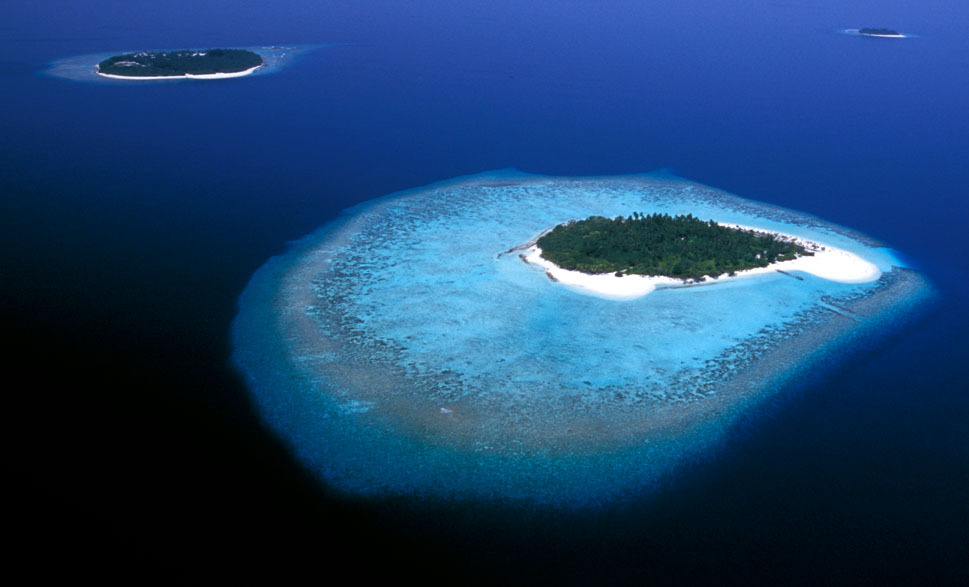
Aerial view of the Maldives (from http://www.visitmaldives.com)
These traditions, about a foreign people called Diba (Wadiba), Debuli (Wadebuli), and variants thereof, have been recorded in scattered locations between the Lamu archipelago in the north and Kilwa (and thereabouts) in the south. The Diba et al. are sometimes described as unwelcome slave-raiders and invaders, and in other sources as the bearers of new cultural practices, technologies (maritime, architectural), and agricultural crops. There is no consensus on who the Diba and Debuli were: commentators have identified them as visitors of Arabian, Persian, Indian, Laccadive or Maldive origin. Harold Ingrams (1931: 47-48) considered but rejected the possibility, raised by Archdeacon Dale (1920: 13), that they might have been Malay. Some traditions as well as one version of the ethnonym (Dubuki) imply a connection with Madagascar, while the name Diba (ultimately from Sanskrit dvipa, 'island') could refer to inhabitants of any of the islands in the Indian Ocean, not just the Laccadives and Maldives. These and other features of the traditions suggest that the Diba et al. might have been Austronesians, though the evidence for this is equivocal. It is clear that the recorded traditions conflate different historical events, and in my paper I concluded as follows:

Unless we read the Diba/Debuli traditions very selectively, we cannot interpret them as evidence for interaction with a single group of visitors to the East African coast. And if they contain a deep memory of Austronesian contacts and trade, then this has evidently been overlain by other memories of interaction with outsiders, Persians, Arabs, Indian, and Portuguese included. (2010: 469).

Aerial view of the Maldives (from http://www.visitmaldives.com)
Nevertheless, I remain attracted by a selective reading of the Diba traditions. Sacleux (1939: 538) defined Swahili Mdiba as the name for an indigenous inhabitant of the Maldives, and Lydekker (1919: 90-91) was led to believe that the Wadiba of Bajuni tradition came from the Laccadive islands. In his paper, Pierre-Yves Manguin reviews the documentary evidence for historical connections between insular Southeast Asia and these continguous archipelagos, which are often treated as one in the early literature. The evidence is impressive, and includes the suggestion that the Maldivian (Dhivehi) name for the Chagos archipelago, Folovahi (and variants), is derived from Malay Pulo Weh, an island off the northwestern tip of Sumatra which is on the old sailing route to the Maldives. Manguin argues that in addition to the direct and well-known route between the Maldives and the coast of Somalia, Austronesian voyagers may also have used Diego Garcia and the Chagos islands as a stepping stone to reach Madagascar and the East African coast. In any event these different journeys involve passing through the Maldives.

A boxfish in the Maldives (from http://www.visitmaldives.com)
Other kinds of evidence, from maritime technology (Manguin 2000) and comparative linguistics (Tom Hoogervorst, personal communication, April 2010), support the hypothesis that the Maldives were an important staging point for Austronesian exploration and expeditions into the western Indian Ocean. We know from Buzurg ibn Shahriyar's Book of the Marvels of India that Indonesians were raiding and trading on Pemba and the mainland coast (down to Sofala) in the 10th century (Mauny 1965: 7-8), and they may well have been doing so for some time. Two centuries later Al-Idrisi reported that merchants from Sumatra were still trading with the East African coast, where "they understand one another's language" (Mauny 1965: 14). These facts fit well with some of the Diba and Debuli traditions, including one Pemban historian's repeated reference to the people of "Diba and Jawa" together, as though they were a single entity (Ingrams 1931: 125). Jawa, of course, is the island of Java (Yawadvipa in the Sanskrit epic Ramayana). Can it be that his garbled history and others like it are showing us a glimpse of events that happened so long ago? I'm tempted to say yes. The Maldives connection certainly deserves a closer look.

Aerial view of the Maldives (from http://www.visitmaldives.com)
References

Beaujard, Philippe 2010. Les plantes cultivées apportées par les premiers migrants austronésiens à Madagascar. In Radimilahy and Rajaonarimanana (2010). 357-385.

Dale, Godfrey 1920. The Peoples of Zanzibar: Their Customs and Religious Beliefs. Westminster: Universities' Mission to Central Africa.

Dahl, Otto Christian 1951. Malgache et Maanjan: une comparaison linguistique. Oslo: Egede Institutett.

Ducourneau, Alex 2010. Approche phylogéographique du peuplement de l'océan Indien occidental. In Radimilahy and Rajaonarimanana (2010). 855-871.

de Houtman, Frederik 1603. Spraeck ende woord-boeck, inde Maleysche ende Madagaskarsche Talen met vele Arabische ende Turcse woorden. Amsterdam.

Aerial view of the Maldives (from http://www.visitmaldives.com)
von Humboldt, Wilhelm 1836-39. Über die Kawi-Sprache auf der Insel Java (3 vols.). Berlin.

Ingrams, Harold 1931. Zanzibar, its History and its People. London: H. F. & G. Witherby.

Lydekker, C. J. W. 1919. The "mtepe" dhau of the Bajun islands. Man 19 (46): 88-92.

Manguin, Pierre-Yves 2000. Les techniques de construction navale aux Maldives originaires d'Asie du Sud-Est. Techniques & Culture 35-36: 21-47.

Manguin, Pierre-Yves 2010. The Maldives connection. In Radimilahy and Rajaonarimanana (2010). 261-284.

Mauny, Raymond 1965. The Wakwak and the Indonesian invasion in East Africa in 945 A.D. Studia 15: 7-16. 

Radimilahy, Chantal and Narivelo Rajaonarimanana (eds.) 2010. Civilisations des mondes insulaires (Madagascar, îles du canal de Mozambique, Mascareignes, Polynésie, Guyanes): Mélanges en l'honneur du Professeur Claude Allibert. Paris: Karthala.

Sacleux, Charles 1939.Dictionnaire Swahili-Français. Paris: Institut d'Ethnologie.

Walsh, Martin 2010. Deep memories or symbolic statements? The Diba, Debuli and related traditions of the East African coast. In Radimilahy and Rajaonarimanana (2010). 453-476.

Thursday, 20 January 2011

JIM ALLEN'S UNFINISHED WORK (and an unfinished conversation)

Languishing in a hospital bed recently, my feverish mind swirled with memories of earlier hospitalisations - my own and others' - many of them in East Africa. The institution I came to know best, as both patient and visitor, was Mombasa Hospital, memorably situated on the sea front next to Fort Jesus. If I close my eyes I can still feel the strong breeze blowing off the Indian Ocean into an upstairs ward. And I'll never forget my first visit there, the last time that I saw Jim Allen.

James de Vere Allen was an independent scholar who played a key role in the establishment of the Lamu Museum. He became an authority on coastal history and culture, and is perhaps best known now as the author of the posthumously published Swahili Origins: Swahili Culture and the Shungwaya Phenomenon (1993). When I first came to live in Mombasa in 1985 Jim was ensconced on his farm in Kwale, to the south-west of the town. For a long time I knew of him only through other researchers, all of whom described him in glowing terms. I only recall meeting Jim twice, once when he came to find me in the Jubilee Building on Moi Avenue, where I worked. A diary entry for 28 April 1988 records that I met him in the morning (was this the same occasion?) and gave him a copy of William Frank's Habari na Desturi za Waribe (1953) and (I presume from the cursory entry) Krapf and Rebmann's Nika-English Dictionary (1887) - the latter a photocopy for him to copy and then return. I also gave him my unpublished paper on 'Mijikenda origins' (written in March 1987, but not published until 1992); we must have discussed this at some point, as well as my research on the historical influence of the Segeju on the Mijikenda, but I can't now remember when.

James de Vere Allen Collection (http://archnet.org)
I didn't know that Jim was seriously ill until May 1990, a month before he died. I went to see him in Mombasa Hospital on Thursday 7th June. He looked terribly weak, but found the energy to talk briefly about our different views of Segeju history. We agreed to disagree and continue the conversation when he had "turned the corner" and got better. I squeezed his frail hand and left. That was the last time I saw Jim: he died the following Wednesday, the 13th June 1990. Although I didn't know Jim well, I felt cheated by his death and its rude interruption of our discussion of coastal history. I've regretted ever since that we didn't spend more time together.

As it happens, Jim had already drafted his magnum opus, Swahili Origins. A year or so before he died, knowing that he was seriously ill, he asked the anthropologist John Middleton to edit the sprawling typescript. The resulting book was published in 1993 with a somewhat apologetic preface by Middleton explaining its genesis and warning the reader of its author's unorthodoxy. Like other researchers I was and remain very critical of Swahili Origins. Here's part of what I wrote in a review article at the time:

James de Vere Allen Collection (http://archnet.org)
Before his untimely death in 1990 [...], Jim Allen had already made an outstanding contribution to Swahili studies. Among a variety of achievements, he played a key part in helping to overturn the traditional image, which still lingers in popular literature and tourist brochures, of Swahili culture as an exotic blend of Oriental and African influences in which the former have consistently dominated the latter. Linguists had long realised that Swahili was not a creole or pidgin combining Arabic, Persian and Bantu elements, but a Bantu language with a significant proportion of recent Arabic and other loanwords. Allen was among the first to trace the cultural and historical corollaries of this linguistic observation. In a series of articles published from the 1970s onwards he attacked the traditional emphasis upon exogenous, oriental influences ([an emphasis] encouraged, it must be said, by many Swahili speakers themselves), and highlighted instead the indigenous, African, roots of Swahili culture. The detailed implications of this paradigm shift are still being worked out by younger researchers, many of whom benefited directly from Jim Allen's personal interest and encouragement.

James de Vere Allen Collection (http://archnet.org)
The manuscript of Swahili Origins, having been edited by John Middleton and published posthumously, presents Allen's view of Swahili genesis and his alternative to the orientalist interpretation of Swahili history. The core of this gloriously detailed account is a hypothesis first outlined in his papers published in 1983 and 1984. Allen argues that Swahili society and culture, as well as various institutions among the Mijikenda and other neighbouring people, originated in the interaction between a polyethnic blend of pastoralists and their clients, including indigenous hunter-gatherers and Bantu-speaking farmers. The dominant alliance of pastoralists included Cushitic speakers and the Segeju (whose contemporary representatives fall into two related groups, one speaking Daisu, a Central Kenya Bantu language, and the other speaking dialects of Swahili and/or Mijikenda). The culmination of this alliance was a unified state, called Great Shungwaya by Allen (after the name of the mythical homeland of various Swahili, Mijikenda and other coastal traditions) and estimated by him to have flourished some time between the ninth and fourteenth centuries. Its sequel is hypothesised to have been a series of so-called successor states, relatively familiar to us from the historical record and ushering in the ethnic map of the region as we now know it.

James de Vere Allen Collection (http://archnet.org)
This hypothesis and Allen's idiosyncratic use of different historical sources to support it have already been widely criticised, indeed in some cases dismissed out of hand (as by Spear, 1983). In Swahili Origins Allen has expanded and amplified many details of his account, but done absolutely nothing to answer his critics, who would see Great Shungwaya as no more than a fantasy of his fertile imagination. It is all too easy to find fault with Allen's arguments and cast him as a kind of Erich von Däniken of Swahili studies. It is perhaps more useful to consider why Allen, a master of historical detail, should have clung to such a flawed hypothesis, and what subsequent influence it has had. Despite his work for the Lamu Museum and his living for many years on the Kenya coast, Allen was essentially an armchair historian, which helps to explain both his skill in uncovering obscure documentary references and his largely uncritical interpretation of them. Ironically his successful critique of the orientalist thesis of Swahili origins encouraged his promotion of an inflated account of the indigenous alternative, constructing an imaginary state to counter the traditional picture of coastal civilization as a ready-made import from overseas. To this extent Allen was an unwitting prisoner of the tradition which he sought to overthrow, and his understanding of the variety of everyday coastal life remained subordinate to a continuing fascination with the classical tradition of urban Swahili culture. (1993: 143-144)

Flawed though Jim Allen's thesis is, I remain captivated by the detail in his work, as a source for further exploration if nothing else. For many years I wondered what had been omitted from the original typescript. John Middleton described his editorial work as follows:

My actual 'editing' has comprised several actions. First, the shortening of the original manuscript by over a quarter, almost entirely by the deletion of repetitious sentences and paragraphs. Secondly, the omission of a long final chapter that was intended to be the summary of a second part of the book, seemingly not written: this chapter was clearly cobbled together during Jim's final illness, and is inconsequential, without footnotes, and wanders away from the Swahili: it is not in any sense a conclusion to the whole. Thirdly, the omission of four appendices that are marginal to the main account. In brief, I have shortened, but not 'edited' or 'revised', and I have tried to retain as many of Jim's comments on others' work and approaches as I could. This is a very personal work and I have tried to keep that characteristic. (1993: ix)

James de Vere Allen Collection (http://archnet.org)
Then, in autumn 2004, I met another of Jim Allen's friends at a conference in Oxford, the historian Ed Steinhart, and he told me that he had a copy of the unedited draft of Swahili Origins. On his return to the States Ed scanned the typescript and announced its availability to interested scholars on the H-Africa discussion network. Both of us also made electronic copies for deposit in different libraries (the University of Florida, Rhodes House in Oxford, the British Institute in Nairobi).  Comparison of this draft with the published work shows that aside from making the major excisions that he noted, John Middleton (who died himself in February 2009) had indeed remained largely faithful to Jim's text. The final chapter that he left out was entitled '"Galla incursions" and the demise of Shungwaya': readers can judge for themselves whether this omission and that of the appendices was justified. The version of this chapter in Ed Steinhart's typescript includes foootnotes; John Middleton's comments about their absence suggests that he was working with a different text. I must confess a personal interest in this chapter and especially its footnotes, because that's where Jim made reference to my draft paper on 'Mijikenda origins' and arguments about the influence of the Segeju on the Mijikenda. But seeing my name in his typescript is little comfort. I'd much rather that he'd turned that corner and stuck around to continue our conversation.

References

Allen, James de Vere 1983.  Shungwaya, the Mijikenda, and the traditions. International Journal of African Historical Studies 16 (3): 455-485.

Allen, James de Vere 1984. Shungwaya, the Segeju and Somali history. In T. Labahn (ed.) Proceedings of the Second International Congress of Somali Studies (Volume II: Archaeology and History). Hamburg: Helmut Buske. 35-72.

Allen, James de Vere 1993. Swahili Origins: Swahili Culture and the Shungwaya Phenomenon [edited by John Middleton]. London: James Currey.

Frank, William 1953. Habari na Desturi za Waribe. London: Sheldon Press.

Horton, Mark 1990. [Obituary of] James de Vere Allen 1936-1990. Azania 25: 108-109.

Krapf, L. and J. Rebmann 1887. Nika-English Dictionary. London: Society for Promoting Christian Knowledge.

Middleton, John 1993. Preface. In Allen 1993: vii-ix.

Spear, Thomas 1983. A Reply by Thomas Spear [appended to Allen 1983]. International Journal of African Historical Studies 16 (3): 484.

Walsh, Martin 1992. Mijikenda origins: a review of the evidence. Transafrican Journal of History 21: 1-18.

Walsh, Martin 1993. Becoming Swahili and Mijikenda [a review article]. Azania 28: 143-147.