Showing posts with label historical linguistics. Show all posts

Sunday, 5 May 2019

HOW THE GREY PARROT DIDN'T GET ITS NAME

by Martin Walsh

I’ve got an article in press for Kenya Past and Present about the search for words of Austronesian origin in Swahili. It’s a follow-on and much-revised update of a presentation I gave at a meeting in SOAS, the School of Oriental and African Studies in the University of London, a couple of years ago. Here’s just one section from the new piece. After writing it, I developed a bit of an obsession with parrots. Expect to hear more about this in future posts.

Illustration of a Grey parrot
Endangered parrots and dodgy etymologies

What then do we know about words of Austronesian origin in Swahili? What have we learned so far? First, it is evident that many existing proposals are wrong or doubtful, including some of my own.  The literature is littered with etymologies that are either demonstrably false or questionable in other ways. A notable example of the first category is Otto Dempwolff’s parrot. Here is Krumm on the origin of the Swahili word kasuku, ‘parrot’:

“Kasuku is a Malayan word which spread to India. According to Prof. Dempwolff, Hamburg, kasuku has the meaning: my darling, my sweetheart. It must be mentioned that west from Lake Tanganyika (in the Congo state) a river has the name “kasuku.” In that district parrots are frequent.” (1940, p. 125; also 1932, p. 77)

Leaving aside the evident mismatch between Malay kasihku, ‘my love’, and Swahili kasuku, it so happens that the Swahili name has a perfectly good Bantu etymology. In his dictionary entry for kasuku, Sacleux correctly identified it with the Grey parrot, Psittacus erithacus, and noted that the same name is also found in the Nyamwezi language in the west of Tanzania, and in a related shape in other languages to the north, into modern Uganda.

The Ganda name for the Grey parrot is enkusu: similar names are found in many languages to the west and can be traced back in time to proto-Bantu, as the linguist Edgar Polomé observed in 1987. At some point the syllables in the word root -kusu were switched around – a process linguists call metathesis – perhaps at the same time that it acquired the diminutive prefix ka-, to give kasuku, literally ‘little Grey parrot’. This may originally have been a reference to the fledglings that people took from their nests inside trees. Swahili has never had this ka- diminutive (it uses ki- instead), but has borrowed the name kasuku in its entirety, treating it as though it has no prefix, with an invariant plural.

Grey parrot close-up
When and where did this happen? Grey parrots are denizens of the central African rainforest: the nearest population to the East African coast is found in the west of Kenya, in Kakamega Forest. Because of their intelligence and ability to learn words in human speech, they are also highly desirable as pets, and captive birds are bred and sold throughout the world. Grey parrots are now considered to be endangered in the wild and the trade in them has been banned.

Writing in his book on The Uganda Protectorate (1902), the British explorer and colonial administrator Harry Johnston described how the trade from that area began:

“The young birds are captured by the natives from the nesting places (holes in trees) and are easily tamed. Yet as far as I can ascertain the Baganda never commenced this practice until taught to do so by the Swahili porters from the coast, who of course were incited thereto by the Europeans and Indians [...].” (Volume I, p. 401)

He later makes clear that it was the local people themselves who began taming the young parrots: “The natives nowadays catch and tame the young of the grey parrot for sale to European or Swahili caravans” (Volume II, p. 715). The earliest reference I have found so far to this trade dates to 1874. It may explain why the caravan porters also took away a version of the parrot’s name with a diminutive prefix; they were, after all, being sold juvenile birds. Where exactly they picked up this name is open to question. It may have been from one of the Bantu languages in the Great Lakes region, perhaps in the area to the west of Lake Tanganyika, where there was already a local demand for the scarlet tail feathers of adult parrots to be used in ceremonial headwear.

A Grey parrot in Dar es Salaam
The word kasuku had already reached Mombasa by the end of the 19th century: I have seen references dating to 1891, and so the trade must have begun some time earlier. Once the name became established on the coast, it then travelled back into the East African interior, as a loanword from Swahili, referring to caged parrots and, colloquially, to talkative people. This must have happened quite early, because Johnston found that the Swahili form was widespread south and east of the Great Lakes.

Returning now to Krumm’s original passage, I assume he was alluding to the existence of similar names for parrots in different Indian languages. The direction of borrowing, however, went the other way: Old Javanese adopted śuka, ‘parrot’ from Sanskrit. The resemblance of Indian terms to the Swahili name is almost certainly coincidental – unless they have been influenced by the latter as it has accompanied birds traded from East Africa. As an etymological hypothesis, Dempwolff’s parrot – or at least Krumm’s version of it – has no legs to stand on, and is as dead as a dodo.

Many of the Austronesian etymologies that have been proposed in the literature fare little better, either because there are better alternatives or because they can be shown to be implausible on linguistic and other grounds – though it isn’t always easy to choose between competing etymological hypotheses.

Acknowledgements
Many thanks to Tom Hoogervorst for help with the Malay, and Asha Fakhi Khamis for her linguistic observations and more.

References

Johnston, Harry H. 1902. The Uganda Protectorate. Volume II. London: Hutchinson & Co.

Krumm, Bernhard 1932. Wörter und Wortformen orientalischen Ursprungs im Suaheli. Hamburg: Friederichsen, De Gruyter & Co.

Krumm, Bernhard 1940. Words of Oriental Origin in Swahili (2nd edition). London: The Sheldon Press.

Polomé, Edgar C. 1987. Swahili words of Indian origin. Sprache und Geschichte in Afrika 8: 325-334.

Sacleux, Charles 1939. Dictionnaire Swahili-Français (Travaux et Mémoires de l’Institut d’Ethnologie 36 & 37). Paris: Institut d’Ethnologie, Université de Paris.

Walsh, Martin T. 2017. Evidence for early Malay and Malagasy loanwords in Swahili. Presentation to Baraza III: Swahili Conference at SOAS, School of Oriental and African Studies, University of London, 14 October.

Walsh, Martin T. In press. Cockatoos and crocodiles: searching for words of Austronesian origin in Swahili. Kenya Past and Present.

Friday, 26 April 2019

THE WHALE AND THE PANGOLIN

by Martin Walsh

A pilot whale in Pongwe Bay, Unguja, Zanzibar (photo by Yaroslav Alexandrov)
Was there a proto-Bantu word for ‘whale’ and other mischievous questions’ is the characteristically thought-provoking title of an unpublished paper (last updated in 2012) by my good friend Roger Blench. As Roger points out, there is no listed proto-Bantu form for ‘whale’, though it is quite possible that early Bantu speakers were familiar with marine creatures, and certainly so once they spread from their putative homeland in southern Cameroon down the west coast of equatorial Africa. The rest of the paper sets out the lexical evidence for knowledge of marine fauna in northwest Bantu, including a generic term for whales (2012: 21-22).

This word did not, of course, make it across or around the central African rainforest to the eastern side of the continent. How, then, did Bantu speakers name whales when they first encountered them on the shores of the Indian Ocean? Knowledge of whales doesn’t require possession of a fully-fledged maritime culture, just familiarity with the seashore. As we know, whales can become stranded on beaches, as well as washing up when they are dead, as reported in my January 2012 post on ‘A pilot whale in Pongwe’.

There are more than 30 species of whale in the western Indian Ocean region (Richmond 2002: 398), and according to the TUKI English-Swahili Dictionary, nyangumi is the common Swahili name for all of them. Indeed, it’s the only name given for whales in both online TUKI dictionaries (English-Swahili and Swahili-English), which are our best guide to contemporary Standard Swahili. Older dictionaries, however, give variants of this term, which has an invariant plural – in the lingo of Bantuists it has 9/10 (singular/plural) noun class prefixes and takes 1/2 animate agreements.

There are even more variants of nyangumi in the different dialects of Swahili, as well as other names. Here’s a provisional list of the generic term for whales in all the dialects between Somalia in the north and Mozambique in the south for which I have data. I’ve also included terms from other Sabaki languages, which are Swahili’s closest historical relatives.

Swahili and other Sabaki language names for whales

Language
and dialects
Attestation
and noun class pairing (if known)
Source and comments
Swahili


Standard
nyangumi 9/10
Johnson 1939a, 1939b; TUKI 2019a, 2019b

nyamngumi 9/10
TUKI 1981
Mwiini
yama 9/10 ~ iyama 5/4
Kisseberth 2016. Cf. nama 9/10 ‘meat, flesh’
Bajuni
muungumi ~ nngumi 3/4
Sacleux 1939; Nurse 2010
Pate
mngumi
Sacleux 1939
Amu
mngumi
Sacleux 1939
Pemba
mngumi
Sacleux 1939
Mvita
mngumi
Sacleux 1939; Abdulaziz 1979

mgumi ~ nyamgumi
Binns 1925
Unguja
nyamgumi 9/10
Madan 1903

mnyāngumi 3/4
Sacleux 1939, 1959

nyangumi 9/10
field notes 2016
Mafia/Ngome
nyamabahari 9/10
Kipacha 2004. Cf. nyama 9/10 ‘meat’ + bahari 9/10 ‘sea’, lit. ‘flesh (animal) of the sea’
Koti
nangumi (1a/2a)
Schadeberg and Mucanheia 2000
Lower Pokomo


(New Testament)
ungumi
The British and Foreign Bible Society 1901; BTL 2019
Mijikenda


Giryama
mungumi
United Bible Societies 1951
Comorian


Ngazidja
ngume 3/4
Fischer 1949

mngome ~ mngume 3/4
Ahmed-Chamanga and Gueunier 1979

nduju
Fischer 1949. Cf. Lafon 1991, nduju 9/10 ‘dolphin’

ndundju
Ahmed-Chamanga and Gueunier 1979
Ndzuani
ndruju 9/10
Ahmed-Chamanga 1992, 1997, Cf. fumba-ndruju 5/6 ‘dolphin’
Maore
mongume
Ahmed-Chamanga and Gueunier 1979

The Swahili names from Brava in Somalia (Mwiini) and northern Mafia island (Ngome) in Tanzania are euphemisms that allude to the animality, and perhaps edibility, of whales as large creatures of the sea. Comorian ndruju and variants seem to have been borrowed from Malagasy trózona, ‘whale’, or an earlier form thereof (see Simon 2006: 439). As Sander Adelaar (1989: 17) has pointed out – and kindly expanded upon while I was writing this post, this was originally a loanword from Malay *duyuŋ, ‘dugong’ – the English name of which is ultimately from the same source.

Derek Nurse and Tom Hinnebusch (1993: 665) tentatively reconstructed proto-Sabaki *mungumi 3/4 ‘whale’, citing the Amu, Unguja, Giryama, and Ngazidja forms. Allowing for errors in transcription, the expanded list provides additional support for this reconstruction. The only real anomaly is the initial consonant in Lower Pokomo ḅungumi, assuming that this isn’t a mistake made by different generations of Bible translators. Given that most Pokomo live along the Tana River and not near the sea, then perhaps we should not be surprised to see them using a skewed form of the name of a creature they were unlikely to encounter.

Where, then, did the ancestors of the Swahili and other Sabaki speakers get this word from? There’s no obvious connection between *mungumi (with the root *-ngumi) and another tentative proto-Sabaki reconstruction, *ngumi 9/10 ‘fist’ (Nurse and Hinnebusch 1993: 669). I don’t know if there are cognate whale names in other languages along the Tanzanian coast. The record of nyangumi in a modern vocabulary of Zigua (Mochiwa 2008: 52) might reflect recent borrowing from Swahili. An alternative possibility is that the transfer went in the opposite direction, i.e. that the Unguja and related forms aren’t inherited, but derive from Zigua or another mainland language.

A Termminck's ground pangolin in Iringa (video still by Martin Walsh)
The only similar name that I have come across is given to a very different animal in the drylands of central Tanzania, a long way from the Indian Ocean. Temminck’s ground pangolin, Smutsia temminckii, is called nyamung’umi (9/10, plural zinyamung’umi) by some speakers of the Gogo language (Swynnerton 1946: 30; field notes 2002), abbreviated to nyamumi by others (Rugemalira 2009: 83). Is this just a coincidence? What’s the connection, if any, between these little-seen scaly ant-eaters in the interior of Tanzania and the world’s largest marine mammals?

Gogo, a West Ruvu language, is classified in the same wider group of languages as Zigua and the Sabaki languages: Northeast Coast Bantu (NECB). As the name implies, NECB speakers occupy a large swathe of territory that begins in central Tanzania and sweeps eastwards and northwards, following the Indian Ocean coastline up to southern Somalia. They were presumably the first Bantu to arrive on the coast opposite Zanzibar, and perhaps the first to encounter beached whales on this side of the continent.

The ancestors of the Gogo and other NECB speakers would have been familiar with ground pangolins, which can be found everywhere in the hinterland of the Tanzanian coast. Is there anything that would lead them to dub whales with the same name? A clue may lie in the comparative rarity of pangolin and inshore whale sightings. Among the Gogo and their neighbours, encounters with pangolins were traditionally treated as auspicious events, triggering ritual actions that typically ended in the sacrifice of the animal (for examples see Walsh 1995/96, 2007).

Could it be that the stranding of a whale was viewed as a similarly auspicious event by early NECB settlers on the coast? Was the whale, like the pangolin, thought to offer itself for sacrifice? And did this lead whales to be dubbed with the same name, or a version of it?

I am, of course, letting my imagination run riot. The Gogo name for the ground pangolin, nyamung’umi, doesn’t seem to have a wider distribution, and I don’t know its etymology: it might even be a recent euphemism. Reflexes of proto-Bantu *kákà 9/10 ‘pangolin spp.’ are widespread in East Africa. Swahili kakakuona is one of them, though evidently borrowed from Nyamwezi ngakákύβonwá 9/10 (Maganga and Schadeberg 1992: 268, 305), perhaps via Gogo, which also has a related form, written as ngakakuona by my research assistants in 2002.

It may even be that Gogo nyamung’umi was itself borrowed from the coast (cf. the Swahili form nyamngumi). Whatever the case, the switch to or from velar nasal ng’ /ŋ/ would have to be explained. Likewise, the comings and goings of different prefixes and noun class designations, reminiscent of a case I’ve discussed elsewhere (Walsh 2004). Still, in the absence of alternative hypotheses, I find it difficult to resist speculation. There are certainly cases in which deep cultural knowledge is needed to make sense of an otherwise opaque etymology. This one is a long shot, but every now and then long shots hit the target.

Acknowledgements
Many thanks again to Yaroslav Alexandrov for letting me use his photos from Pongwe. I'm also very grateful to the wonderful Bonny Sands for LOT Project dictionaries (many more than are referenced here!), and Sander Adelaar for putting me right on ndruju. They’re real linguists, and the usual disclaimer applies.

References
Abdulaziz, Mohamed H. 1979. Muyaka: 19th Century Swahili Popular Poetry. Nairobi: Kenya Literature Bureau.

Adelaar, Alexander A. 1989. Malay Influence on Malagasy: linguistic and culture-historical implications. Oceanic Linguistics 28 (1): 1-46.

Ahmed-Chamanga, Mohamed 1992. Lexique comorien-(shindzuwani)-français. Paris: Editions l’Harmattan.

Ahmed-Chamanga, Mohamed 1997. Dictionnaire français-comorien (dialecte shindzuwani). Paris: CEROI-INALCO / L’Harmattan.

Comorian dictionaries
Ahmed Chamanga, Mohamed and Noël-Jacques Gueunier 1979. Le dictionnaire comorien-français et français-comorien du R. P. Sacleux (2 vols.). Paris: SELAF.

Binns, H.K. 1925. Swahili-English Dictionary: Being Dr. Krapf’s Original Swahili-English Dictionary Revised and Re-arranged. London: Society for Promoting Christian Knowledge.


BTL 2019. Bible Translation  and Literacy, Pokomo Language Project. Online at https://kipfokomu.com/en/homepage.

Fischer, François 1949. Grammaire-dictionnaire comorien. Strasbourg: Société d’Édition de la Basse Alsace.

Johnson, Frederick 1939a. A Standard Swahili-English Dictionary. London: Oxford University Press.

Johnson, Frederick 1939b. A Standard English-Swahili Dictionary. London: Oxford University Press.

Kipacha, Ahmad 2004. Kingome-English lexicon. Swahili Forum 11: 179-209.

Kisseberth, Charles W. 2016. Chimiini-English Dictionary and Chrestomathy. Online at http://swahiliendangered.cdh.ucla.edu/wp-content/uploads/2016/05/Chimiini-Lexicon-and-Chrestomathy-February-2016.pdf.

Lafon, Michel 1991. Lexique français-comorien (shingazidja). Paris: Editions L’Harmattan.

Madan, A.C. 1903. Swahili-English Dictionary. Oxford: The Clarendon Press.

Maganga, Clement and Thilo C. Schadeberg 1992. Kinyamwezi: Grammar, Texts, Vocabulary. Köln: Rüdiger Köppe Verlag.

Mochiwa, Zacharia 2008. Kizigula: Msamiati wa Kizigula-Kiswahili-Kiingereza [Zigula-Swahili-English Lexicon]. Dar es Salaam: Languages of Tanzania (LOT) Project, University of Dar es Salaam.

Nurse, Derek 2010. Lexicon for Ki-Bajuni = Ki-Gunya = Ki-Thikhuu. Online at http://www.ucs.mun.ca/~dnurse/bajuni_database/wordlist.pdf.

Nurse, Derek and Thomas J. Hinnebusch 1993. Swahili and Sabaki: A Linguistic History. Berkeley: University of California Press.

Richmond, Matthew D. (ed.) 2002. A Field Guide to the Seashores and Eastern Africa and the Western Indian Ocean Islands (2nd edition). Dar es Salaam: Sida/SAREC & UDSM.

Rugemalira, Josephat M. 2009. Cigogo: Kamusi ya Kigogo-Kiswahili-Kiingereza / Kiingereza-Kigogo / Kiswahili-Kigogo [Gogo-Swahili-English / English-Gogo / Swahili-Gogo Dictionary]. Dar es Salaam: Mradi wa Lugha za Tanzania, Chuo Kikuu cha Dar es Salaam.

Sacleux, Charles 1939. Dictionnaire Swahili-Français. Paris: Institut d’Ethnologie.

Sacleux, Charles 1959. Dictionnaire Français-Swahili (2nd edition). Paris: Institut d’Ethnologie.

Schadeberg, Thilo C. and Francisco Ussene Mucanheia 2000. Ekoti: The Maka or Swahili Language of Angoche. Köln: Rüdiger Köppe.

Simon, Pierre R. 2006. La langue des ancêtres Ny Fitenin-dRazana: Une périodisation du malgache de l’origine au XVème siècle. Paris: L’Harmattan.

Swynnerton, G.H. 1946. Vernacular names for some of the better-known mammals in the Central Province, Tanganyika Territory. Tanganyika Notes and Records 21: 21-38.

The Bible Society of Kenya 1951. Chuwo cha Malagano Masha ga Bwana Wehu Jesu Masihi Mokoli Wehu [The New Testament and Psalms in Giryama].  Nairobi: The Bible Society of Kenya.

The British and Foreign Bible Society 1901. Chuo cha Ḍamano Ibfya ḍya Ḇwana na Mubfonya Jwehu Yesu Kristo [Pokomo New Testament]. London: The British and Foreign Bible Society.

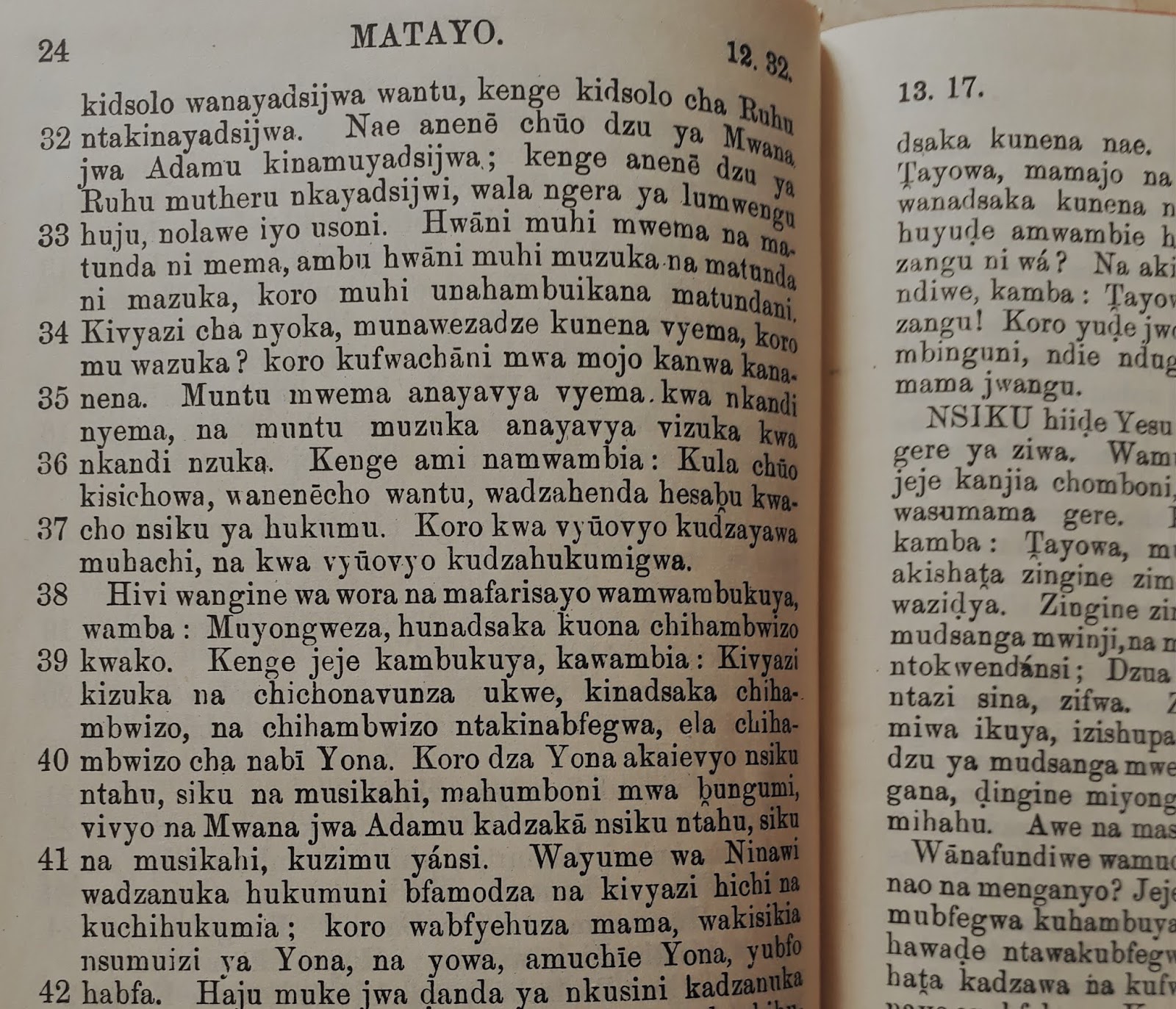
'Whale' in Pokomo, Matthew 12: 40

TUKI 1981. Kamusi ya Kiswahili Sanifu. Dar es Salaam: Oxford University Press.

TUKI 2019. Kamusi ya Kiswahili-Kiingereza. Online at http://www.elimuyetu.co.tz/subjects/arts/swa-eng/index.html.

TUKI 2019. English-Swahili Dictionary. Online at http://www.elimuyetu.co.tz/subjects/arts/eng-swa/index.html.

Walsh, Martin T. 1995/96. The ritual sacrifice of pangolins among the Sangu of south-west Tanzania. Bulletin of the International Committee on Urgent Anthropological and Ethnological Research 37/38: 155-170. Online at https://www.academia.edu/708993/The_ritual_sacrifice_of_pangolins_among_the_Sangu_of_south-west_Tanzania.

Walsh, Martin T. 2004. Variability and compounding of affixes in Hehe animal names (Tanzania). Paper presented to the 34th Colloquium on African Languages and Linguistics (CALL 34), Leiden University, 23-25 August. Online at https://www.academia.edu/1691467/Variability_and_compounding_of_affixes_in_Hehe_animal_names_Tanzania_.

Walsh, Martin T. 2007. Pangolins and politics in the Great Ruaha valley, Tanzania: symbol, ritual and difference / Pangolin et politique dans la vallée du Great Ruaha, Tanzanie: symbole, rituel et différence. In E. Dounias, E. Motte-Florac and M. Dunham (eds.) Le symbolisme des animaux: L'animal, clef de voûte de la relation entre l'homme et la nature? / Animal Symbolism: Animals, Keystone of the Relationship between Man and Nature? Paris: Éditions de l’IRD. 1003-1044. Online at http://horizon.documentation.ird.fr/exl-doc/pleins_textes/divers16-08/010041952.pdf.

Walsh, Martin T. 2018. The Swahili language and its early history. In S. Wynne-Jones and A. LaViolette (eds.) The Swahili World. Abingdon and New York: Routledge. 121-130. Online at https://www.academia.edu/36719077/The_Swahili_language_and_its_early_history.

Sunday, 14 November 2010

A SHOE BOX FOR SHISANGO

At my desk in Utengule: shoebox in the foreground
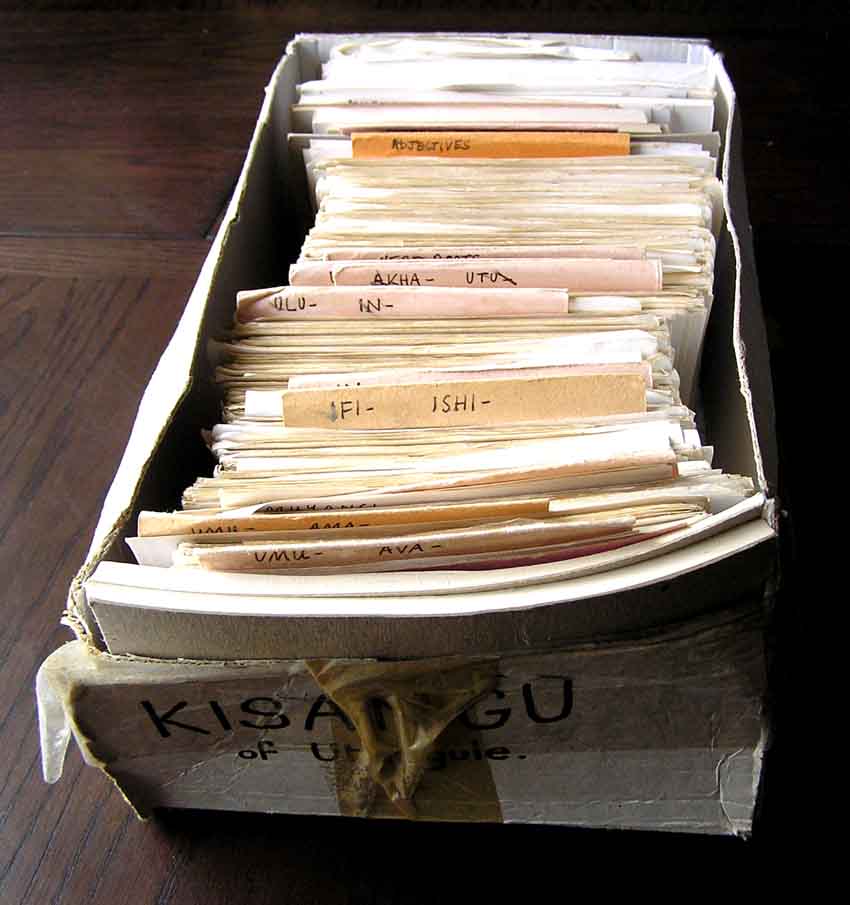
Last weekend my daughter asked me if I had any empty shoe boxes: she needed one to fill with odds and sods for an annual charity appeal. There is of course a pile of old shoe boxes in one corner of my study, waiting for the day when I abandon computers and manufactured filing systems in favour of the cheap and cheerful homemade solutions of yore. My most treasured shoe boxes lie at the bottom of the pile. One of them is filled with the slips of paper on which I recorded my Sangu (shisango) dictionary in the field; the other with subject and person indexes of my field notes compiled in the first month or so after my return to Cambridge in early 1982.

I indexed my chronologically written and organised notes at the suggestion of my research supervisor, Ray Abrahams, and having never word-processed them remain eternally grateful for this simple piece of advice. Compiling a dictionary using a card index or slips of paper was a time-tested practice, as afficianados of the making of the Oxford English Dictionary and James Murray's 'quotation slips' will know. Alison Redmayne, my ethnographic mentor, suggested I use index cards for recording Sangu when I first visited her in Oxford in April 1980. She also later recommended that I get hold of a copy of Wilfred Whiteley's 'Suggestions for recording a Bantu language in the field', an article based on a brief study of the Fipa language, in which the same method is suggested  ("It is probably easiest to begin by collecting a word-list on cards", 1964: 2). At the same time she sent me photocopies of the slips of paper on which she'd made her own small collection of Sangu vocabulary in the 1960s. And afterwards she wrote "If you do not have a filing box and cardboard index cards you can make your own index cards and use a biscuit tin - that is how my Kihehe dictionary started" (letter from Oxford dated 11 July 1980). While writing this note I asked Alison for more details: she recalls quartering quarto-sized sheets of paper to make her own cards or rather slips. For many years now she's kept these in a metal index card file drawer. This is the only copy of her Hehe dictionary, a language which very few Europeans can speak like her.  

I ended up with a shoe box. I've forgotten now whether I took this with me to Tanzania in July 1980 or obtained it when I was out there. New shoes were available in the country in 1980 but like a lot of basic goods were in short supply. Stationery, however, was essential to the functioning of the socialist state, and I had no trouble getting hold of pads of plain paper slips. Indeed there are still some unused pads in my Sangu shoe box with the price marked on them: four shillings each. Once I was installed in the village of Utengule-Usangu I set about recording Sangu vocabulary on these slips. At the same time I was learning Swahili, the primary language of my research in this increasingly polyethnic area. But collecting Sangu words and phrases provided me with endless pleasure. Even on the leanest of days I was sure to hear or elicit new items that I scribbled down on scraps of paper before transferring them to the thin slips of paper that were filed away in the box on my desk in alphabetical order within appropriate morphological categories. Let me hasten to add that I didn't study the language as systematically as I might if I knew what I do now, or my research depended on a professional description of it. To make matters worse, I've got cloth ears and struggle to hear vowel-length or distinguish tones and stress, and I didn't mark any of these. Indeed I didn't really understand the pitch accent system of Sangu until the mid-1990s (when I had time to work through and build on the work of my predecessor in Utengule, the White Father-turned-linguist Jacques Bilodeau), and a later attempt to elicit the finer points of tense and aspect in the language fizzled out in frustration. But my rough and ready dictionary was adequate for everyday ethnographic purposes, including the sociolinguistic analysis of Sangu greetings and titles that became one of the chapters of my thesis (Chapter 5, "The theory and practice of misreading greetings", 1984: 126-157).

After I'd written my thesis on the Phoenix mainframe computer in Cambridge, I typed up most of my Sangu dictionary (Walsh 1985), though I didn't get round to including all of the linguistic information from the shoe box and other notes that I'd made on language use, including transcriptions of songs and other tape recordings. And although I've since done further work on particular parts of the lexicon, including Sangu plant and animal names (e.g. Walsh 1995; 1996), I haven't made any attempt to incorporate additional terms and definitions in the dictionary, which I no longer have in electronic form (except as a scan of the computer printout). Nonetheless, I'm pleased that the contents of my old shoe box have been of some use to subsequent researchers, including linguists working for the Summer Institute of Linguistics (SIL) (e.g. Tlustos 2000). For some years SIL researchers have used their own electronic Shoebox, "a computer program that helps field linguists and anthropologists integrate various kinds of text data".  As the blurb says, this programme "is especially useful for helping researchers build a dictionary as they use it to analyze and interlinearize text. The name Shoebox recalls the use of shoe boxes to hold note cards on which definitions of words were written in the days before researchers could use computers in the field." Such is progress, but I'd hate to be parted from my own tatty box of linguistic history.

References

Bilodeau, Jacques 1979. Sept contes Sangu dans leur contexte culturel et linguistique. Elements de phonologie du Sangu, langue Bantou de Tanzania. Textes des contes avec traduction et notes. Thèse de Doctorat de Troisième Cycle, Université de la Sorbonne Nouvelle, Paris.

Tlustos, Martin 2000. Draft Sangu dictionary (incomplete). Unpublished ms., Mbeya, December 2000.

Walsh, Martin. 1984. The Misinterpretation of Chiefly Power in Usangu, South-west Tanzania. Unpublished Ph.D. dissertation, University of Cambridge.

Walsh, Martin 1985. Shisango Dictionary. Unpublished ms. (computer printout), Cambridge, June 1985.

Walsh, Martin 1995. Snakes on the Usangu Plains: an introduction to Sangu ethnoherpetology. East Africa Natural History Society Bulletin 25 (3): 38-43.

Walsh, Martin 1996. Fish and fishing in the rivers and wetlands of Usangu. East Africa Natural History Society Bulletin 26 (3/4): 42-47.

Whiteley, W. H. 1964. Suggestions for recording a Bantu language in the field. Tanzania Notes and Records 62: 1-19.