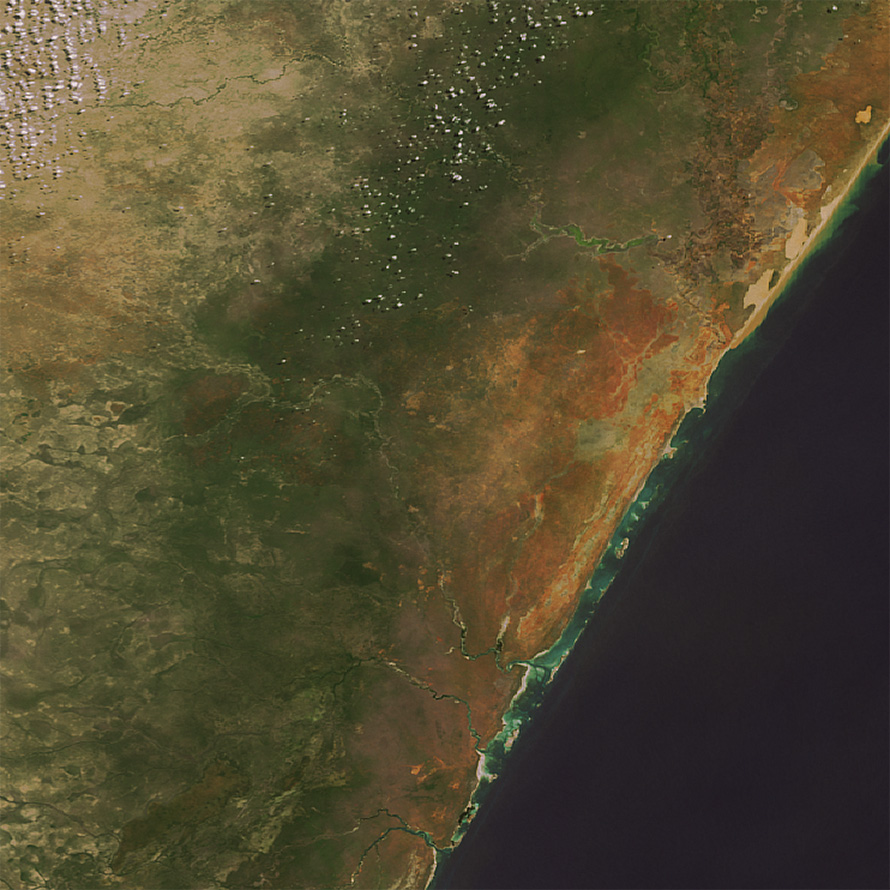
by Martin Walsh
 |
| A pilot whale in Pongwe Bay, Unguja, Zanzibar (photo by Yaroslav Alexandrov) |
This word did not, of course, make it across or around the central African rainforest to the eastern side of the continent. How, then, did Bantu speakers name whales when they first encountered them on the shores of the Indian Ocean? Knowledge of whales doesn’t require possession of a fully-fledged maritime culture, just familiarity with the seashore. As we know, whales can become stranded on beaches, as well as washing up when they are dead, as reported in my January 2012 post on ‘A pilot whale in Pongwe’.
There are more than 30 species of whale in the western Indian Ocean region (Richmond 2002: 398), and according to the TUKI English-Swahili Dictionary, nyangumi is the common Swahili name for all of them. Indeed, it’s the only name given for whales in both online TUKI dictionaries (English-Swahili and Swahili-English), which are our best guide to contemporary Standard Swahili. Older dictionaries, however, give variants of this term, which has an invariant plural – in the lingo of Bantuists it has 9/10 (singular/plural) noun class prefixes and takes 1/2 animate agreements.
There are even more variants of nyangumi in the different dialects of Swahili, as well as other names. Here’s a provisional list of the generic term for whales in all the dialects between Somalia in the north and Mozambique in the south for which I have data. I’ve also included terms from other Sabaki languages, which are Swahili’s closest historical relatives.
Swahili and other Sabaki language names for whales
Language
and dialects
|
Attestation
and noun class pairing (if known)
|
Source and comments
|
Swahili
| ||
Standard
|
nyangumi 9/10
|
Johnson 1939a, 1939b; TUKI 2019a, 2019b
|
nyamngumi 9/10
|
TUKI 1981
| |
Mwiini
|
yama 9/10 ~ iyama 5/4
|
Kisseberth 2016. Cf. nama 9/10 ‘meat, flesh’
|
Bajuni
|
muungumi ~ nngumi 3/4
|
Sacleux 1939; Nurse 2010
|
Pate
|
mngumi
|
Sacleux 1939
|
Amu
|
mngumi
|
Sacleux 1939
|
Pemba
|
mngumi
|
Sacleux 1939
|
Mvita
|
mngumi
|
Sacleux 1939; Abdulaziz 1979
|
mgumi ~ nyamgumi
|
Binns 1925
| |
Unguja
|
nyamgumi 9/10
|
Madan 1903
|
mnyāngumi 3/4
|
Sacleux 1939, 1959
| |
nyangumi 9/10
|
field notes 2016
| |
Mafia/Ngome
|
nyamabahari 9/10
|
Kipacha 2004. Cf. nyama 9/10 ‘meat’ + bahari 9/10 ‘sea’, lit. ‘flesh (animal) of the sea’
|
Koti
|
nangumi (1a/2a)
|
Schadeberg and Mucanheia 2000
|
Lower Pokomo
| ||
(New Testament)
|
ḅungumi
|
The British and Foreign Bible Society 1901; BTL 2019
|
Mijikenda
| ||
Giryama
|
mungumi
|
United Bible Societies 1951
|
Comorian
| ||
Ngazidja
|
ngume 3/4
|
Fischer 1949
|
mngome ~ mngume 3/4
|
Ahmed-Chamanga and Gueunier 1979
| |
nduju
|
Fischer 1949. Cf. Lafon 1991, nduju 9/10 ‘dolphin’
| |
ndundju
|
Ahmed-Chamanga and Gueunier 1979
| |
Ndzuani
|
ndruju 9/10
|
Ahmed-Chamanga 1992, 1997, Cf. fumba-ndruju 5/6 ‘dolphin’
|
Maore
|
mongume
|
Ahmed-Chamanga and Gueunier 1979
|
The Swahili names from Brava in Somalia (Mwiini) and northern Mafia island (Ngome) in Tanzania are euphemisms that allude to the animality, and perhaps edibility, of whales as large creatures of the sea. Comorian ndruju and variants seem to have been borrowed from Malagasy trózona, ‘whale’, or an earlier form thereof (see Simon 2006: 439). As Sander Adelaar (1989: 17) has pointed out – and kindly expanded upon while I was writing this post, this was originally a loanword from Malay *duyuŋ, ‘dugong’ – the English name of which is ultimately from the same source.
Derek Nurse and Tom Hinnebusch (1993: 665) tentatively reconstructed proto-Sabaki *mungumi 3/4 ‘whale’, citing the Amu, Unguja, Giryama, and Ngazidja forms. Allowing for errors in transcription, the expanded list provides additional support for this reconstruction. The only real anomaly is the initial consonant in Lower Pokomo ḅungumi, assuming that this isn’t a mistake made by different generations of Bible translators. Given that most Pokomo live along the Tana River and not near the sea, then perhaps we should not be surprised to see them using a skewed form of the name of a creature they were unlikely to encounter.
Where, then, did the ancestors of the Swahili and other Sabaki speakers get this word from? There’s no obvious connection between *mungumi (with the root *-ngumi) and another tentative proto-Sabaki reconstruction, *ngumi 9/10 ‘fist’ (Nurse and Hinnebusch 1993: 669). I don’t know if there are cognate whale names in other languages along the Tanzanian coast. The record of nyangumi in a modern vocabulary of Zigua (Mochiwa 2008: 52) might reflect recent borrowing from Swahili. An alternative possibility is that the transfer went in the opposite direction, i.e. that the Unguja and related forms aren’t inherited, but derive from Zigua or another mainland language.
 |
| A Termminck's ground pangolin in Iringa (video still by Martin Walsh) |
Gogo, a West Ruvu language, is classified in the same wider group of languages as Zigua and the Sabaki languages: Northeast Coast Bantu (NECB). As the name implies, NECB speakers occupy a large swathe of territory that begins in central Tanzania and sweeps eastwards and northwards, following the Indian Ocean coastline up to southern Somalia. They were presumably the first Bantu to arrive on the coast opposite Zanzibar, and perhaps the first to encounter beached whales on this side of the continent.
The ancestors of the Gogo and other NECB speakers would have been familiar with ground pangolins, which can be found everywhere in the hinterland of the Tanzanian coast. Is there anything that would lead them to dub whales with the same name? A clue may lie in the comparative rarity of pangolin and inshore whale sightings. Among the Gogo and their neighbours, encounters with pangolins were traditionally treated as auspicious events, triggering ritual actions that typically ended in the sacrifice of the animal (for examples see Walsh 1995/96, 2007).
Could it be that the stranding of a whale was viewed as a similarly auspicious event by early NECB settlers on the coast? Was the whale, like the pangolin, thought to offer itself for sacrifice? And did this lead whales to be dubbed with the same name, or a version of it?
I am, of course, letting my imagination run riot. The Gogo name for the ground pangolin, nyamung’umi, doesn’t seem to have a wider distribution, and I don’t know its etymology: it might even be a recent euphemism. Reflexes of proto-Bantu *kákà 9/10 ‘pangolin spp.’ are widespread in East Africa. Swahili kakakuona is one of them, though evidently borrowed from Nyamwezi ngakákύβonwá 9/10 (Maganga and Schadeberg 1992: 268, 305), perhaps via Gogo, which also has a related form, written as ngakakuona by my research assistants in 2002.
It may even be that Gogo nyamung’umi was itself borrowed from the coast (cf. the Swahili form nyamngumi). Whatever the case, the switch to or from velar nasal ng’ /ŋ/ would have to be explained. Likewise, the comings and goings of different prefixes and noun class designations, reminiscent of a case I’ve discussed elsewhere (Walsh 2004). Still, in the absence of alternative hypotheses, I find it difficult to resist speculation. There are certainly cases in which deep cultural knowledge is needed to make sense of an otherwise opaque etymology. This one is a long shot, but every now and then long shots hit the target.
Acknowledgements
Many thanks again to Yaroslav Alexandrov for letting me use his photos from Pongwe. I'm also very grateful to the wonderful Bonny Sands for LOT Project dictionaries (many more than are referenced here!), and Sander Adelaar for putting me right on ndruju. They’re real linguists, and the usual disclaimer applies.
References
Abdulaziz, Mohamed H. 1979. Muyaka: 19th Century Swahili Popular Poetry. Nairobi: Kenya Literature Bureau.
Adelaar, Alexander A. 1989. Malay Influence on Malagasy: linguistic and culture-historical implications. Oceanic Linguistics 28 (1): 1-46.
Ahmed-Chamanga, Mohamed 1992. Lexique comorien-(shindzuwani)-français. Paris: Editions l’Harmattan.
Ahmed-Chamanga, Mohamed 1997. Dictionnaire français-comorien (dialecte shindzuwani). Paris: CEROI-INALCO / L’Harmattan.
 |
| Comorian dictionaries |
Binns, H.K. 1925. Swahili-English Dictionary: Being Dr. Krapf’s Original Swahili-English Dictionary Revised and Re-arranged. London: Society for Promoting Christian Knowledge.
Blench, Roger M. 2012. Was there a proto-Bantu word for ‘whale’ and other mischievous questions. Unpublished paper. Online at http://www.rogerblench.info/Language/Niger-Congo/Bantu/Was%20there%20a%20proto-Bantu%20word%20for%20whale.pdf.
BTL 2019. Bible Translation and Literacy, Pokomo Language Project. Online at https://kipfokomu.com/en/homepage.
Fischer, François 1949. Grammaire-dictionnaire comorien. Strasbourg: Société d’Édition de la Basse Alsace.
Johnson, Frederick 1939a. A Standard Swahili-English Dictionary. London: Oxford University Press.
Johnson, Frederick 1939b. A Standard English-Swahili Dictionary. London: Oxford University Press.
Kipacha, Ahmad 2004. Kingome-English lexicon. Swahili Forum 11: 179-209.
Kisseberth, Charles W. 2016. Chimiini-English Dictionary and Chrestomathy. Online at http://swahiliendangered.cdh.ucla.edu/wp-content/uploads/2016/05/Chimiini-Lexicon-and-Chrestomathy-February-2016.pdf.
Lafon, Michel 1991. Lexique français-comorien (shingazidja). Paris: Editions L’Harmattan.
Madan, A.C. 1903. Swahili-English Dictionary. Oxford: The Clarendon Press.
Maganga, Clement and Thilo C. Schadeberg 1992. Kinyamwezi: Grammar, Texts, Vocabulary. Köln: Rüdiger Köppe Verlag.
Mochiwa, Zacharia 2008. Kizigula: Msamiati wa Kizigula-Kiswahili-Kiingereza [Zigula-Swahili-English Lexicon]. Dar es Salaam: Languages of Tanzania (LOT) Project, University of Dar es Salaam.
Nurse, Derek 2010. Lexicon for Ki-Bajuni = Ki-Gunya = Ki-Thikhuu. Online at http://www.ucs.mun.ca/~dnurse/bajuni_database/wordlist.pdf.
Nurse, Derek and Thomas J. Hinnebusch 1993. Swahili and Sabaki: A Linguistic History. Berkeley: University of California Press.
Richmond, Matthew D. (ed.) 2002. A Field Guide to the Seashores and Eastern Africa and the Western Indian Ocean Islands (2nd edition). Dar es Salaam: Sida/SAREC & UDSM.
Rugemalira, Josephat M. 2009. Cigogo: Kamusi ya Kigogo-Kiswahili-Kiingereza / Kiingereza-Kigogo / Kiswahili-Kigogo [Gogo-Swahili-English / English-Gogo / Swahili-Gogo Dictionary]. Dar es Salaam: Mradi wa Lugha za Tanzania, Chuo Kikuu cha Dar es Salaam.
Sacleux, Charles 1939. Dictionnaire Swahili-Français. Paris: Institut d’Ethnologie.
Sacleux, Charles 1959. Dictionnaire Français-Swahili (2nd edition). Paris: Institut d’Ethnologie.
Schadeberg, Thilo C. and Francisco Ussene Mucanheia 2000. Ekoti: The Maka or Swahili Language of Angoche. Köln: Rüdiger Köppe.
Simon, Pierre R. 2006. La langue des ancêtres Ny Fitenin-dRazana: Une périodisation du malgache de l’origine au XVème siècle. Paris: L’Harmattan.
Swynnerton, G.H. 1946. Vernacular names for some of the better-known mammals in the Central Province, Tanganyika Territory. Tanganyika Notes and Records 21: 21-38.
The Bible Society of Kenya 1951. Chuwo cha Malagano Masha ga Bwana Wehu Jesu Masihi Mokoli Wehu [The New Testament and Psalms in Giryama]. Nairobi: The Bible Society of Kenya.
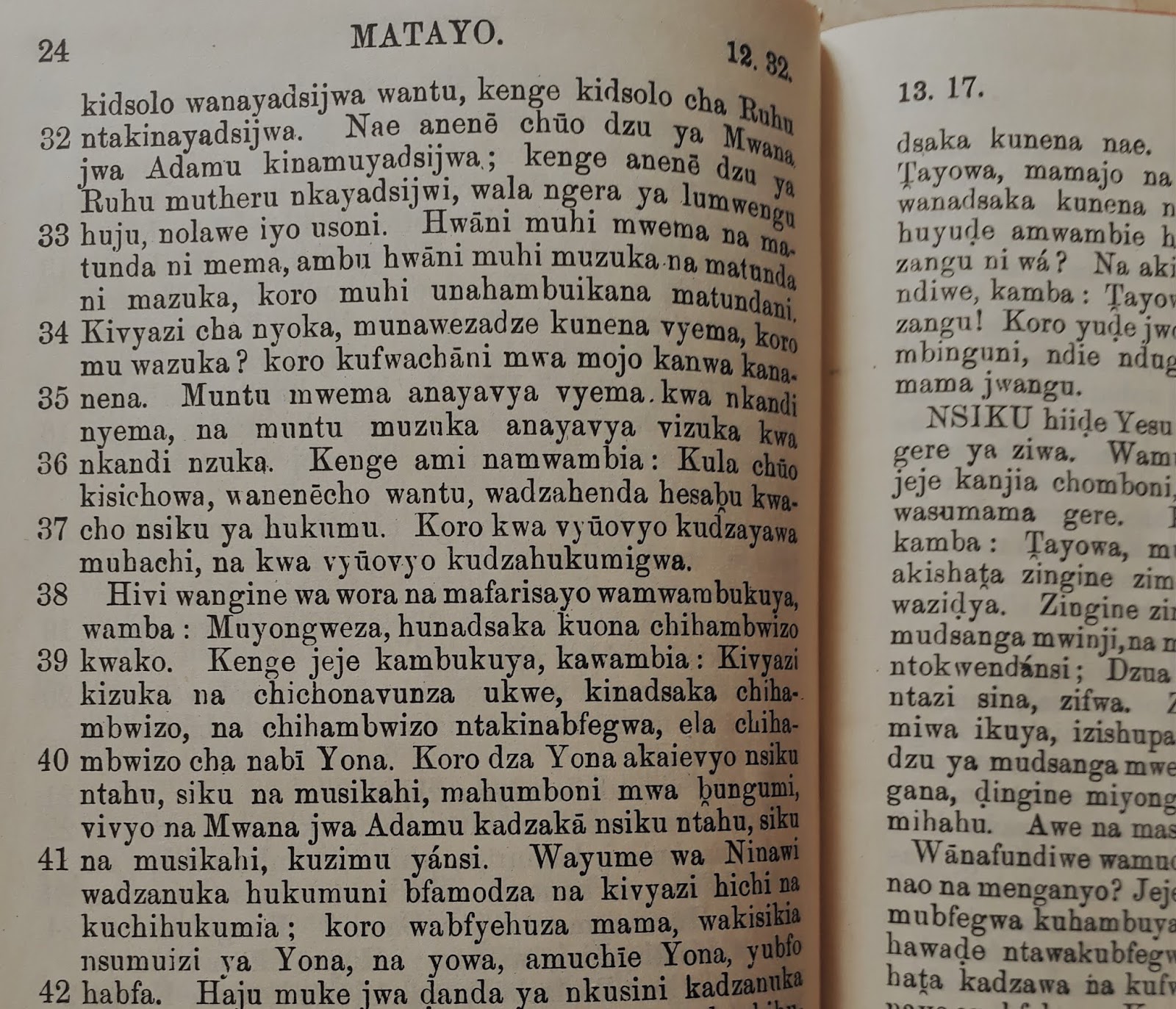 |
| 'Whale' in Pokomo, Matthew 12: 40 |
TUKI 1981. Kamusi ya Kiswahili Sanifu. Dar es Salaam: Oxford University Press.
TUKI 2019. Kamusi ya Kiswahili-Kiingereza. Online at http://www.elimuyetu.co.tz/subjects/arts/swa-eng/index.html.
TUKI 2019. English-Swahili Dictionary. Online at http://www.elimuyetu.co.tz/subjects/arts/eng-swa/index.html.
Walsh, Martin T. 1995/96. The ritual sacrifice of pangolins among the Sangu of south-west Tanzania. Bulletin of the International Committee on Urgent Anthropological and Ethnological Research 37/38: 155-170. Online at https://www.academia.edu/708993/The_ritual_sacrifice_of_pangolins_among_the_Sangu_of_south-west_Tanzania.
Walsh, Martin T. 2004. Variability and compounding of affixes in Hehe animal names (Tanzania). Paper presented to the 34th Colloquium on African Languages and Linguistics (CALL 34), Leiden University, 23-25 August. Online at https://www.academia.edu/1691467/Variability_and_compounding_of_affixes_in_Hehe_animal_names_Tanzania_.
Walsh, Martin T. 2007. Pangolins and politics in the Great Ruaha valley, Tanzania: symbol, ritual and difference / Pangolin et politique dans la vallée du Great Ruaha, Tanzanie: symbole, rituel et différence. In E. Dounias, E. Motte-Florac and M. Dunham (eds.) Le symbolisme des animaux: L'animal, clef de voûte de la relation entre l'homme et la nature? / Animal Symbolism: Animals, Keystone of the Relationship between Man and Nature? Paris: Éditions de l’IRD. 1003-1044. Online at http://horizon.documentation.ird.fr/exl-doc/pleins_textes/divers16-08/010041952.pdf.
Walsh, Martin T. 2018. The Swahili language and its early history. In S. Wynne-Jones and A. LaViolette (eds.) The Swahili World. Abingdon and New York: Routledge. 121-130. Online at https://www.academia.edu/36719077/The_Swahili_language_and_its_early_history.