Saturday, 12 June 2010

RED VELVET FROM HEAVEN

About October the dark clouds begin to gather in the east, lingering about the crests of the ridges before breaking in spectacular thunderstorms. While it is still raining the hot sun comes out, the earth steams and rainbows appear over the lakes and dams. At this moment, the people say, “The hyaena is giving birth to twins.” Overnight scarlet lilies appear like balls of fire among the sprouting millet; shrubs along the cattle-paths break into leaf and in a few days are covered with pink scented flowers; bees hum everywhere; and a red velvet mite which crawls over the damp earth is welcomed as “the child of the rain” (mwambua) - a favourite personal name for anyone born at this time. Along the edge of the cattle-paths grass begins to appear. By late December, in a normal year, the rain may be so heavy that much of the country becomes impassable.” (Jellicoe 1978: 6-7)

Marguerite Jellicoe’s evocative description of the start of the annual rains in Singida includes a rare reference to the cultural significance of red velvet mites in Tanzania. I first came across these brightly coloured arachnids (family Trombidiidae) in 1981, at the start of my second wet season in the village of Utengule in Usangu (in what is now Mbarali District). I was away when the rains began on 2nd December, but when I returned to the village two days later these small crimson creatures were everywhere on the newly dampened earth. Sangu-speakers called them inkhadupa, their generic name for ticks and mites, and told me that they were thought to fall down from the sky along with the rain. In this respect they were similar to ground pangolins (Manis temminckii), another creature believed to fall from the heavens, from whence they were sent by the ancestors, amanguluvi.

At the time I had no idea what kind of tick or mite these might be. I later found a reference to them in adventurer Marius Fortie's book Black and Beautiful (1938). When he was in Dodoma in December 1933, Fortie was told by an American naturalist that the "velvety red bugs" crawling on wet sand after heavy rainfall were a kind of tick (1938: 251). In May 1995 I wrote to the National Museums of Kenya in Nairobi asking if they could help identify the creature that both Fortie and I had seen. In the absence of a specimen they couldn't. I therefore referred to it as a "small red tick" in the paper that I wrote about 'The Ritual Sacrifice of Pangolins among the Sangu of South-west Tanzania' (1995/96: 165).

The growth of the internet has since made searching for this kind of information much easier than it once was, and when I eventually revisited this question it didn't take me long to find out that these 'ticks' were in fact red velvet mites - a perfect description of their external appearance. According to Joanna Makol, an authority on the Trombidiidae and their relatives, the red velvet mites that appear in large numbers after heavy rain are most likely members of the genus Dinothrombium (Oudemans, 1910), only two species of which have been recorded in Tanzania, D. tinctorium (Linnaeus, 1767) and D. zarniki (Krausse, 1916). But definite identification of the heavenly mites that make such a dramatic seasonal appearance in Usangu and elsewhere in the Eastern Rift must await the collection and description of more specimens.

Whatever species are involved, it's clear that red velvet mites are known throughout the region. A post on the Tanzania Odyssey blog in February 2009 describes their sudden appearance in Ruaha National Park, when "in some areas the whole ground can take on an almost red sheen and to walk without standing on one is almost impossible." But their emergence at the start of the rains isn't everywhere ascribed to heavenly intervention. Writing in 2002, my Hehe-speaking research assistant in Iringa, John Justin Kitinye, described pink-coloured ngudupa or ngudupasa mwihala (lit. 'bush mites', as distinct from ngudupasa mnyumba or kaye, 'house ticks') quite accurately as creatures which could dig down and hide in sand for months on end during the long dry season. No mention of them falling from heaven here, but wondrous animals nonetheless.

Acknowledgements
I couldn't have written this note without the information provided by the late Ngwila Simuhongole and other villagers in Utengule, as well as by John Justin Kitinye in Iringa. I'm also grateful to Richard Bagine and David Moyer for answering my queries, and especially to Joanna Makol for her email correspondence in February 2008 and for sending me extracts from her paper in Annales Zoologici (2007).

References

Fortie, Marius 1938. Black and Beautiful: A Life in Safari Land. London: Robert Hale.

Jellicoe, Marguerite 1978. The Long Path: A Case Study of Social Change in Wahi, Singida District, Tanzania. Nairobi: East African Publishing House.

Makol, Joanna 2007. Generic Level Review and Phylogeny of Trombidiidae and Podothrombiidae (Acari: Actinotrichida: Trombidioidea) of the World. Annales Zoologici 57 (1): 1-194.

Walsh, Martin 1995/96. The Ritual Sacrifice of Pangolins among the Sangu of South-west Tanzania. Bulletin of the International Committee on Urgent Anthropological and Ethnological Research 37/38: 155-170.

Sunday, 6 June 2010

EPONYMY IN BONGOLAND

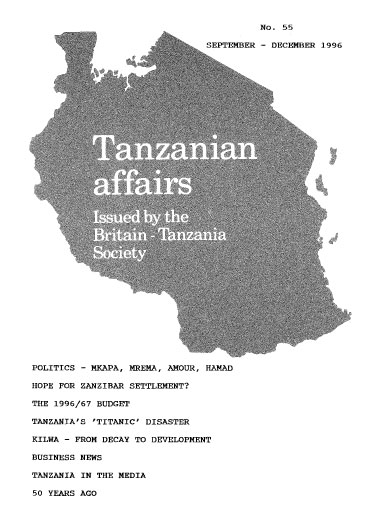
One of my favourite examples of linguistic innovation in Tanzania was the rapid transformation in 1996 of a politician’s name into a term of ridicule in Swahili. Ramadhani Kihiyo became CCM MP for Temeke constituency in Dar es Salaam in the first multi-party general elections in October 1995. But his election was challenged, and in the subsequent petition hearing it emerged that he had lied about his academic qualifications (there’s a nice summary of these proceedings in Tanzanian Affairs, No.55). Kihiyo resigned his seat at the end of May 1996, and his name became a byword for fake certificates and invented resumés.

I remember this well because it was the running joke among my travelling companions (government officials and a driver from Dar) when I was visiting villages in Pawaga, in Iringa District, in September 1996. ‘Fulani ana kihiyo’, and the plural form ‘Fulani ana vihiyo’, ‘So-and-so has bogus qualifications’, was the expression I heard in endless variations and hilarious applications as we drove along the dusty dry-season roads. As this became widespread usage in the country it was said that people who shared Kihiyo’s Sambaa name were dropping it to avoid its unfortunate associations and the embarrassment thus caused.

Fortunately for them, time has since begun to erase memories of the Kihiyo scandal, and many Tanzanians don’t know what a kihiyo is, though the practice it refers to is all-too familiar. A quick search of the internet produces a few examples, all of them using kihiyo as a term for the person with the invented qualifications (e.g. ‘huyo kihiyo!’, ‘that faker!’) rather than the made-up achievements (paper or otherwise) themselves.

The only other example of eponymy in Swahili that I can think of was coined during the Lewinsky scandal in 1998, when US President Bill Clinton’s extra-marital relationship with White House intern Monica Lewinsky was a major international news story. Among at least some urban Tanzanians kumk(i)linton mtu, ‘to “clinton” someone’, is now a jocular euphemism for fellation, kunyonya (lit. ‘sucking’) in everyday Swahili.

If this was an English expression you’d expect it to be a reference to whatever the president did to his young intern. But as Clinton told the courts, he didn’t really do anything, and the Swahili slang refers to the act that Monica is alleged to have performed on him. So while it would be correct to say that Monica “clintoned” Bill (Monica alimklinton Bill), you can’t use this eponymous verb to say that he had “clintoned” her – or indeed any other woman. It is possible, however, for one man to “clinton” another, linguistically-speaking that is.

It’s perhaps no coincidence that these two examples of contemporary eponymy derive from political scandals and the prominence given to them in the newly-liberalised Tanzanian media. But the first seems not to have stuck and I don’t know how widely used or understood the second is, beyond the circle of Zanzibari women and Bongo dwellers that I’ve heard it from. I can’t imagine seeing the likes of ‘kihiyo, n. vi-’ or ‘k(i)linton, v.’ in a printed Swahili dictionary anytime soon, but would love to be proved wrong.

Sunday, 30 May 2010

MUMIANI AND CHINJACHINJA

Mumiani and chinjachinja were once the very stuff of urban legend in East Africa, and they haven’t entirely remained in the graves that historians implicitly consign them to.

Although Luise White in Speaking with Vampires (2000) claims these two terms for blood-takers to have been synonymous in everday use, etymology and distribution suggest that this hasn’t always been the case. Mumiani is a coastal Swahili term with an Indian Ocean pedigree that can refer both to the imagined drawers of blood as well as the medicine made from it; while chinjachinja and its variants is a a rather more literal name for the supposed perpetrators of these and other crimes. The reduplicated Swahili verb kuchinjachinja means ‘to slaughter, cut throats again and again’, and by extension ‘kill repeatedly, commit mass murder’. I first heard stories about the wachinjachinja of the colonial era and after in the Southern Highlands of Tanzania in the early 1980s, and it’s a name that seems to have a much wider currency up-country.

In October 2000 I asked a 34 year-old Zanzibari woman what she understood by mumiani and chinjachinja. There is, she said, an obvious difference. The mumiani take blood and sell it, but don’t kill their victims, leaving them with some blood in their bodies. The chinjachinja, however, kill and cut up their victims for their own purposes (whatever these may be). She remembered mumiani from Zanzibar. When she was a child there was a European couple living alone at Gymkhana (near Kilimani and the cemetery), where they had a large garden with a lot of trees in it. They were said to be mumiani and children were told not to pass there at dusk or after. This warning was repeated by a lot of people; and in the same context she and other children were also told not to let strangers escort them anywhere.

More recently, in the last couple of years (i.e. between 1998 and 2000), she had heard a story about chinjachinja in Dar es Salaam. A rich man with a large house in Oyster Bay (she didn’t know whether he was European or not) was said to have helpers who enticed women there with money. He has sex with them, then drugged, killed and cut them up. He kept the heads, breasts and genitalia of his victims, but chopped the rest of their bodies into pieces and flushed them into the sea down a drain. One day a woman who was a habitual drug-user brought to his house. One of the guards there had some connection with and knew her. When her host slipped pills into her drink she was unaffected, and while he was taking a bath she saw the heads of previous victims in his fridge. The friendly guard came and told her to run away with him, and she did. They told the police who went to the house that same night. But the killer was long gone, and only some of the evidence of his killing remained – the body parts that he kept.

My Zanzibari informant heard this last tale in a hair salon in Dar and relayed it to me in a hotel on the Msasani Peninusla, just round the corner from one of the city’s most notorious expatriate pick-up bars and a road leading down to Oyster Bay that turns into a mecca for kerb-crawlers after dark. Whereas her memory of mumiani in post-revolutionary Zanzibar conjured up warnings from the colonial (and perhaps even precolonial) past, this story of a chinjachinja in Dar had all the flavour and ingredients of a contemporary urban legend – and what better place than a modern hair salon to hear it. There’s nothing about ‘vampires’* or blood-suckers here – who knows why the killer wanted to kill and dismember his female victims in this way? The parts he is said to have kept suggest a sexual motive, and make this a moral tale about the exploitation of vulnerable women by wealthy (and often foreign) men, a reflection of the setting in which it was told. And the gruesome picture it paints is uncomfortably close to the known practice of real mass-murderers, including the case of Bradford’s ‘crossbow cannibal’ that is filling the British Sunday papers as I write.

* Speaking with Vampires is a catchy title for a great book but Luise White’s generic use of ‘vampire’ is open to question, as are a number of her observations on etymology and translation. And she is wrong when says that “[t]here are no words in the languages of the people I write about for blood-drinker or blood-taker” (2000: 10). Swahili mnyonya-damu, ‘blood-sucker’, is one for a start.

Sunday, 23 May 2010

GIRIAMA BIRD NAMES

Last year (2009) Nature Kenya / the East Africa Natural History Society (EANHS) published its Checklist of the Birds of Dakatcha Woodland, an Important Bird Area (IBA) in the hinterland of Malindi on the Kenya coast. The woodland is home to a number of globally threatened and near-threatened bird species and is itself threatened by illegal commercial agricultural development. One of the birds under threat graces the checklist’s cover: the beautiful Fischer’s Turaco (Tauraco fischeri), known as kulukulu in the Giriama (= Giryama) language. This is the first checklist of its kind in Kenya to include the vernacular names of birds recorded and cross-checked by local community members. It was edited by Fleur Ng’weno, the Honorary Secretary of the EANHS, and I played a minor role by reviewing the Giriama names and advising on a consistent orthography.

I’d been keeping a file of bird names in Giriama and other Mijikenda languages since 1992, when I met ornithologist John Fanshawe in Mombasa and we discussed the possibility of working on my largely dictionary-derived list together with David Ngala, a colleague of John’s at the Arabuko-Sokoke Forest Reserve. Unfortunately other work took us both away from the Kenya coast and nothing came of this planned collaboration, although we didn’t entirely give up on the idea and I continued adding to my list of Mijikenda names. I never did get to meet David, and so was delighted to see that he was one of the main contributors to the Dakatcha checklist. The matching of local names with reliable ornithological identifications transformed my untidy lexical collection, and I’ve typed up a working list of Giriama names incorporating the new information from Dakatcha. Linguistic and ethnobiological research like this won’t by itself save endangered flora and fauna, but experience suggests that it does have a part to play in combatting the ignorance of local knowledge and practice that all too often accompanies extractive development.

Afterword, 29 July 2010

Further information and up-to-date news on the land grab that is threatening Dakatcha woodland is available on the A Rocha Kenya website: see for example this recent post on the use of violence against conservation staff and a reporter. ActionAid is running an appeal for international support against the commercial cultivation of Jatropha curcas at Dakatcha, part of its wider campaign against biofuel production. Resources on the problem of land grabs in Africa can be dowloaded from the Oxfam pages on land rights in Africa maintained by Robin Palmer.